A quick quilt

This has been the week of New Kitchen, which I anticipated (correctly, as it happens) would be Quite Stressful.

I needed a little quilting/stitching task that wouldn’t take too much space, effort, or concentration, because of all the noise and disruption. Something that would keep me busy enough to be distracted but available enough to make regular cups of tea for the workers and be prevailed upon to make decisions etc.

This little chair has been in the conservatory over the summer. It’s pretty basic and uninspiring but has the advantage of folding out into an emergency bed should we ever need one. The conservatory is currently 2°C so we brought it into the house to prevent it getting too cold or damp. Due to lack of space it’s ended up in my work room, where it makes a very acceptable little reading chair. I may well keep it here.

the dull chair

This seemed like the week to make a more colourful covering for it. You can see I’ve started on the arms, just by wrapping some padded patchwork strips around them. They need the ends gathering and stitching to secure them better.

I was never going to completely reupholster the chair; it just needed something a bit more colourful as a throw.

patchwork throw

I’d bought a few cotton fat quarters a while ago. I very rarely buy new fabric, but this was my consolation purchase for the disappointment of not being able to go to the Knitting and Stitching show in Harrogate this year because it was Kitchen Week. Somewhat incredibly, all nine fat quarters ended up sitting together quite happily. The fabrics are mostly Moda and Marcia Derse quilting cottons. The map fabric is Tim Holtz.

I didn’t paper-piece this one, of course, and you can see some little mis-matches here and there where my quarter-inch seams went a bit awry. Slightly imperfect, but it was just what I needed to see me through a fairly turbulent week.

Here’s how our kitchen looked on Monday, by the way:

alas, poor kitchen

It will be really lovely when it’s done. The upside is that there were a few meals out, so no cooking and no washing up. The kitchen should be finished next week, if all goes well, then it will need redecorating and new flooring. In the meantime it’s a case of keep calm and quilt.

ready for quilting

Quilting time

You might remember this that began in June. It’s taken five months to put it together, in between other things, but it’s now one complete square, about 37″ or so.

removing the basting stitches – always the best job

I hadn’t originally envisaged ‘proper quilting’ it – as in backing, batting, and top, but somehow that just happened. Normally I would just have used a top and a backing. My batting of choice is Hobbs Heirloom wool, which is lightweight and very easy to quilt; I’ve never got on well with the cotton or polyester battings. The backing is cream cotton calico.

making a start

It’s very pale, and very neutral, and I’m currently undecided about whether that’s a good thing or a dull thing. It’s definitely quiet, and I like quiet. And it’s winter, which is a good time for quilts and quiet.

The circular outline (couched, black and cream silk bourette yarn) is a little thin, and the quilting so far is probably a little small.

silk bourette circular outline

But it’s a start. For now, it will rest on the chair while I look at it a bit more.

Gutermann cotton 12 thread

My problem generally, and this applies to painting as well as textile art, is that I usually like backgrounds as they are. I often have trouble adding the requisite focal point because I don’t want to obscure the background.

This little quilt has some really interesting patches, some of them made from layering sheer fabric over another, like this tea-dyed silk with a layer of dress net over the top:

layered patch, silk and net

And this vintage cotton with textured nylon chiffon over the top:

layered patch, cotton and spotted chiffon

I don’t want the quilting to trample all over the piecing and the more interesting patches, but I do need to quilt all the layers together securely. I may try tying the layers here and there. I think it just needs to sit on the chair for a bit while it thinks about what it needs (don’t we all!)

The sketchbook I’m plotting this (and others) in is an A4 landscape-format book, one of my favourite layouts.

Remember sketchbook

Everything in this sketchbook is about remembering, recollecting, and forgetting. There are spots of time, there are ghosts (from time past), there are attempts to turn something intangible and unfathomable into something visual and tactile. There are shadows from time past, and there is the light of time present.

sketchbook page

The thinking and the testing is all part of the finished thing.

sketchbook page

Today I will be mostly looking at a small quilt as it rests on a chair. And yes, I call that work now. It’s ridiculous really.

Quilts

I’m finding all sorts of treasure as I unpack the boxes in my work room.

These are quilts I made around 15 years ago, mostly with commercial cotton fabric scraps.

glorious colour

All are hand-pieced and hand-quilted, made using the quilt-as-you-go (QAYG) method. This is where you piece, layer and quilt each block separately and then join all the blocks together. There are lots of QAYG tutorials online if you’re not familiar with it.

quilts

This block made me smile:

number 24

Made in the first house I owned and rediscovered during the second week in our new house, the number of which happens to be… 24. Not only that, but the little yellow flowers next to it suggest spring. Maybe I was seeing my own future. Spooky!

Quilt-as-you-go gives you the opportunity to use up larger scraps for the back of the blocks, rather than having to wrestle with a large piece of backing fabric. I never have enough floor space for that, so I prefer this more portable method. The backs of these 7″ quilt blocks are all different:

quilt back

Nice to find this little burst of colour on what’s been a grey overcast day.

E for Evolution

Evolution: an evolving cloth

I pick this cloth up from time to time, usually when I don’t know what else to do or, in this case, while I’m thinking about how to start some new work. I started this one a couple of years ago, as a kind of map. Then it became a kind of journey.

Then I looked again at the embroidered E in the corner, and renamed it Evolution, since it never seems to know what it wants to be.
E for Evolution. Hand-dyed vintage handkerchief.

It was always intended to be a very lightweight bed cover for those awful hot summer nights when no one can get any sleep. The backing is a large vintage tablecloth, onto which I have randomly layered pieces of hand-dyed lawn, cheesecloth, and muslin – all ultra-lightweight, semi-sheer fabrics to add colour without adding too much warmth. I made it a bit bigger at some point by adding a 10” border of brushed cotton to either end so it’s now about the size of a single duvet.

This is the reason it used to be called ‘Map’

At some point I applied a ragged row of circles across it and then realised they looked a bit heavy. I’ve cut the centres out of the bigger circles and am stitching the edges under to form rings. Better, I think.

From circle to ring

It has a long way to go, and there is no plan. I often think life should come with some kind of handbook so we all know where we’re supposed to be going. I think most of us haven’t a clue what we’re doing here and are making it up as we go along. Some people manage to make it look as if they have everything under control, which can be quite unsettling for the rest of us.

Empty space, ready for the next adventure

I’m guessing this isn’t going to be finished in time for this year’s hottest nights in a month or two, though it is functional in its present form. In an emergency it would do.

In progress

Getting it together

I finished the scraps quilt that I started about this time last year.

‘Together’ – scraps quilt, hand-pieced, hand-quilted

Its working title was ‘All Together Now’ but I found that gave me a constant earworm of the song with the same name, which became distracting, so it had to go. I dropped the outer words and have named it simply ‘Together’. I like the etymology – it comes from an Old English word meaning ‘to gather’ – and that’s exactly what this quilt is. It’s a gathering: of fabrics, of textures, of colours, and of time.

‘Together’ 66″ square (121 x 6″ blocks)

I have a perennial problem with making large quilts. I like working on a large scale, as a rule, but when the thing is finished I have no way of taking a decent photograph of it. I don’t have a wall big enough to hang it on (in any case, there is no hanging sleeve on this one). Usually what happens is we have to move the furniture out of the dining room, lay the quilt out on the floor, and then climb up a stepladder, hold a camera out at arms length over it and hope for the best. Textiles are very difficult to photograph at the best of times and always look so much better in real life.

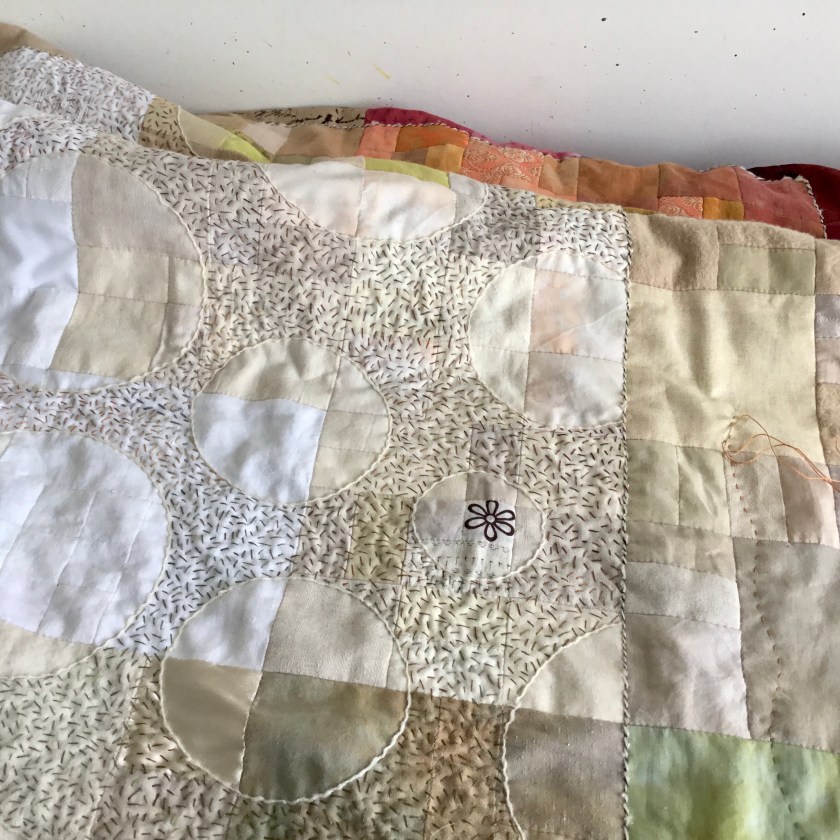
Seed stitching across the central panel

The quilt is made entirely of scraps and leftovers, hand-pieced over paper using the traditional English paper-piecing method. I assembled the blocks as 6″ squares, using patches in multiples of 1″ (so for example, 1 x 1, 1 x 2, 2 x 2, etc). I then arranged the blocks by colour group, with the whites and neutrals in the centre. The fabrics are an immensely eclectic mix of very modern and very old, plain and patterned, textured and plain-weave. The oldest pieces in it are from the eighteenth century, and they sit happily next to very modern scraps and samples. Most of the fabrics are hand-dyed vintage cotton and linen, with some over-dyed modern quilting cottons. There are a few synthetics and satins in there as well. I don’t normally like shiny fabrics much but I do like the way these little squares catch the light.

The blue corner
The red corner

The seeding stitches in the central panel create circles of negative space. Initially this was just a design decision to disrupt the straight lines created by the square blocks, but now I can see that the circles create little oases floating like bubbles across the surface. I like the way the circles are distinct but at the same time visibly still a part of their foundation.

Lots of seeding
spots of time among seeding stitches

The middle layer of the quilt is cotton flannel rather than traditional quilt batting, only because that’s what I had. I didn’t want to have to buy anything for this one. The backing is pieced together from a vintage silk sari. The quilt is thin but quite heavy.

Quilt back, pieced from patterned silk sari

I am a little nervous about the longevity of the quilt. It’s designed to be decorative rather than functional, but not to hang on a wall. I imagine it displayed on a bed, ideally. I don’t know the remaining life span of the silk backing: silk tends to tear very easily as it ages, and I’m not sure how old this sari is. The quilt isn’t washable, due to all the different kinds of fibre – the very elderly patches will shred, and the hand-dyed fabrics might not be entirely colour-fast. The seeding stitches on the surface would be quite easy to pull and distort accidentally. Its new owner (when I find them) is going to have to be very careful with it. But then, very few things last for ever.

Quilt label made from embroidered vintage linen, hand-dyed. I really like the way those two embroidered arms reach out to each other.

I did think about whether it needed some sort of additional circular pattern in the outer borders, but in the end I think there’s probably enough going on in it. I’m looking forward to being able to start something a little more manageable.

Going straight

I started quilting ‘All Together Now’ with a meandering line, and I thought I knew exactly where it was going.

Wandering aimlessly

This quilt has been very particular from the very beginning about what it wants, but I was just starting to feel that we were becoming friends now that we’ve reached the outer sections. The quilt waited until I had done a fair few meandering lines before telling me that was very wrong and not what it wanted at all. Quite a lot of unpicking and tutting ensued. The second attempt is now well under way, and everyone seems to be happier. I’m now working very simple diagonal lines across each of the 6” blocks.

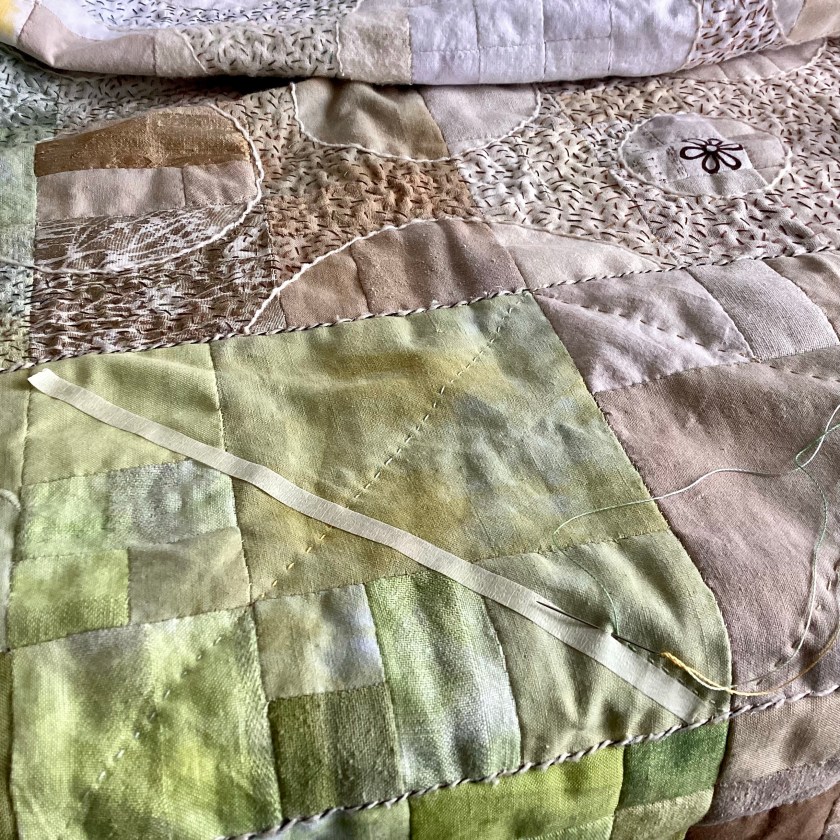
Diagonal quilting lines across 6” blocks

I couldn’t sew a straight line if my life depended on it, so I use quilter’s masking tape. It’s one of the best things ever invented.

Quilter’s masking tape

I confess I am slightly disappointed not to have more expressive quilting lines to create. It’s one of my philosophies of life that there are already enough straight lines in the world and now here I am, adding to them. There is, however, quite a lot going on in this quilt – there are a lot of colours to manage, with a lot of seams and some very busy seed stitching – and keeping the rest of it simple I think is the right thing to do.

All together now

I started this quilt some time last year, rounding up (squaring up) all the scraps into 6” blocks and then assembling them into a kind of square colour wheel with all the whites in the centre. It’s 11 blocks square, so 66”-ish, all paper-pieced. I had to abandon it when I broke a bone in my right hand in October, but that was no great hardship as by then I didn’t really like it. It also had no name, so I didn’t know what it was trying to be.

In progress
Lots of seed-stitching

Last year I had started seed-stitching the central panel to define the circles, and it quickly turned into one of those things I wish I’d never started. Seed-stitch takes a long time, and there was acres of it. OK, about a square yard. I tend to exaggerate.

Seed-stitching around circles

So since October it has been rolled up in a corner of the room, nameless and baleful, scowling every time I passed it, and now I need to finish it before I feel free enough to start something else. A few days ago I steeled myself to set about finishing the seed-stitching. And what do you know? It didn’t take as long as I thought it would, and it looks OK. The texture is really interesting. The backing is made from a vintage silk sari, and the middle layer is cotton flannel, so it isn’t too bulky but is still quite substantial. It’s surprisingly heavy.

Quilting the edge

And then it named itself: All Together Now. So now I need to figure out what to do with the rest of it. I’ve couched some two-tone silk bourette yarn down to create a couple of borders around the central panel, and I’m starting with a meandering line just to see where it goes.

First line of quilting

Sometimes making a large quilt by hand feels a bit like wrestling with an alligator (no, since you ask, I have never wrestled an alligator). I do feel as if I am starting to tame this one.