Quilting time

You might remember this that began in June. It’s taken five months to put it together, in between other things, but it’s now one complete square, about 37″ or so.

removing the basting stitches – always the best job

I hadn’t originally envisaged ‘proper quilting’ it – as in backing, batting, and top, but somehow that just happened. Normally I would just have used a top and a backing. My batting of choice is Hobbs Heirloom wool, which is lightweight and very easy to quilt; I’ve never got on well with the cotton or polyester battings. The backing is cream cotton calico.

making a start

It’s very pale, and very neutral, and I’m currently undecided about whether that’s a good thing or a dull thing. It’s definitely quiet, and I like quiet. And it’s winter, which is a good time for quilts and quiet.

The circular outline (couched, black and cream silk bourette yarn) is a little thin, and the quilting so far is probably a little small.

silk bourette circular outline

But it’s a start. For now, it will rest on the chair while I look at it a bit more.

Gutermann cotton 12 thread

My problem generally, and this applies to painting as well as textile art, is that I usually like backgrounds as they are. I often have trouble adding the requisite focal point because I don’t want to obscure the background.

This little quilt has some really interesting patches, some of them made from layering sheer fabric over another, like this tea-dyed silk with a layer of dress net over the top:

layered patch, silk and net

And this vintage cotton with textured nylon chiffon over the top:

layered patch, cotton and spotted chiffon

I don’t want the quilting to trample all over the piecing and the more interesting patches, but I do need to quilt all the layers together securely. I may try tying the layers here and there. I think it just needs to sit on the chair for a bit while it thinks about what it needs (don’t we all!)

The sketchbook I’m plotting this (and others) in is an A4 landscape-format book, one of my favourite layouts.

Remember sketchbook

Everything in this sketchbook is about remembering, recollecting, and forgetting. There are spots of time, there are ghosts (from time past), there are attempts to turn something intangible and unfathomable into something visual and tactile. There are shadows from time past, and there is the light of time present.

sketchbook page

The thinking and the testing is all part of the finished thing.

sketchbook page

Today I will be mostly looking at a small quilt as it rests on a chair. And yes, I call that work now. It’s ridiculous really.

Creative English Paper-Piecing

After weeks and weeks of work, play, and production, I think my new course on English paper-pieced patchwork is about ready to be let loose.

new Teachable course

There’s a free preview, so make sure you watch that before committing – just so you know what you’re letting yourself in for.

Mostly what you’re letting yourself in for is me trying (and occasionally failing) to keep my hands in shot where you can see them. I think it’s probably – mostly – good enough though.

Many people think English paper-piecing is hexagons. Not the way I do it. In fact there are no hexagons here, apart from a few accidental or antique ones.

So, what do we cover in this course?

We start with English paper piecing (EPP) for absolute beginners, where you get to make a little box like this out of simple squares:

patchwork box, 3″ x 1.5″

Then we make a paper-piecing sampler where you can practise piecing triangles, curves, and irregular shapes:

EPP sampler

We get creative with fabrics and paper:

getting creative

And we do some colourful sketchbook work:

sketchbook page

Before you know it, you’ll be branching out unaided and doing your own thing.

patchwork circles

And as if all that wasn’t enough, we do a (pretty brisk) overview of making a patchwork cover for your sketchbook, we have a whistle-stop look at how quilt-as-you-go works, and we see how to turn a pretty square of patchwork into this:

little hanging bag

Do I sound as if I’ve recently taken a course on Basic Marketing for the Self-Employed? I promise you I haven’t. But here’s the thing about being self-employed. You have to do All The Jobs, including all the marketing and self-promotion, which is my least favourite thing. My second least favourite thing, by the way, is video-editing – as you’ll see if you embark on the course. It’s all very informal, as usual.

OK, enough self-promotion and advertising.

In other news, I’m now setting about trying to restock the shop somewhat as all the fabrics are sold out. More on that later.

hand-dyed fabric packs coming soon

In the meantime did I mention that I have a new course out…?

😎

Papa’s got a brand new pegbag

Sincere apologies to James Brown and Pigbag. Couldn’t resist.

Also apologies for the slightly surreal title and intro there. A week off has done me the world of good, as you can see.

But I genuinely did need a new pegbag. My old one was literally falling apart.

definitely time to replace

I used the old one as a template and made a paper pattern, which turned into paper-pieced patchwork, and then it all went a bit Mondrian:

paper-pieced patchwork a la Mondrian

Completely hand-pieced and hand-stitched, it went together pretty quickly really. It’s lined with medium-weight calico for extra strength and stability.

modern art peg bag

And the back:

give us a twirl, pegbag

I made its mouth a little less gapey than the previous one.

I eat pegs

It’s full of pegs and ready for the next wash day.

primed and loaded

I was even able to salvage some of the lining from the old one. This batik fabric was one of my favourites and I used the last of it many years ago. You can see the difference in colour and quality between the side that’s been exposed to the light and the side that’s been kept in the dark.

sun-dyed batik fabric

Jobs for next week include trying to get my new patchwork course videos recorded. The shop will remain closed while I attend to recording the lessons, and then I’ll try to dye/restock threads probably in September.

Always busy.

Piecing it together

Everything patchwork here this week. A little sketchbook cover, with one of Jude’s moons finding a home:

sketchbook cover, 6″ x 5″

You can see that I’ve couched a thicker thread (silk perle 3) over some of the seams, just to define some of the lines.

couching in the ditch

The little book of patchwork, I’m calling it. Somewhere to collect and join fragments of thought.

patchwork objects
sketchbook page

Inspiration comes from unlikely places. This outdoor paving kit from The Range translates perfectly:

pavement patchwork

I’ve dug out these fragments of late Victorian patchwork, just to look and to touch the antique papers.

Victorian patchwork, impossibly tiny stitches

This week I’m putting a patchwork sampler together, just to see how that might work. At some point there will be a (hexagon-free) paper-piecing patchwork course. Nothing wrong with hexagons, but paper piecing is much more than granny’s flower garden.

paper-piecing sampler in progress

Looking at, and thinking through.

hand-dyed silk organza patchwork 6″ square

Online homes

Progress on piecing this patchwork is slow, but that’s fine and exactly as it should be.

hand piecing

Sewing by hand creates plenty of thinking time. I’m currently thinking about where I live online. I have the blog here on WordPress, an online shop with Big Cartel, and a Teachable school for online courses, plus Instagram and Facebook. Big Cartel and Teachable are quite heavy on annual maintenance fees, and ideally I’d like as much as possible in one place to simplify things more. I’m basically a Luddite, so I will need to investigate the technical options for reducing or combining everything I have into fewer separate spaces.

At the same time I’m weighing up whether to create more online courses with Teachable, or whether to create some sort of exclusive subscriber-only content for sharing more process videos and techniques etc. That would probably mean setting up something like Patreon, which would result in even more online homes, unless there’s a way to do something like that here on WordPress.

I’m also considering whether to continue offering overseas shipping for physical goods like fabrics and threads. International shipping is very expensive, it can take several weeks to reach its destination, and there can be additional customs charges when it does arrive. I have no control at all over any of that, but fielding the questions and occasional complaint does take time and energy. Customs charges seem to be particularly prevalent in European countries since the UK, in its ill-informed judgement, decided to leave the EU.

The box of patchwork pieces is basically a box of separate thoughts, plans and ideas. I just need to join them together.

pieces of a jigsaw puzzle

Quilts

I’m finding all sorts of treasure as I unpack the boxes in my work room.

These are quilts I made around 15 years ago, mostly with commercial cotton fabric scraps.

glorious colour

All are hand-pieced and hand-quilted, made using the quilt-as-you-go (QAYG) method. This is where you piece, layer and quilt each block separately and then join all the blocks together. There are lots of QAYG tutorials online if you’re not familiar with it.

quilts

This block made me smile:

number 24

Made in the first house I owned and rediscovered during the second week in our new house, the number of which happens to be… 24. Not only that, but the little yellow flowers next to it suggest spring. Maybe I was seeing my own future. Spooky!

Quilt-as-you-go gives you the opportunity to use up larger scraps for the back of the blocks, rather than having to wrestle with a large piece of backing fabric. I never have enough floor space for that, so I prefer this more portable method. The backs of these 7″ quilt blocks are all different:

quilt back

Nice to find this little burst of colour on what’s been a grey overcast day.

Piecing

Not quite a square yard – it’s about 32″ x 34″, and all pieced together now. Some people think English paper piecing is too fiddly and takes too long, but I find it fairly quick and very enjoyable. I’m already thinking about a bigger, bed-sized version.

slightly blurry picture, but you get the idea

All the curves went together just fine, after I added the balance lines.

look at that lovely curve

The best part of English paper pieced patchwork is removing the tacking thread and papers, when all the piecing is complete. The cloth starts to relax, and you can see what you’re working with.

some of the tacking and papers removed

Much nicer to handle, and the colours seem to come alive more.

A few more to go, then I need to think about how to back it, line it, or quilt it. Haven’t decided where it’s going yet. There will probably be textured yarns couched along some of the boundaries and of course some stitch here and there. Maybe even some tiny sheep.

some tacking still in, some already out

Initially this was going to be a PDF pattern but I think it might be a bit too complicated for that. There is quite a lot of tweaking and easing, to get the curves to lie correctly and line up the balance marks, which is easier to do than to explain. Maybe a PDF for the intrepid.

And, incidentally, there is thread in the shop.

delicious

I anticipate that this may well be the last thread update before Christmas, as our house move may or may not happen before then. Everything is still very up-in-the-air at this point. Good job I have the patchwork to keep me grounded.

Balancing curves

You might recall the patchwork I started last month, using my proposed 2024 stitch journal template to piece together an aerial map of fields:

false start

I got so far with it and then hit a slight problem: having pieced two A4 sized blocks together, it became clear that none of the next A4 blocks were going to fit properly. My mistake entirely – a couple of mistakes, actually, and schoolboy errors at that. I had failed to read the plan before stitching, so mis-aligned the outer edges, and I hadn’t marked balance lines on the template for accurately joining the curves.

It was less work to start again than to unpick, so I’ll use my false start as a practice piece and then will probably turn it into a sketchbook cover, so nothing is wasted.

So for attempt no. 2, I added balance lines to the template.

balance lines (in red) for piecing curves

Piecing curves is tricksy and has to be accurate, particularly when a lot of separate pieces are involved. You can see how this works:

balance lines in action (in blue/red)

It’s just an extra insurance for making sure everything is going to fit correctly later on. If the balance marks don’t join up on either side of the seam, then you know you’ve gone a bit wrong.

curves fitting nicely

The second thing I’ve done differently this time is piece the thing in irregular sections rather than A4-sized blocks, and it seems to be working better.

sections completed

I’ll wait until each section is finished before joining them all together.

fitted but not joined

It’s probably about half done, and is continuing to come together quite nicely. At this stage it’s still very portable so is an easy and relaxing thing to work on in the evenings.
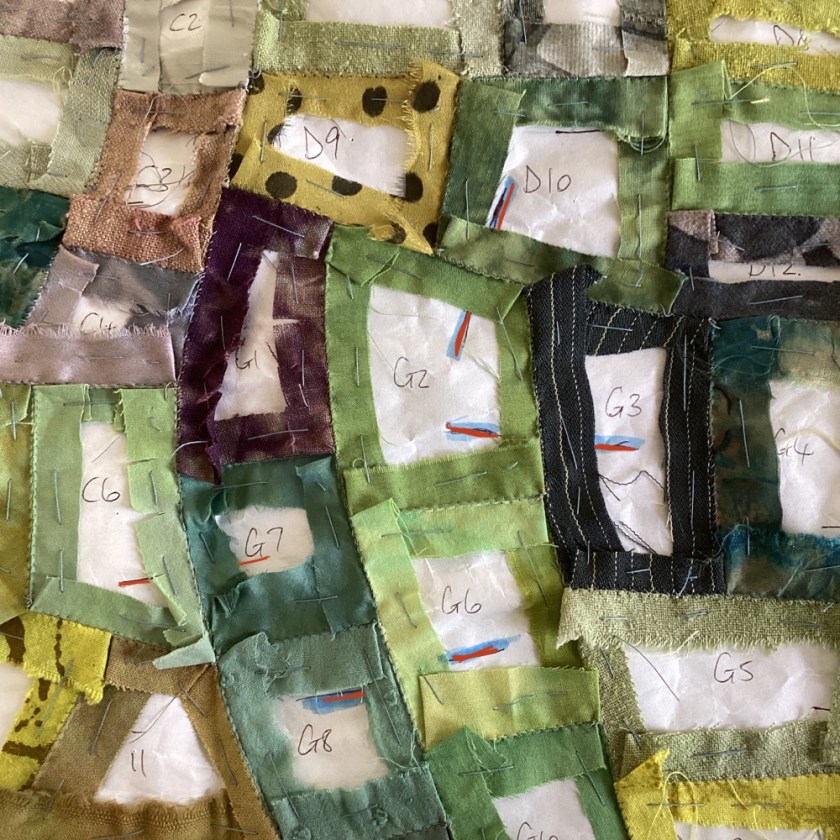
box of tricks

I only roughly planned the colours (as in all of the M section will be greens and golds, the A section was greys and browns etc) so it’s a nice surprise to find out what ends up sitting next to each other. Keeps it interesting. And I always think patchwork is a kind of piecing together of life’s problems too, and finding a solution in the whole. Art, stitch and therapy all at the same time. What’s not to like?

Patchwork

We had a day out at the seaside recently, revisiting the East Yorkshire coastal town where I grew up. I’ve always liked the seaside colour palette – aqua blues, sandy browns, sky blues and whites – and I set about assembling some patchwork to cover a spare pillow in my workroom.

patchwork in progress

I generally use the freezer paper method for English paper piecing (google it if you’re not familiar with this, there are lots of tutorials and instructions out there). This design is based on a little paint sketch I did a couple of months ago:

watercolour sketch

It all came together fairly quickly. I didn’t want to stitch on it much because the fabrics are really beautiful in themselves – scraps of textured silks, vintage linens, and vintage/handwoven cottons.

hand pieced patchwork

I found a bit of old black soutache braid, which I used to emphasise some of the seams. I quite like the Mondrian-esque effect.

Mondrian went to the seaside

And after a couple of days, a new pillow cover. The back is just tea-dyed calico, simple envelope style, so there are no zips or fastenings.

patchwork pillow

It’s made a the spare bed look extra cosy.

Matchmaking

I hope no one’s bored with book covers yet. I’m making a cover for a 12” square sketchbook – though I expect it will be more of a notebook, really, with drawings. Somewhere I can jot down ideas and designs for Red Bubble.

Book cover in progress

I’ve always enjoyed seeing red and turquoise together. It started me thinking about the concept of clashing colours, and I’m not sure that I agree there is such a thing. In my experience, you can generally put any two or three colours together and they will sit side by side fairly happily. Red seems to go with pretty much anything; so does purple. I think there is the potential for a problem when you put too many different colours together, but even then you can generally tone them down by adding some black and white.

Front cover, about 12” square

The main problem I’m having is trying to get an accurate photograph. If the red is right, the turquoise is wrong, and vice versa. Suffice to say the colours are richer and deeper in real life.

Moon flowers

The design initially started with the red circle, which is a piece of shot silk from an old sari layered over a circle of felt. I was going for a fairly obvious red bubble, but then the little flowers popped up and it’s turned into a kind of moon flower arrangement. These things happen. I find the thing that grows organically in its own way is usually better than the thing I was aiming for. You just have to trust the process sometimes. The turquoise background is pieced together using strips from the edge of a hand-dyed vintage tablecloth. You can see the creases, which formed the edge of the cloth where the fabric had been doubled. They won’t iron out, and in any case I quite like these scars from a previous life.

And then I found a piece of really ugly fabric. I don’t often have dye disasters, but this poor thing was definitely one of them. Usually you can rescue a disaster by over-dyeing it, but I think this one has been over-dyed a few times and never looks any better.

A dye disaster

But actually it looks ok here. It looks as if it has found its place in the world. Maybe ugliness is as much in the eye of the beholder as beauty. Maybe there is even no such thing as ugly. Beauty is, after all, one of many problematic cultural concepts that just excludes the non-conforming. It’s not exactly a match made in heaven, but then most of us can rub along ok with most people most of the time. Perfection is virtually unattainable. I will settle for OK on this occasion.

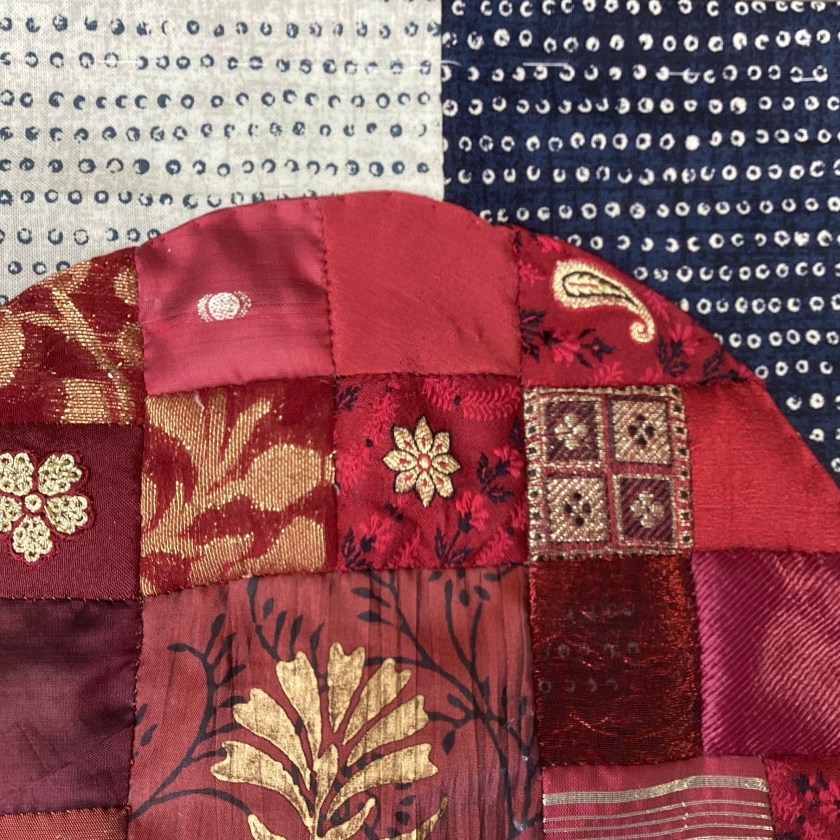
The back almost made itself. I already had the patchwork circle, pieced a while ago when I was gathering together some scraps of red print. These are mostly shiny/glitzy silk and satin, fabrics I wouldn’t ordinarily use much. But put them together, cheek by jowl, and they seem very happy.

Patchwork circle, paper-pieced, about 9” diameter

I often think auditioning fabrics to see which of them looks good together is a bit like sending them on a blind date. Sometimes they instantly find true love, and sometimes they never want to see each other again and end up back in the drawer. Eventually there will be something for all of them, even if that turns out to be solitude. Some fabrics don’t need others; they do just fine on their own. Some need company. Sometimes which of them ends up together is more luck than judgement.

Red and gold glitz