The last day of June, and another month on the stitch journal.

A little handstitching every day, reflecting on the time that has passed…


…and on the time to come. July will be with us tomorrow.


The last day of June, and another month on the stitch journal.
A little handstitching every day, reflecting on the time that has passed…
…and on the time to come. July will be with us tomorrow.
One of the perks that comes with working at a university is free access to an academic library, and last week I found this:
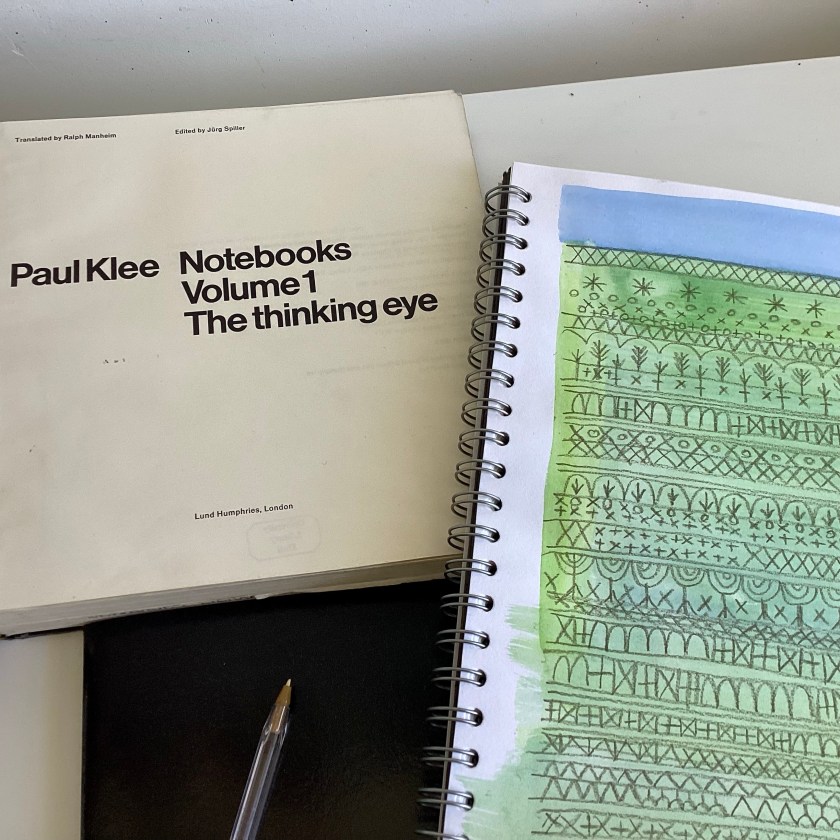
You can read it free online, actually, but I prefer books to be on paper. I like leafing through pages and don’t like scrolling up and down a screen. It was good exercise carrying it home too, so twice the benefit.
I’ve had a completely free weekend so have been immersing myself in Klee and his life and works.

Having started to read his words, I feel I am beginning to understand him and his work better. Weirdly, I understand myself better too. I periodically berate myself for not drawing more often (what kind of artist doesn’t draw?) but then I read Klee and feel more validated about valuing process over object and trying to explore the intangible. I admire people who can draw with photographic realism but learning how to do that doesn’t really interest me. I don’t want to draw what I can already see. Klee famously said, ‘art does not reproduce the visible but makes visible’. And I guess I draw with a needle and thread instead of a pencil.
Klee’s writing is, as you would expect, pretty dense, so in between nibbles of philosophical art theory I’m working on a sketchbook cover. I accidentally deleted the photo I took of it in progress, so this is just a screenshot:

It’s just regular watercolour on fabric. It won’t ever be washed so it doesn’t matter about fixing the colour. The fabric I’m using is loom state cotton, and it’s a really good surface for sewing on. It’s not quite as thick as furnishing fabric, but a bit more substantial than heavyweight calico, and a nicer weave than cotton canvas – it’s quite a fine twill weave, similar to impossibly lightweight denim, if there could be such a thing. I’ve started to add rows of running stitch in threads similar to one strand of DMC floss.

The colour seems to be fading slightly already, but that’s ok. I thought it was a bit too bright to begin with anyway. You can see how I’ve had to draw lines on it to keep me on the straight and narrow and not go wandering off on a tangent. I’m not keen on the way the yellow square has ended up being more or less right in the middle, but it’s never going to end up on show anywhere so I can overlook that I think.
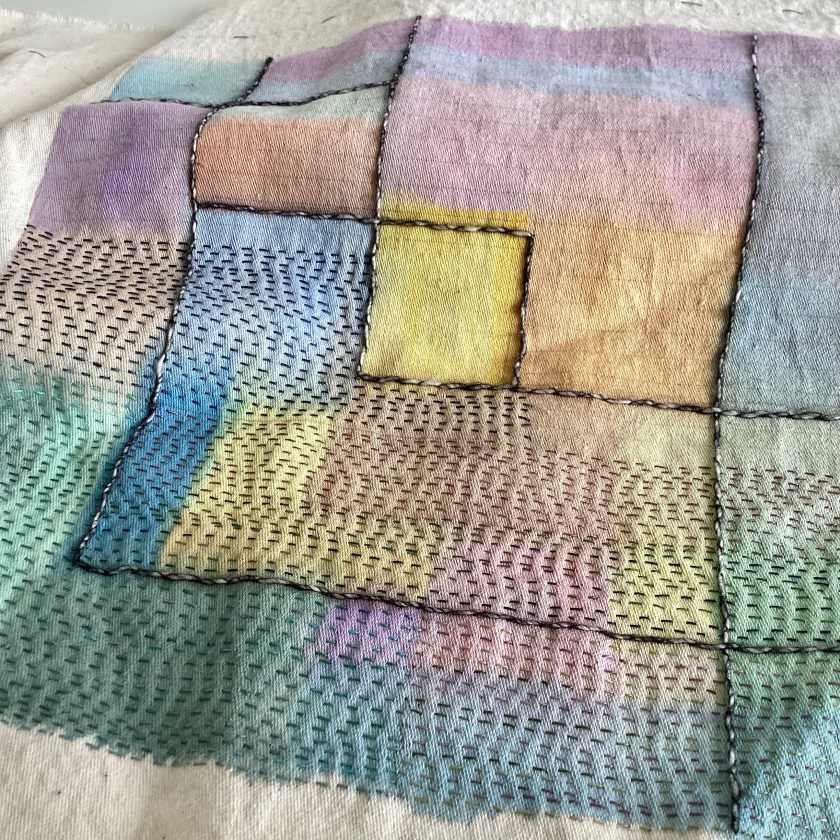

I pick this cloth up from time to time, usually when I don’t know what else to do or, in this case, while I’m thinking about how to start some new work. I started this one a couple of years ago, as a kind of map. Then it became a kind of journey.
Then I looked again at the embroidered E in the corner, and renamed it Evolution, since it never seems to know what it wants to be.

It was always intended to be a very lightweight bed cover for those awful hot summer nights when no one can get any sleep. The backing is a large vintage tablecloth, onto which I have randomly layered pieces of hand-dyed lawn, cheesecloth, and muslin – all ultra-lightweight, semi-sheer fabrics to add colour without adding too much warmth. I made it a bit bigger at some point by adding a 10” border of brushed cotton to either end so it’s now about the size of a single duvet.

At some point I applied a ragged row of circles across it and then realised they looked a bit heavy. I’ve cut the centres out of the bigger circles and am stitching the edges under to form rings. Better, I think.

It has a long way to go, and there is no plan. I often think life should come with some kind of handbook so we all know where we’re supposed to be going. I think most of us haven’t a clue what we’re doing here and are making it up as we go along. Some people manage to make it look as if they have everything under control, which can be quite unsettling for the rest of us.

I’m guessing this isn’t going to be finished in time for this year’s hottest nights in a month or two, though it is functional in its present form. In an emergency it would do.

This is not what I intended to start right now, but I’m really intrigued to know how long it will get, and how long it will take.
Let’s start at the beginning.
A while ago two things happened that made me stop and think: I read a statistic that the lifetime of a person who lives to be in their early 80s amounts to around 30,000 days. That strikes me as much, much fewer than you might expect. Life is short, even when you get to be old.
I also very luckily found a collection of antique and vintage clothing online that included (hand-stitched!) christening gowns and home-made vintage lingerie. One of the items was a silk petticoat, pre-dating elastic because the waistband was made from lingerie tape, but machine-sewn. It was simply made: a narrow A-line skirt constructed with French seams, and a flounced frill around the hem. The silk is very lightweight and billowy – similar to fine habotai.

I wonder (and this is just a hunch that feels ‘right’) if this might be a post-war silk parachute that has been repurposed by a resourceful stitcher in the late 1940s.
So I ended up putting those two thoughts together – taking something from around 80 years ago that has potentially saved someone’s life, and using it to make something that signifies an octogenarian lifespan. There is something quite incredible about launching yourself out of an aeroplane with only a gossamer-thin canopy of worm-spit between you and the ground.

So the result is a very, very long cloth, just 6” wide, with bits of vintage silk parachute/petticoat applied to a strip of brushed cotton (for stability and softness) on which I intend to place 30,000 stitches.

I’m keeping as much of the original sewing as possible.

I have no idea what 30,000 stitches will look like but I’m looking forward to finding out.
Another month on the stitch journal, and in total (as of today) there are now 92 blocks of meditative stitching, each one witnessing the passing of a little more time.

I’ve deliberately not added space between the days because in reality there isn’t any. Day turns to night and night turns to day, and it is all just time. I continually find myself thinking these are days of my life that have gone forever. Not in a sad way, just noticing the transience and inevitability of it, the impermanence of living. Every day a bit less life left, but every day a bit more life lived. Philip Larkin (‘Days’, 1953) wrote ‘days are where we live…. Where can we live but days?’

I like the way the stitch journal is filling up with these moments, and I like the empty space that stretches ahead.

I wonder what this new month will bring. April is the cruellest month, according to T S Eliot. Everything is growing, leaves are starting to burst from their buds, and another cycle of life begins. In the garden my young flowering currant is looking particularly splendid at the moment, and I like to memorialise these little moments of recognition.


One day at a time, going on.
Here we are in a whole new January, and a happy new year to you. One of the things I’ve been wanting to make for a while now is a stitch journal – some sort of ongoing cloth with a little stitching every day. I sew most days anyway, of course, but hardly ever in the same place. I’ve often thought it would be interesting to see how the threads of days join up over time. I don’t keep a written diary or journal, because not that much happens in my life – which is just the way I like it, incidentally. A new year seems like a good time to start.

I’m using a long strip torn from an antique linen sheet, about 12″ wide and about 8 feet long, and I’ve mapped out a block of 31 fields that I can use as a template for each month – obviously, some months are shorter than that so I can adapt the template as necessary. Each monthly block is about 8″ x 10″ altogether, so each daily field is an inch and a half or so. I will fill in a field every day for the rest of this year, and I’m hoping that the end result will look something like a cross between a map and a path through the year.

I really want this to be just thread, on one single layer of cloth – so no patching, applique, layering, lining, etc – just thread, whatever happens to be at hand, and whatever kind of stitch presents itself on the day. I will let it unfold in its own way and in its own time, and create an overall pattern (or not) as time goes by. Because I don’t know how this is going to go, I’m starting with very simple running stitches, but I think that will change as I settle in to working with this cloth.

I’m really looking forward to seeing how this unfolds. The older I get, the more quickly time seems to pass, and the more precious time seems. I’m hoping that a daily stitch journal will help me to slow down more and notice each single day for the gift that it is.