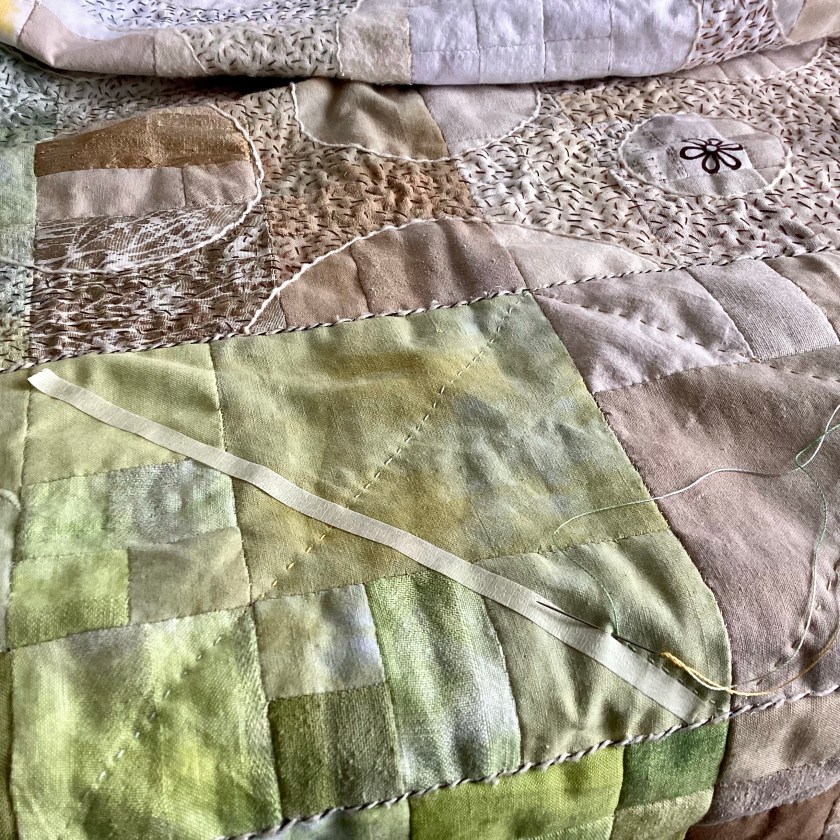
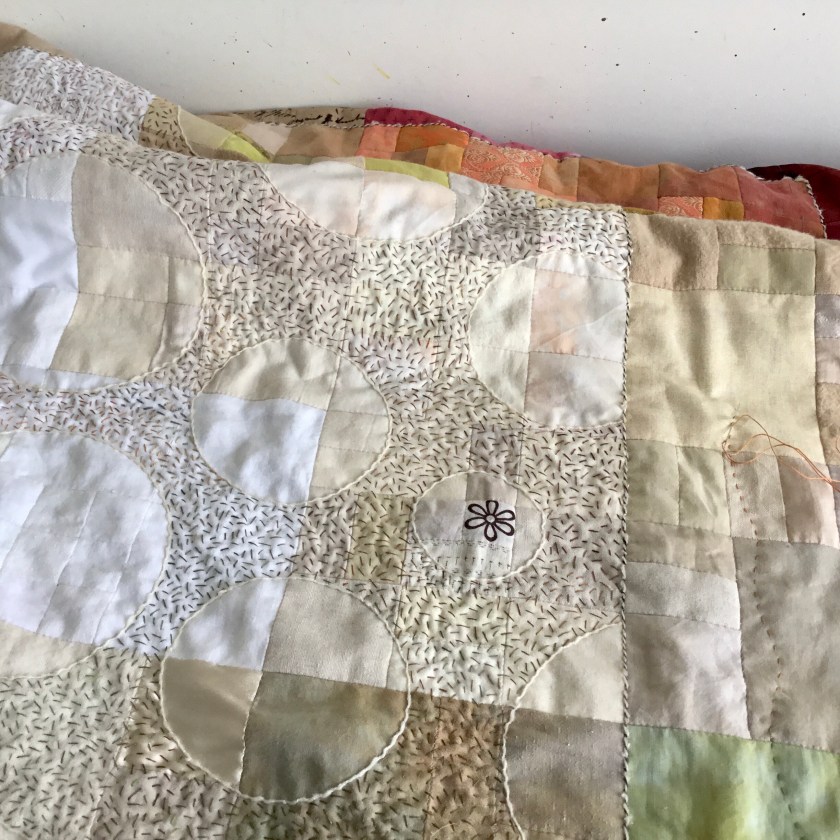
I started quilting ‘All Together Now’ with a meandering line, and I thought I knew exactly where it was going.
Wandering aimlessly
This quilt has been very particular from the very beginning about what it wants, but I was just starting to feel that we were becoming friends now that we’ve reached the outer sections. The quilt waited until I had done a fair few meandering lines before telling me that was very wrong and not what it wanted at all. Quite a lot of unpicking and tutting ensued. The second attempt is now well under way, and everyone seems to be happier. I’m now working very simple diagonal lines across each of the 6” blocks.
Diagonal quilting lines across 6” blocks
I couldn’t sew a straight line if my life depended on it, so I use quilter’s masking tape. It’s one of the best things ever invented.
Quilter’s masking tape
I confess I am slightly disappointed not to have more expressive quilting lines to create. It’s one of my philosophies of life that there are already enough straight lines in the world and now here I am, adding to them. There is, however, quite a lot going on in this quilt – there are a lot of colours to manage, with a lot of seams and some very busy seed stitching – and keeping the rest of it simple I think is the right thing to do.
I started this quilt some time last year, rounding up (squaring up) all the scraps into 6” blocks and then assembling them into a kind of square colour wheel with all the whites in the centre. It’s 11 blocks square, so 66”-ish, all paper-pieced. I had to abandon it when I broke a bone in my right hand in October, but that was no great hardship as by then I didn’t really like it. It also had no name, so I didn’t know what it was trying to be.
In progressLots of seed-stitching
Last year I had started seed-stitching the central panel to define the circles, and it quickly turned into one of those things I wish I’d never started. Seed-stitch takes a long time, and there was acres of it. OK, about a square yard. I tend to exaggerate.
Seed-stitching around circles
So since October it has been rolled up in a corner of the room, nameless and baleful, scowling every time I passed it, and now I need to finish it before I feel free enough to start something else. A few days ago I steeled myself to set about finishing the seed-stitching. And what do you know? It didn’t take as long as I thought it would, and it looks OK. The texture is really interesting. The backing is made from a vintage silk sari, and the middle layer is cotton flannel, so it isn’t too bulky but is still quite substantial. It’s surprisingly heavy.
Quilting the edge
And then it named itself: All Together Now. So now I need to figure out what to do with the rest of it. I’ve couched some two-tone silk bourette yarn down to create a couple of borders around the central panel, and I’m starting with a meandering line just to see where it goes.
First line of quilting
Sometimes making a large quilt by hand feels a bit like wrestling with an alligator (no, since you ask, I have never wrestled an alligator). I do feel as if I am starting to tame this one.
The scraps build up alarmingly. I have no idea where they all come from. I find it difficult to concentrate on a large piece of work when there are so many tiny bits shouting for attention and I have a couple of large pieces waiting to begin, so I’ve been trying to get the scraps under control first.
The way I usually handle the tiny bits is to arrange them on a base of very lightweight fusible interfacing, iron them down and then cover the whole thing with a sheer of some kind (usually chiffon or organza) and then stitch onto the surface. I think of these as backgrounds for later, but some of them turn out to be quite attractive in themselves.
Short strips of cotton and silk layered under hand-dyed silk organza with hand stitch, 4” x 12”Fabric collage under silk organza, 5” x 7”
Sometimes I dispense with the sheer covering and just layer the various bits.
Scrap of patchwork covered with vintage hand-dyed cotton lace on hand-dyed linen, 6” x 8”
I have quite a big pile of these waiting, which makes for a nice relaxing evening job – something of a manageable size and scale that can be pieced and stitched while watching (in my case, listening to) TV.
Scraps collages stitched, waiting to see what happens next
Some of these little backgrounds are destined for studies of ancient rocks and monoliths, as an extension of the sketchbook I’m currently working on. This piece is very small, made from tiny layered scraps and a piece of decorative lace that I’ve had for many years:
Tiny monolith, 3” x 4.5”
In the quest for zero waste, I think we’re doing ok so far.
Still working on paper, thinking things through. I don’t have a lot to say about this today. Not in words, at least. Colour, shape and composition have their own language that is universal and goes far beyond the limits of words.
Collaged sketchbook pages in progress
I have started to draw what might become stitches.
Marks on a standing stonePatterns similar to those found on carved rocksStone circle with hengeAbstract marks suggested by irregularities in the inked background
Another month on the stitch journal, and in total (as of today) there are now 92 blocks of meditative stitching, each one witnessing the passing of a little more time.
Stitch journal, 31 days of March
I’ve deliberately not added space between the days because in reality there isn’t any. Day turns to night and night turns to day, and it is all just time. I continually find myself thinking these are days of my life that have gone forever. Not in a sad way, just noticing the transience and inevitability of it, the impermanence of living. Every day a bit less life left, but every day a bit more life lived. Philip Larkin (‘Days’, 1953) wrote ‘days are where we live…. Where can we live but days?’
March in progress
I like the way the stitch journal is filling up with these moments, and I like the empty space that stretches ahead.
Looking at it from the other end: April days, waiting
I wonder what this new month will bring. April is the cruellest month, according to T S Eliot. Everything is growing, leaves are starting to burst from their buds, and another cycle of life begins. In the garden my young flowering currant is looking particularly splendid at the moment, and I like to memorialise these little moments of recognition.
I really like paper. I especially like painting sheets of paper and then tearing them up to make collages for sketchbook pages – I find this much easier than drawing on a blank page with a pen or pencil. I like the accidental shadings that occur, and the blocks of colour. It’s like patchwork, really.
sketchbook page, collage with painted paper
I’m in the process of making two sketchbooks: one that explores the marks on ancient rocks and stones, and one that explores the marks on ancient landscapes. I find land particularly fascinating because it holds so much time and has witnessed millions of years of life. Land and ground can be synonyms, and grounding is what happens when we connect to the land.
sketchbook page, collage with painted and textured paperssketchbook page, drawing over collageSketchbook page, cut and torn painted paperssketchbook page, mark-making over monoprint
While I’ve been working on these pages, some thoughts about the fiction I’ve read recently have been weaving themselves together. A couple of months ago I read All Passion Spent, by Vita Sackville West (first published in 1931), which is about an elderly woman who, when widowed, decides to live where she chooses and on her own terms. There is a passage at the beginning of Part Two, where Lady Slane finds that for once she has time to reflect:
‘She had plenty of leisure now, day in, day out, to survey her life as a tract of country traversed, and at last become a landscape instead of separate fields or separate years and days, so that it became a unity and she could see the whole view, and could even pick out a particular field and wander around it again in spirit, though seeing it all the while as it were from a height, fallen into its proper place, with the exact pattern drawn round it by the hedge, and the next field into which the gap in the hedge would lead. So, she thought, could she at last put circles around her life.’
Sketchbook page, collage – ‘so could she at last put circles around her life’
I recall seeing a fascinating interview with the actor Liz Smith a few months ago, and she said it’s only when you get older that you can look back at your life and begin to see the recurring patterns that have always been there. You don’t notice the patterns at the time because you’re too close to recognise them.
In another novel I’ve read recently, Alias Grace, by Margaret Atwood (1996), one of the characters, Reverend Verringer, speaks this line:
“What becomes of the soul? We cannot be mere patchworks!” (p. 471, ‘Pandora’s Box’)
Patchwork, silk and cotton fabrics
All these thoughts and patterns are coming together, like paths converging, and it feels as if I am going somewhere. I am still drawing the map, but I have a compass and a vague sense of direction. I am travelling slowly, on foot. Step by step, or stitch by stitch, or piece by piece, it will come together somehow, in its own time.
And *of course* we are all patchworks. What else could we possibly be?
I finished the cover/bag for the stitch journal – something to carry it round in, and something to keep the sun off it now we’re heading for longer days.
stitch journal cover, about 15″ long
It’s basically a quilted/lined tube with a circular base and a casing around the top for some hand-dyed ribbon to tie it closed. Initially I was a bit disappointed because it turned out bigger and bulkier than I intended, and the stitch journal rolls up quite small. And then I saw this:
very large industrial wooden bobbin
I bought the large wooden bobbin some time ago with no real purpose in mind. But – what do you know – it fits the stitch journal cover *perfectly*. And furthermore, the stitch journal itself fits the bobbin *perfectly* if I hem the edges:
stitch journal with bobbin, on a roll
So the over-sized cover is actually exactly the right size, I have a purpose for a spare bobbin, and a permanent home for the stitch journal when it’s finished. I don’t know about you but I call that a roaring success. An accident for the most part, for which I can’t take much credit, but a success nevertheless.
a little gentle seeding and running stitch on beautiful eco-printed silk by Jane Hunter Textiles
So I’m taking this as a little life lesson: most things really do turn out OK in the end.
I don’t feel very productive at the moment. It’s not really a question of being stuck, since I think I know where I’m going next in terms of creating a new series of art work. Nor is it a matter of not knowing where to start, because I think I know that too. It isn’t lack of energy or motivation either as I have plenty of both. It isn’t even the unrest and terrible conflict out there in the world, I don’t think. I wonder if it is to do with the season. We have just passed the spring equinox, where day and night are perfectly balanced, and I wonder if the temporary desire to stand still, to look and think for a while, is an expression of that pivotal moment of poise, standing between two halves. I see a lot of people calling this the first day of spring, but in fact the equinox is the mid-point of spring, since it falls exactly halfway between the midsummer and midwinter solstices.
Despite the hesitation in starting something big, I do like to keep busy and I usually find myself in the middle of something. At the moment it’s a useful thing as well as a decorative thing – and it’s interesting that I feel the need to make the distinction between useful and decorative. It’s that old establishment-driven art/craft chestnut, isn’t it, where art is purely decorative and craft is useful. I like to think textiles work confounds that over-simplified distinction.
Anyway, here I am, finally getting to the point after a bit of waffle and introspection. I’ve started making a cover for the stitch journal, which will be a cylindrical bag. I’ve made a start by layering strips of ribbon and tape onto a piece of hand-dyed cotton sheet.
cover for the stitch journal in progress
The strips of silk are from a hank of white sari ribbon that I dyed and ironed flat. I’ve turned the edges under by about 1/8″ and attached them with very simple straight stitches. I will probably go back and add more hand-stitching. It’s an intuitive process, and I will know when it’s had enough.
strips of hand-dyed silk sari ribbon, ironed flathand-dyed silk ribbon ready for couching
When all the vertical lines have been attached, I will add this horizontal band of silk expertly and beautifully eco-printed by Jane Hunter:
strip of eco-printed silk by Jane Hunter Textiles – see link in text above
This will keep me busy, while I think about where I’m going next. I find the mind ticks over nicely while the hands are engaged in some quiet stitching.
In the interests of keeping busy, I made a start on the cover for my sampler book.
birdie in his natural habitat
I’ve spent a lot of time thinking about how to tackle the cover. I considered various kinds of needlepoint, cross stitch (really didn’t want to do any more of that) and a variety of seams. In the end I went for my usual style of book cover, which is layers of strips laid on a foundation fabric. I used modern, vintage and antique silk and cotton fabrics, mostly hand-dyed.
cover in progress
I really like old lace and ribbon, but I don’t tend to use it much. I thought this was probably a good place for it.
layered fabrics, lace and ribbon with hand stitch
A couple of weeks ago I acquired a few old wooden bobbin reels – more on that later, there are plans afoot – all of which came with very old dusty thread still in place. Most of the thread was unusable, very brittle from age and light damage. But on two of the bobbins, once the outer layer of damaged thread was removed, the rest of it appears to be sound. I’ve dyed some, and have road-tested the finer of the threads on this cover. It breaks quite easily so wouldn’t be any good for sewing seams, but it seems fine for surface decoration.
vintage cotton thread from an old mill bobbin, hand-dyed
As with the sampler book itself, I found myself wondering whether Ellen Mahon would like the cover I’ve made. I wanted to make it pretty for her.
Hand-dyed vintage viscose ribbon, very soft and silky
I wondered about whether I should label the cover with words, whether I should stitch the words ‘sampler book’ somewhere on it. I decided not, in the end. For one thing I’m not very good at stitching lettering, and for another thing I didn’t think it needed words. I really like the way stitching conveys its own meaning without the need for words as well. I always think hand-stitching is more like writing than drawing. I often find myself recognising artists’ work by their stitching the same way I might recognise the handwriting on an envelope.
I have taken to rolling up and pinning the stitch journal, just to stop it getting so unwieldy. It’s a long strip, about 7 or 8 feet, and it tends to unroll itself as I stitch each daily block.
Safety pins keeping it together
I unrolled it today, just to see everything in context. Winter into spring.
The year so far
And what I find myself thinking is: those are 69 days of my life that I will never see again. I know I was there, because I stitched each block. But do I remember all those days? I don’t. And, of course, we can’t possibly remember everything. We only tend to remember the exceptionally good and the exceptionally bad things that happened on those days.
A number of days
I’m deliberately choosing not to mark the stitch journal with numbers or dates, because the calendar is arbitrary really. Who decided that our years begin on January 1st? We are born, and we live for some days, and then our days end, and the calendar has very little to do with it. The calendar just gives us something on which to pin and memorialise our experience. The days just join up.
I found myself wondering about how many days we can expect, in general. If you live to be 80 you get about 30,000 days. You spend about 10,000 of those days asleep. Factor in all the other practical necessary things that take time – washing, cooking, eating, going to work, etc – and it really isn’t very long. Factor in war and disease, for those people in terrible circumstances, and it’s even less.
The most recent days
This isn’t about making the most of every minute, or trying to cram more things in because life is short. Sometimes just being alive – just being – is enough, and sometimes that takes a lot of mental and emotional energy. Even when we’re sitting still, time is passing and taking us along for the ride.
The day before yesterday. The Welsh have a lovely word for it: echdoe
I wonder about the empty space still to come, the section of blank sheet that is still to be unrolled. The days I will stitch together. The white sheet, that is the foundation for the stitch journal, is antique/vintage French metis (a linen/cotton blend), and will itself have seen birth, life, and death. So much time rolled up in my hands. We are lucky to be here.