Darning

I made some darning samples a few weeks ago, inspired by the darning samples created by Ellen Mahon in her sampler book

(left page) darning samples by Ellen Mahon, 1852-4

I’ve never done darning before. I have mended clothes, obviously, but have never done ‘proper’ traditional darning, which is basically weaving. I am not a weaver. I had to draw a diagram to stop me getting confused about all the unders and overs.

darning sample in progress

I used a single strand of DMC embroidery thread on hand-dyed evenweave (32 count, I think). You can see that my attempts are nowhere near as fine as Ellen’s.

darning sample with different colours

If you follow the instructions in nineteenth-century needlework manuals, you are supposed to leave a little loop at the end of each row to allow for shrinking in the wash. As these are only ever going to be decorative, I didn’t bother doing that. I tried a few different patterns, and made a few mistakes, but overall I think it will do. I was a bit concerned about the tension, as I didn’t use a hoop or frame, but a quick (careful) press with the iron seems to have sorted it out. The rather shoddy-looking example top right below was my first attempt.

five darning samples

This sample overall measures about 7″ square.

Sampling

A while ago I became fascinated by samplers, and in particular by the sampler books made by nineteenth-century schoolgirls. These consisted of little samples of various kinds of needlework, like seams, hemming, cross stitch, embroidery, darning, etc, and were pasted into exercise books as a record of the skills they had learned.
In fact I remember making something very similar as a schoolgirl myself. In the olden days, by which I mean the 1970s, in our secondary school boys and girls were separated for some of the lessons. The boys were herded off to do woodwork and technical drawing while the girls did needlework and cookery. We learned to sew using very old cast iron Singer treadle machines, and we stapled samples of flat felled seams and French seams into our exercise books.

I thought it might be an interesting exercise to connect the past and present by making my own version. The example that started this train of thought is in the V and A museum and can be viewed here:

Sampler book by Ellen Mahon, V and A Collection

This is a sampler book compiled by Ellen Mahon, when she was a student at Boyle School in Ireland in the early 1850s. It is filled with examples of fine needlework.

First page of Ellen Mahon’s sampler book, worked in cross stitch on linen

I still can’t sew, of course, but I’m thinking about how I might create something similar, and how that might be a good opportunity to sample some varieties of needlework that I wouldn’t normally do. There’s always something to learn, right?

Shop update

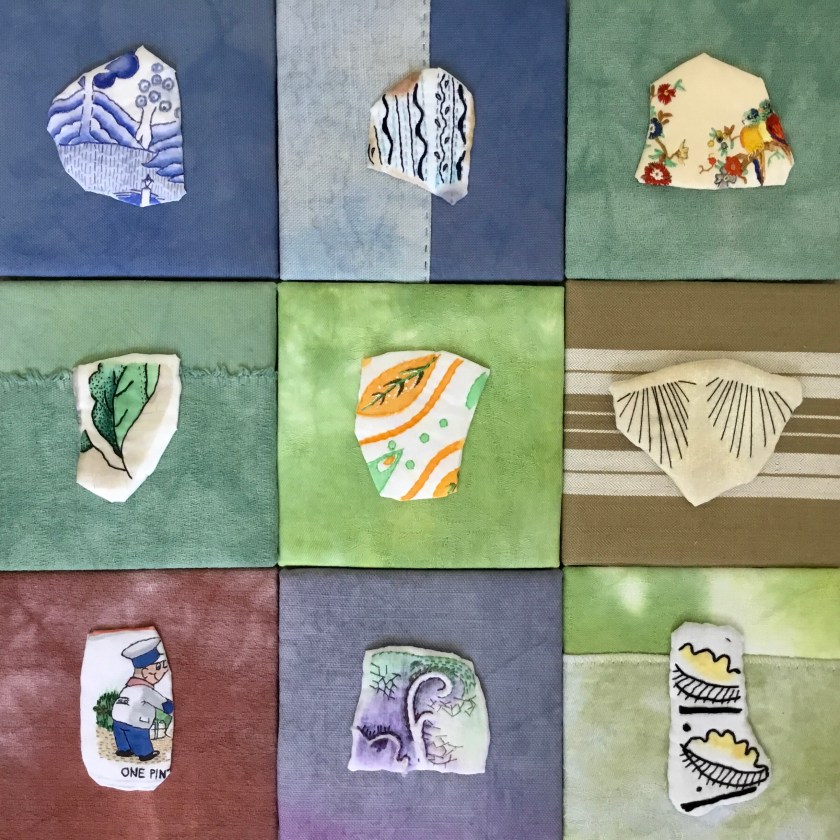
Just to say you can now buy the textile interpretations of pottery shards (see my Exhibition page for more information about these) via the shop link in the top menu bar.

They are ready to hang – I’ve stitched each hand-embroidered fragment to a fabric-covered 5″ square with a hanging loop on the back – but you could also display them in a small box frame.

Thanks for taking a look.