I was hoping to have the latest batch of hand-dyed threads in the shop next week but unfortunately that’s not going to be possible.
A few thread types are done but I still have many more skeins to wind, and then they will need sorting into sets, photographing, describing and listing, all of which takes more time than you might expect.
the winding chair
Further progress will be limited because it looks as if our long-awaited house move may finally be happening the week after next, and I will have to close the shop temporarily while I focus on packing.
The shop will close on Tuesday 20th February, and will re-open as soon as I’ve been able to unpack my supplies in our new home. I don’t know how long that will take, but I’m aiming for the first or second week in March. If you’re looking for daily stitching templates while the shop is closed, you can now get those through my Teachable school here.
A preview of some of the silk threads that will be coming next month:
silk threads coming next month
And in the meantime, here’s what I’ll be doing next week:
The thread update last week has kept me very busy, and if you have ordered some thread (thank you) it’s on its way.
Most of the thread collections have gone; (at the time of writing) there’s just one silk set left:
the last silk thread collection, very pink
I gave myself a surprise extra dyeing day yesterday. Normally I plan these events and spend a week or two preparing for it, but this time I wondered what would happen if I just wound some larger hanks and got stuck in.
And it turned out to be so much easier this time. Winding single skeins and dyeing them takes a bit of time and effort, particularly as many of them need winding again if they tangle too much in the wash. Bigger hanks don’t tangle anywhere near as much, and will yield several skeins of similar colours. They will still all need winding individually, but that’s fine. They’ll be done when they’re done.
threads in various stages of drying/waiting to be washed
This current batch will just be for thread sets, not single skeins. There will be some silk sets and some mini cotton sets, when they’re all dry and sorted. I like putting these collections together, finding colours that sit nicely side by side. They’re a bit like a choir, I always think. Some sing loud and clear, others sing a quieter underlying harmony that sits in the spaces between the more strident notes.
I have a tiny bit of dye left, and there is some fine silk thread that should be arriving today, so I will put all of that together later until all the colour is used up.
leftover dye, and waste not want not
In the meantime there are a few single skeins left in the shop but when they’re gone there will just be thread sets for now.
silk single skeinscotton single skeins
I’m really looking forward to sorting this week’s threads when they’re all dry. There is nothing so joyful as glorious colour on a grey wet day.
Three weeks of thread-dominated days, and I think we’re almost there.
Shop update waiting
I’m taking the afternoon off, and then I’ll update the shop some time later today (UK time). If you’re waiting for thread, keep checking in. The ‘coming soon’ boxes will disappear when the threads are live.
Just a few announcements, while we’re here:
(1) There was an alarming point in early January when I discovered that some of my silk and cotton thread suppliers were no longer trading. I’ve managed to connect with new suppliers in the meantime, but their thread is more expensive so I have had to make a small increase in my prices. I think the prices are still reasonable, given that each thread is unique. I don’t dye by recipe so everything turns out to be slightly different every time.
(2) I’ve found some commercially hand-dyed silk threads that I’ve added to the shop. These are the only threads there that are not dyed by me. I’ve used these threads myself and I like them, despite the many annoying knots that appeared in the hanks. They do come with a warning about their colourfastness – I have thoroughly washed and rinsed them all before winding into skeins, and some of them did lose a little colour (mainly anything with magenta or dark blue in it, including purples and dark greens) but they may still lose more colour if they’re washed again. If you need to wash your project, then test the threads first (actually that advice probably applies to all of my hand-dyed threads, none of which can be guaranteed colourfast). If you do need to wash the thread, then I would suggest cool water, minimal detergent and minimal agitation. Rinse well in cool water and blot the excess water onto a towel; don’t wring or squeeze, and definitely don’t tumble dry. If you’re not washing your project, then none of this matters. I rarely, if ever, wash embroidered work and have never had a problem with rogue colours staining the cloth. If you’re making something that will need frequent washing then I’d suggest using commercially dyed thread that does have a colourfast guarantee.
Silk perle 8 (not dyed by me)
(3) This time I have made available some undyed skeins, in case anyone wants to have a go at either dyeing their own thread or painting it. You can paint thread quite successfully with something like Jacquard Dye-na-Flow fabric paints – these are very liquid colours that behave more like dye than paint, and they don’t alter the hand (the softness) of the thread. There are lots of dyeing tutorials and instructions online, for fibre-reactive dyes and for botanical dyes. You can also use the undyed threads as they are, of course; white thread is always A Useful Thing.
new for 2024: undyed threads
Other than these new additions, there are the usual ranges of cotton and silk in various weights, plus a few thread collections.
Cotton thread mini collectionThread taster setssilk thread perle 8/12
The entire month has passed in a blur of thread winding, dyeing, sorting and labelling, a task that is still very much ongoing.
But daily stitching counts the days and maps the path, creating lines of progress and marking the days in which standing still for a time becomes restorative.
January days
I’m loving this year’s template. I like the way every day is a slightly different shape, as they are in real life. Some days are short and fill up quickly; some days have awkward angles and sharp corners; some days feel a bit longer than they should.
January, detail
Looking back, I notice a lot of running stitch trundling along, charting a path and counting steps.
January detail
I think it’s probably my favourite stitch. It’s so versatile and can be very expressive. I like the way it moves forward one step at a time, putting one foot in front of the other just to keep going. I also like its simplicity and its capacity for trust. It doesn’t always know where it’s going but somehow it finds its way and ends up where it’s supposed to be.
I like the quietness of January, where nothing much happens. I enjoy the pale, muted colours of winter and the gentle light. I know some people don’t like the grey days and the long nights and are glad to see the back of it.
the back of January
Tomorrow is Imbolc, which marks the start of spring in the pagan calendar. It’s still cold, and the nights are still long, but you can see the light starting to change and there are snowdrops gamely battling on through the cold. Spring is on the way; you can smell it in the air.
In the meantime, I am still sorting through thread and fearing that I may never get to the end of it. But myself says keep calm and carry on and it will be done soon. If you’re waiting for thread, please keep an eye on the shop; all being well, the update will happen in a couple of days or so.
It will be the middle of next week before everything is washed, rinsed and dried, then it will take me a week or two to sort, label, rewind where necessary, photograph and list. I’m hoping to have them in the shop around the end of January, house move depending (yes, we’re still on the edge of our seats here waiting for dates).
There won’t be much else happening here while this is in progress so if I’m particularly quiet, I’m probably just up to my elbows in thread. And what better place to be?
Thirty days, thirty boxes, one box a day. Counting the days, observing the minutes, watching time as it hurtles past.
November daily stitching
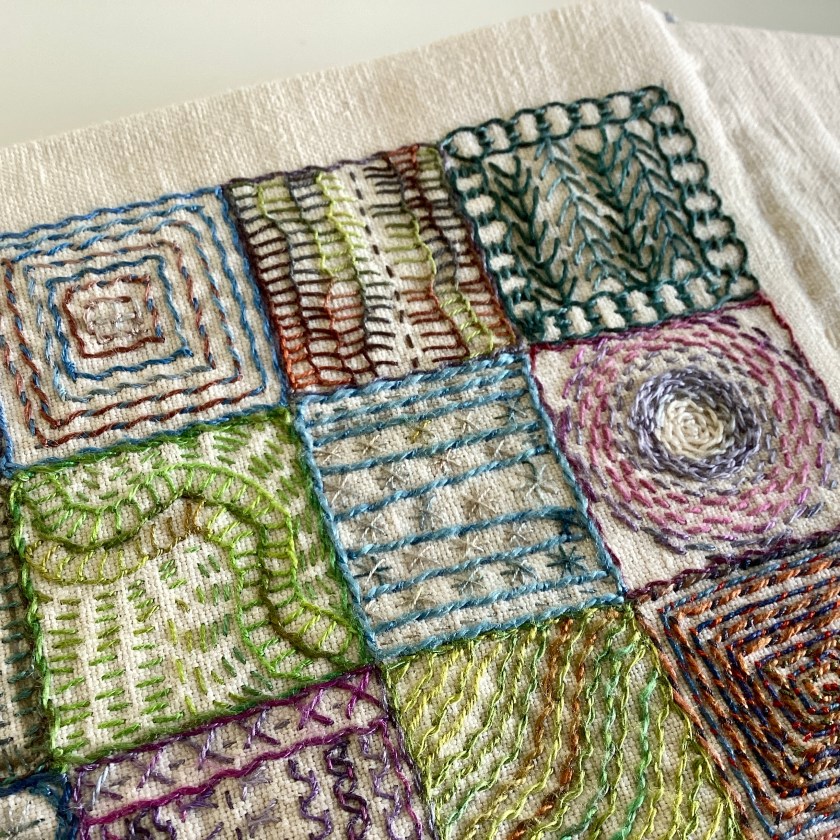
As always, I’ve only used very simple embroidery stitches – mostly variations on running stitch and straight stitch, with a little blanket stitch here and there. Life is complicated enough without trying to figure out double braided Hungarian dragon stitch, whatever that might be. I may have just made that up.
November stitch journal, detail
It looks more complex than it is probably because of the variations in colour and thread weight. Some threads are very fine; some are thicker. There is probably meaning in the colour and thread weight I choose for a given day, but if there is then it’s unconscious.
early November, detail
You can only see the patterns in your life when you’re far enough away to be able to look back on them. Close up, it’s hard to see a difference. But stand back and squint, and you can usually make sense of the threads.
There is still no date for our house move. Today’s square is the shadowy ghost of a house. I know (I hope) our new home is waiting for us, but without a date I can’t connect with it. And frustratingly, I can’t (daren’t) start any packing.
our new home doesn’t seem real yet
I will have to temporarily close the shop for a week or two when we do get a date because at some point I will have to pack everything away. In the meantime, if you’d like to help me have less to pack, there are quite a few threads left and some of the fabric scraps packs are reduced. I’ll post updates here when I know more about when the shop will close, but keep in mind that we may not get much notice. My last international posting date is 6th December.
Also, while we’re on housekeeping, my stitch journal PDF templates are now available in my Teachable school as well as in my online shop. They’re exactly the same templates, just in two places at once. This is in response to requests from those of you who signed up for my Intuitive Daily Stitching class (thank you) and wanted easier access to the templates. If you’ve already bought the templates from the shop (and thank you, if you have) then please don’t buy them again from Teachable. If you have problems downloading any templates, or if you’ve lost access to them, please let me know so that I can email them to you.
I think that brings us all up to date – and here we are, poised on the doorstep of December, wondering what the last thirty-one days of the year will bring.
Next month, stars:
December (yes, it’s biro. All the outlines will be covered up)
Not quite a square yard – it’s about 32″ x 34″, and all pieced together now. Some people think English paper piecing is too fiddly and takes too long, but I find it fairly quick and very enjoyable. I’m already thinking about a bigger, bed-sized version.
slightly blurry picture, but you get the idea
All the curves went together just fine, after I added the balance lines.
look at that lovely curve
The best part of English paper pieced patchwork is removing the tacking thread and papers, when all the piecing is complete. The cloth starts to relax, and you can see what you’re working with.
some of the tacking and papers removed
Much nicer to handle, and the colours seem to come alive more.
A few more to go, then I need to think about how to back it, line it, or quilt it. Haven’t decided where it’s going yet. There will probably be textured yarns couched along some of the boundaries and of course some stitch here and there. Maybe even some tiny sheep.
some tacking still in, some already out
Initially this was going to be a PDF pattern but I think it might be a bit too complicated for that. There is quite a lot of tweaking and easing, to get the curves to lie correctly and line up the balance marks, which is easier to do than to explain. Maybe a PDF for the intrepid.
I anticipate that this may well be the last thread update before Christmas, as our house move may or may not happen before then. Everything is still very up-in-the-air at this point. Good job I have the patchwork to keep me grounded.
I’m often asked whether I can guarantee that my hand-dyed threads are colourfast.
hand-dyed silk thread
The short answer is: no, I can’t. Domestic dyeing is different from commercial dyeing and the results can never be guaranteed.
The longer answer is: with due caution they probably are, if you’re careful – by which I mean (obviously, I hope) no boil washing and no bleach. A gentlewarmhand wash will *probably* be fine, but no promises.
I dye my threads with Procion fibre-reactive dye, and after dyeing I wash them in the machine, on a mixed load setting, at 30 degrees with regular laundry detergent. I don’t use Synthrapol, and I don’t use a hot wash. Silk threads are delicate, and agitating them at temperatures over 30 degrees could be damaging. I set the machine to do an extra rinse after the standard mixed load wash.
Incidentally, people sometimes express disappointment that the threads aren’t dyed ‘naturally’. The reason I use Procion over natural dyeing is that Procion is quick, easy, reliable, and doesn’t require additional energy resources, as in simmering or steaming, to set the colour. I don’t own a microwave, and at today’s gas and electric prices, I’m not willing to simmer/steam several pans of thread for an hour each time – as well as the environmental impact of using additional energy for heating. All dyeing takes energy and resources, as does all textile production, but if I can keep the energy use to a minimum I’d prefer that. Many people do great things with natural dyes; I’m afraid I’m not one of them.
hand-dyed threads, two similar samples
Anyway: back to the Procion, and I did a little experiment of my own.
various hand-dyed threads before and after washing
I made two (awfully rough) stitched samples with various silk and cotton threads, all hand-dyed with Procion, on white brushed cotton. I soaked the lower sample (in the above photo) in hand-hot water with regular laundry detergent for half an hour, and then rinsed it in hot water. I can’t see any noticeable colour escape. I don’t know whether water quality affects colourfastness – the water in our area is very hard indeed. Soft water might make a difference.
hand-dyed DMC 6-strand floss
And exactly the same process above, with this DMC cotton floss. I’ve listed a few of these in the shop, just to see how they go – as usual, unique and unrepeatable colours, but I’ll hope to make some more soon. Ish.
I did expect some trouble with the magenta sections of this space-dyed thread (above), but no – not as far as I can tell. Red and magenta are notorious for leaching colour, and which of us has never accidentally dyed a load of washing pink because of an errant red sock?
So there we are. I still don’t guarantee colourfastness, and if you really need to wash something that is stitched with my hand-dyed thread, then I would advise testing it first. Mostly my threads are intended for purely decorative work, which will rarely, if ever, need washing.
New: DMC 6-strand cotton floss
And if you have washed anything that I’ve supplied, I’d be interested to know how that went.
When I left the day job eight months ago, I thought I’d have loads more time to create. Hooray, I thought, at last I get to be a full-time artist. All that extra time for stitching and drawing and designing and sketchbook work…
The reality isn’t quite as I expected. I have a lot of tasks to complete, sometimes simultaneously, before I can get anywhere near anything I want to do for myself. This definitely isn’t a complaint. I love being my own boss, and I love the freedom that gives me. I also enjoy working, and I like to be busy.
It’s a good job because at the moment there is So. Much. To. Do.
There is a little heap of fabric scraps to sort into packs for the shop:
fabric scraps old and new, ready for making into packs
There is another pile of fabric scraps for my Stitch a Little Landscape course, waiting to be made into packs (and thank you everyone who’s purchased one, I hope you’re making beautiful landscapes with them)
There’s another pile of undyed fabrics for painting, also for the online course, also for making into packs:
luscious textures
And then there’s the thread mountain. Newly-dyed threads that need sorting, photographing and listing:
cotton and silk hand-dyed threads – some lovely colours this time
And thread taster sets, which take days to assemble:
thread taster packs coming soon
Everything takes twice as long as I think it will – I am optimistic by nature – but all of it is more pleasure than work. And dyeing is a kind of artistry too, I guess. So is curating fabrics and threads, and also creating any kind of online course. Interesting how the universe interprets and delivers your dreams into reality. It’s better than anything I could have anticipated.
I will take a break when all of this is done. But in the meantime, thank you for keeping me busy.
Dyeing this week, which means at least another week to ten days of sorting, winding, twisting, grouping, labelling, photographing, describing and listing. I no longer announce shop updates, but I’ll be quietly adding these into the shop in the next week or two, if all goes well.
hand-dyed threads fresh from the washing line
It’s a lot of work, and it takes a while to sort through. Just as well I enjoy every bit of it. There are some really pretty colours this time.
a rainbow of silk thread sets
Lucky me, I get to choose some of the leftovers – all the odd yards that aren’t needed for a full skein. Just right for a line of daily stitching.
thread ends, dyer’s perks
Apparently we have hot weather on the way here in the UK so I’ll be in a darkened room somewhere trying to stay cool. Enjoy your weekend if you like it hot š