On Work

Approaching the end of my first month as a self-employed artist, there is a lot to reflect on. Briefly, I don’t think I’ve ever worked so hard, and also I don’t think I’ve ever been happier. ‘Work’ means something different now. Primary goal for next month is to get better at managing my work/life balance, which is difficult when work and life have essentially become the same thing.

‘Work’ means this, among other things:

Thread dyeing in progress

It also means wearing a variety of different hats from one minute to the next. Some of the jobs I’ve done so far this month are Sales Manager, Marketing Manager, Accountant, Goods Inwards Manager, Customer Service Manager, International Relations Manager, Tech Support Assistant, Logistics Manager, teacher, photographer, copy writer, proof reader, film director, video editor, sound engineer, dyer, content creator, and researcher. Haven’t had time to do any actual art yet.

But it’s a glorious feeling to wake up every morning filled with excitement for the working day ahead.

There will be thread in the shop soon (ish) – when I can get all of these skeins wound and sorted:

Textured threads
Cotton threads (they’re not all green!)

Here’s my Heath Robinson style skein twister. It’s a tiny hand drill I used to use years ago when I made miniatures, with a bent paper clip where the drill bit should be. The board is thick foam with a pencil stuck in it, clamped to a stool so it doesn’t move. I should probably patent it.

Unpatented Heath Robinson skein winder

I think some of the Teachable teething problems have been resolved now, and so far people seem to be enjoying the online course – I’ve been assured by several students that it isn’t only for beginners, which makes me very happy.

I’ll let you know when threads are available – it will take as long as it takes, but probably (I hope) some time this week. The shop will be temporarily closed while I list the threads, but it should only be down for a day or two. I aim to have threads in the shop every month from now on, if I can. The first batch will be UK post only, just until Royal Mail gets through the backlog of delays caused by strike action in December and the cyber attack earlier this month. From next month I hope to return to international shipping.

And on that note, it’s back to work for me.

Vintage cloth, December days

Over halfway through December, and heading towards the darkest days of the year here in the UK.

Darker days

I’ve learned such a lot through making this stitch journal. I no longer think of it as a journal though; it’s become more a collection of daily stitch meditations. I will certainly make something similar next year, though probably not exactly this design. If you want to try something like this, you can download a PDF with templates and notes here.

At least once a week someone asks me what the foundation fabric is. It’s this, a vintage French bed sheet, cotton/linen blend (sometimes called metis):

French vintage cotton/linen blend bed sheet

I will stitch on this fabric again next year. I probably have enough fabric here for another four daily stitch scrolls, if I stick to the long/thin format. I find it an easy shape to work on because you can roll up the ends as you go along, which keeps it fairly compact.

The sheet holds a few memories of its previous life, one of which is a hand-stitched seam down the centre. I’ve assumed that this was a sign that it had worn well enough for a previous owner to have turned it, because parts of the sheet I’ve been stitching on (a strip torn from the outer edge) had worn very thin. Turning is where you extend the life of an old sheet, which tends to wear most in the middle where you’ve been lying on it, by cutting it down the centre and then swapping the edges – so you then sew the original outer edges together, creating a central seam and letting the worn parts become the new outer edges. Someone from the past has hand-sewn this seam down the middle:

Hand-stitched central seam

BUT there is also a darn on the outer edge, which is clearly a selvedge – so, given that the sheet appears to have been turned, but the new outer edges are selvedges (and not hemmed raw edges) I’m deducing that the fabric was possibly hand-woven on a home loom because it’s taken two widths to make one sheet. Hand looms created fabric with narrower widths than the big commercial looms, so the only way to create wider fabrics was to stitch narrower lengths together.

Vintage bed sheet with original darning

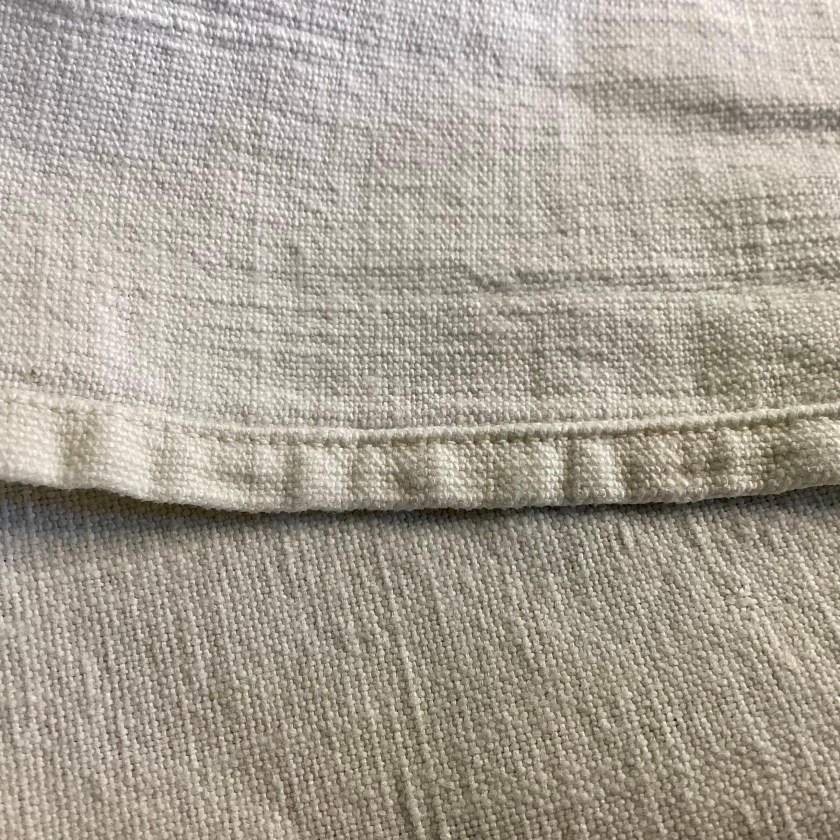
The sheet has been hemmed with impossibly tiny, regular stitches. I had assumed that this was machined, but I’ve unpicked a tiny bit and it’s just one single thread so has clearly been done by hand. It’s a very good quality fabric so will have been stitched and mended carefully.

Tiny stitches on a hand-stitched hem

The only thing I’ve been occasionally dissatisfied with this year is that the fabric is white. Sometimes I have wanted to stitch with white thread, and it just doesn’t show up well enough. The rule that I made for myself was no painting or dyeing, no added fabric or applique, just thread on a foundation. I don’t want to dye or paint it, because then I’d have to predetermine the colour, and I think that would create more limitations. I may, however, give it a very quick dip in some weak tea, just to knock back the whiteness but not enough to colour it too much.

I’m looking forward to revealing the whole thing at the end of the month. Yikes, that’s a week on Saturday! Hope you’re looking forward to seeing it too. In the meantime have a wonderful, peaceful festive season, and thank you for your friendship and support during 2022.

Tangled threads

From this:

Tangled threads

To this:

Threads neatly wound onto paper spools

I call that a successful few days’ work.

On storing thread

A few people have asked about how I store my embroidery threads, so I thought a brief tour of my collection might be helpful.

I use a wide variety of threads, from very chunky cotton yarns (mostly for couching) to very fine silks, and pretty much everything in between. I will write a post some time about the various weights of thread that you can get and what you can use them for. For now I’m focusing on how to organise thread. This jumble of blue threads doesn’t look very organised, I know. I guess all things are relative.

Blue threads

When I dye threads, I dye them in skeins. They look really pretty in skeins, but I find them difficult to use like that because they very soon get horribly tangled, especially if you keep them all in the same box. I find the only way I can make them useable is to wind them somehow. I went through a phase a while ago of winding threads from skeins into little balls, but these also get tangled quite quickly.

Skeins of thread

I used to use sections of plastic drinking straw for winding threads from skeins after dyeing, which works quite well if you cut a little snip in the ends to anchor the thread before you start winding. The straws were left over from the olden days before we knew how damaging they are, and I figured it was better to use (and re-use) them than to let them end up in landfill.

Drinking straw bobbins

Some of my threads are still on straws, but these days I tend to use little squares of regular 80gsm copy paper, about 3” square, and roll them up.

Squares of copy paper ready to roll

Again you need to snip the end of the paper tube so that the thread has somewhere to anchor itself to stop it unravelling. I find you don’t need to glue the roll of paper; the thread keeps it rolled quite securely.

Purples. That horribly tangled black thing (top left) is coton a broder and needs winding

I find it quite therapeutic to wind threads from skeins onto tubes, but it can take a long time depending on how fine the thread is.

Green threads. Some of these are commercial threads; most are hand-dyed cotton and silk

The only time I use the commercial card bobbins (the kind that you can buy from embroidery shops) is for winding DMC stranded embroidery floss. I don’t like these card bobbins much because when you get to the end of the skein the thread ends up with permanent creases from being wrapped round the flat edges of card. I find there is no other sensible way of storing these though – I can’t see colours clearly enough with them piled up in skeins, and you need to label them in case you need to buy that particular colour again.

DMC stranded embroidery thread

So there’s a little tour through my threads. I know lots of people who use sticks and twigs, and the old-fashioned wooden clothes pegs, to store thread. They look lovely, but I imagine would be bulky in large numbers. So – how do you store your threads? Let me know if you have any good tips.

Needles (2)

Thank you everyone who recommended Tulip and Bohin needles. I tried some, and I like both – on balance I prefer the Bohin, just because they’re more like what I’m used to. I like the little glass test tubes that the Tulip needles come in though.

I started with the Tulip sashiko needle. It’s enormous! It was like sewing with a harpoon. It sews well though and is a good choice for this thick cotton thread.

Tulip sashiko needle on the stitch journal

I also tried the Tulip silk needles, which are meant to be fine enough to glide through silk. I’m afraid it didn’t, really, even after a swipe with the emery. I tried this one on a scrap of fine silk sari ribbon covered with a bit of silk organza, using my finest silk thread (I think it’s Coats fine silk but can’t read the small print on the tiny label. My ageing eyesight frustrates me no end).

I also used a fine hand-dyed silk thread in shades of purple. I used the Tulip silk needle for one half and a Bohin embroidery needle for the other. I don’t think you can tell which is which, but the Bohin was easier to use.

Scraps of fine silk covered with silk organza; running stitch with silk thread using two different types of needle

I guess the moral here is that a good needle is a good needle, whatever that turns out to be for you. It’s useful to try a few different types just to see how they work.

Birdie likes Bohin

On Needles

I’m often asked what kind of needles I use, and what size. If you’re new to hand sewing, needles can be a minefield as there are various brands and different sizes within each type. I wondered if it might be helpful if I gather some thoughts, and needles, together this morning.

Birdie is carrying far too many needles at present. He can barely stay on his feet

My favourite needles are made by John James, who have been manufacturing needles since 1840. In my view their needles were better before they developed the association with Entaco, who appear to be overseeing the manufacturing, but they are still good quality needles. You can read about the history of the company here. I am not on commission, by the way – I just like a good needle. What I especially like about this company is that they do a downloadable needle catalogue, showing each needle at its actual size – you can see that here.

The needles I use most often are embroidery needles, and quilting needles. You can buy embroidery needles in a range of sizes; in the picture below you can see sizes 3 to 10 (the higher the number, the smaller the needle). Embroidery needles are sometimes sold as crewel needles – they are more or less the same thing. They have a fine, pointed body with an elongated oval eye which is ideal for stranded cotton (other threads are available – I generally use this kind of needle for my hand-dyed silk and cotton threads). The size of needle you need depends on the type of thread you’re using as well as the kind of fabric you’re sewing on, and the kind of stitch you’re doing. If in doubt, go for matching the needle to the thread. Your thread should go through the eye of the needle comfortably without too much effort. If your thread rolls around in the eye or falls out, you probably need a smaller needle; if it feels too tight (you can sometimes hear it when this happens, and you will feel some resistance when you pull the thread through), then you probably need a larger size. I don’t take much notice of what the size is called, I just use whatever feels right for the thread.

Embroidery needles: from the left (ignore the two random ones on the far left, photobombing – they are a size 5 embroidery needle and a size 24 tapestry needle) – sizes 3, 5, 7, 7, 9 and 10

Quilting needles (often sold as Betweens) are shorter, stronger, and more flexible than embroidery needles. They are designed to pass easily through all three (or more) layers of a quilt, and to enable you to make small, fairly regular quilting stitches to hold the layers together. I often use these for general sewing as well because I like the shorter length. I use mainly size 10 and 11, and I like the Big Eye variety because my eyesight isn’t what it was. These needles also allow me to quilt with thicker threads.

John James Big Eye quilting needles, with grid ruler for scale

For utility hand sewing (sewing seams, piecing patchwork, etc – anything that needs regular cotton sewing thread, the kind that you would use in a machine) I use sharps. These also come in a range of sizes, and probably the easiest way to buy them is in an assorted set so you can choose the best needle for the job. Sharps are flexible, but not as strong as quilting or betweens, which makes them prone to breaking more easily. I generally use size 11 for sewing most lightweight fabrics together (quilters cotton fabric and lighter), and size 7 if I’m sewing thicker fabrics like medium to heavyweight linen.

Sharps needles, sizes 7 and 11

Probably the easiest way to see which needles you like, if you’re a complete beginner, is to buy a set of assorted needles and try them all on various fabrics with different kinds of thread.

Assorted needles: betweens, sharps, darners and tapestry

I am very bad at looking after my needles, which is why all these packs look so new. I’ve had to replace most of my needles recently because I leave them out, stuck in pincushions (like birdie), where they pick up dust and moisture from the atmosphere which turns them rusty in the end. They also become blunt over time. I thought it was probably time I made myself a needle case.

Birdie watches with interest. He will not be redundant, but he will have a bit of a tidy-up.

I’ve used a bitty background that I made a while ago – layered scraps covered with a sheer, with hand stitching across the surface. I’ve backed it with some hand-dyed cotton fabric, added a button and a buttonhole bar, and that was a very nice Sunday morning’s productive stitching.

Little needlecase

So there we are: a very quick gallop through some needles for hand-stitching, which I hope has been useful.

Many people these days tend to refer to hand-stitching as slow-stitching (though they’re not necessarily the same thing, as I understand it) and most of us are all about taking time out and slowing down. Needles in the past were valued for their ability to enable hand stitchers to sew more quickly. How times change.

Vintage needles: no friction no stop rapid work!

To dye for

I had a few days off from the day job this week so at last had time to dye some fabric and thread. This has been on the to-do list for months.

Smorgasbord

Some for me, and some for you, eventually. There will be a shop update when I can get round to sorting these into groups.

Delicious!

While I was waiting for everything to dry, I made a cover for the little notebook I use for dye notes. I made the book many years ago, when I first started having a go at dyeing. I don’t record everything in it, as most of my dyeing is quite intuitive so colours are often not repeatable. There are other dyers out there producing set lines but I prefer the more individual approach.

Colour notes from 2007, handmade notebook A6 size
A6 notebook cover, fabric from Hipposinhats
Hand-dyed silk and cotton threads in action

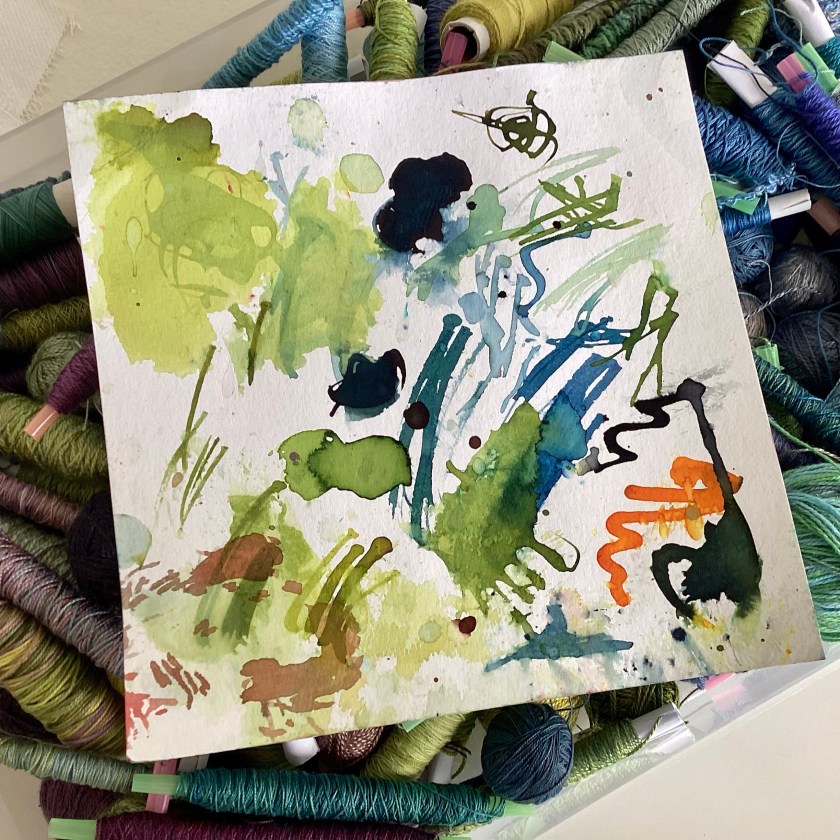
I really like the colour test card. Accidental abstract art in action, I’m calling it.

Dye splodge colour test

Back to sorting and labelling threads…

Skeins of silk and cotton thread

Painting thread

I did a little experiment yesterday. I imagine lots of people have done this before, but it’s the first time I’ve got round to trying fabric paint to colour thread. I used Jacquard dye-na-flow liquid colour, which behaves more like dye than paint, and applied it with a brush to create a space-dyed effect.

Silk and cotton threads coloured with fabric paints

I only used three colours – lemon yellow, turquoise, and purple – with a little black to ‘sadden’ rather than darken. I soaked the threads first in water and squeezed out the excess before painting. They dried outside on the washing line. Fabric paints generally need heat to set them, and I figured if you can iron fabric, which is basically woven thread, then you can also iron thread so I gave them a quick steam with the iron when they were dry. I think I’ve read somewhere that these paints will cure in the air as well if you leave them a few days.

Silk and cotton threads, space-dye effect with paint

I quite like the pastel/watercolour effect but maybe wouldn’t water the colours down so much every time. I wondered if painting the thread would change the hand, and it does, slightly – they are still soft, but maybe not quite as soft as they would be if I’d used dye. On the whole I think I prefer dyed thread, but I found there is slightly more control over the colour with paint. It will be interesting to see how colourfast and lightfast these threads turn out to be over time. I road-tested a bit on today’s stitch journal block:
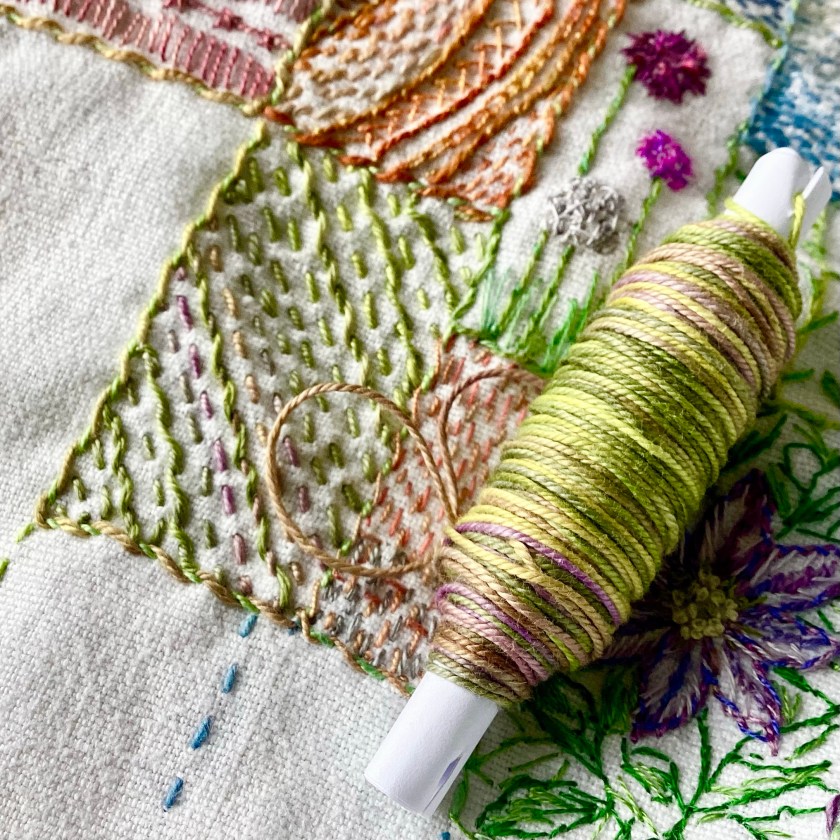
Stitch journal 29th May, hand-painted cotton crochet thread

Good to try new things, I think.

Colouring life

Difficult to concentrate on anything at the moment with all the conflict and trouble in Ukraine, so I rounded up everything that needed dyeing. It takes days to wind skeins of thread, dye fabric and thread, wash it, dry it, iron it, and unwind all the skeins, but it’s worth the effort.

Pile of newly-dyed fabrics and thread wound into little balls

Most of this is vintage linen/cotton, and the threads are mostly new and vintage crochet cottons. I find they work well as hand embroidery threads.

They look delicious don’t they? Like a box of chocolates

I prefer my threads wound into balls like this rather than wrapped onto thread cards. I don’t like the creases you get when you wind onto cardboard bobbins.

Difficult to get decent greens with procion but I’m happy with these

There is a lot of fabric here. There always seems to be more than I think there is, and it seems to last forever. This is a Good Thing. Some of it will find its way into the shop eventually.

Stitch doodling

It rained a lot today. I spent my lunch hour road-testing some of the threads while the frogs hopped around on the patio. I have plans for some new work, which I will start at some point. I still have a couple of ongoing things to finish first. I added this one to the shop this week:

Make a Wish

It was originally the sleeve of a coat that I was never going to finish but then it took on a life of its own. It seemed to find its own time, as these things do.