Thread

Three weeks of thread-dominated days, and I think we’re almost there.

Shop update waiting

I’m taking the afternoon off, and then I’ll update the shop some time later today (UK time). If you’re waiting for thread, keep checking in. The ‘coming soon’ boxes will disappear when the threads are live.

Just a few announcements, while we’re here:

(1) There was an alarming point in early January when I discovered that some of my silk and cotton thread suppliers were no longer trading. I’ve managed to connect with new suppliers in the meantime, but their thread is more expensive so I have had to make a small increase in my prices. I think the prices are still reasonable, given that each thread is unique. I don’t dye by recipe so everything turns out to be slightly different every time.

(2) I’ve found some commercially hand-dyed silk threads that I’ve added to the shop. These are the only threads there that are not dyed by me. I’ve used these threads myself and I like them, despite the many annoying knots that appeared in the hanks. They do come with a warning about their colourfastness – I have thoroughly washed and rinsed them all before winding into skeins, and some of them did lose a little colour (mainly anything with magenta or dark blue in it, including purples and dark greens) but they may still lose more colour if they’re washed again. If you need to wash your project, then test the threads first (actually that advice probably applies to all of my hand-dyed threads, none of which can be guaranteed colourfast). If you do need to wash the thread, then I would suggest cool water, minimal detergent and minimal agitation. Rinse well in cool water and blot the excess water onto a towel; don’t wring or squeeze, and definitely don’t tumble dry. If you’re not washing your project, then none of this matters. I rarely, if ever, wash embroidered work and have never had a problem with rogue colours staining the cloth. If you’re making something that will need frequent washing then I’d suggest using commercially dyed thread that does have a colourfast guarantee.

Silk perle 8 (not dyed by me)

(3) This time I have made available some undyed skeins, in case anyone wants to have a go at either dyeing their own thread or painting it. You can paint thread quite successfully with something like Jacquard Dye-na-Flow fabric paints – these are very liquid colours that behave more like dye than paint, and they don’t alter the hand (the softness) of the thread. There are lots of dyeing tutorials and instructions online, for fibre-reactive dyes and for botanical dyes. You can also use the undyed threads as they are, of course; white thread is always A Useful Thing.

new for 2024: undyed threads

Other than these new additions, there are the usual ranges of cotton and silk in various weights, plus a few thread collections.

Cotton thread mini collection
Thread taster sets
silk thread perle 8/12

Enjoy!

Double decker thread storage

It’s Wednesday, which is my afternoon off, and I took a break from thread winding/labelling to attend to some – well – thread. Bit of a busman’s holiday perhaps, but my own thread storage system has been underperforming for a while and I do like to see things nicely organised.

Here’s my current purples collection:

purple threads

They’re all together, which is fine, but they’re all in different formats. Some are on paper wraps, some are on bits of drinking straw, some are on reels and spools, and when you’ve rummaged around in the box a few times they get hopelessly jumbled and it’s not easy to find anything.

I had this idea to make stackable trays that would fit inside the plastic boxes (the box is about 6″ x 9″ and 2″ deep) so that the paper rolls would be better contained and stay in roughly a single layer.

A sheet of craft card, a glue stick, and some measuring, folding, and cutting, and it’s working pretty well.

The tabs fold onto the side edges, and then the sides fold down over the glued tabs.

patent easy tray, white craft card

And here’s how the reds/oranges/yellows box is looking:

double decker thread storage
stackable trays for thread

I do like it when an idea works. Wish me luck with the (much larger) box of browns, greys, and neutrals…

thread pile-up

Piecing

Not quite a square yard – it’s about 32″ x 34″, and all pieced together now. Some people think English paper piecing is too fiddly and takes too long, but I find it fairly quick and very enjoyable. I’m already thinking about a bigger, bed-sized version.

slightly blurry picture, but you get the idea

All the curves went together just fine, after I added the balance lines.

look at that lovely curve

The best part of English paper pieced patchwork is removing the tacking thread and papers, when all the piecing is complete. The cloth starts to relax, and you can see what you’re working with.

some of the tacking and papers removed

Much nicer to handle, and the colours seem to come alive more.

A few more to go, then I need to think about how to back it, line it, or quilt it. Haven’t decided where it’s going yet. There will probably be textured yarns couched along some of the boundaries and of course some stitch here and there. Maybe even some tiny sheep.

some tacking still in, some already out

Initially this was going to be a PDF pattern but I think it might be a bit too complicated for that. There is quite a lot of tweaking and easing, to get the curves to lie correctly and line up the balance marks, which is easier to do than to explain. Maybe a PDF for the intrepid.

And, incidentally, there is thread in the shop.

delicious

I anticipate that this may well be the last thread update before Christmas, as our house move may or may not happen before then. Everything is still very up-in-the-air at this point. Good job I have the patchwork to keep me grounded.

Thread

Dyeing this week, which means at least another week to ten days of sorting, winding, twisting, grouping, labelling, photographing, describing and listing. I no longer announce shop updates, but I’ll be quietly adding these into the shop in the next week or two, if all goes well.

hand-dyed threads fresh from the washing line

It’s a lot of work, and it takes a while to sort through. Just as well I enjoy every bit of it. There are some really pretty colours this time.

a rainbow of silk thread sets

Lucky me, I get to choose some of the leftovers – all the odd yards that aren’t needed for a full skein. Just right for a line of daily stitching.

thread ends, dyer’s perks

Apparently we have hot weather on the way here in the UK so I’ll be in a darkened room somewhere trying to stay cool. Enjoy your weekend if you like it hot 😎

On Work

Approaching the end of my first month as a self-employed artist, there is a lot to reflect on. Briefly, I don’t think I’ve ever worked so hard, and also I don’t think I’ve ever been happier. ‘Work’ means something different now. Primary goal for next month is to get better at managing my work/life balance, which is difficult when work and life have essentially become the same thing.

‘Work’ means this, among other things:

Thread dyeing in progress

It also means wearing a variety of different hats from one minute to the next. Some of the jobs I’ve done so far this month are Sales Manager, Marketing Manager, Accountant, Goods Inwards Manager, Customer Service Manager, International Relations Manager, Tech Support Assistant, Logistics Manager, teacher, photographer, copy writer, proof reader, film director, video editor, sound engineer, dyer, content creator, and researcher. Haven’t had time to do any actual art yet.

But it’s a glorious feeling to wake up every morning filled with excitement for the working day ahead.

There will be thread in the shop soon (ish) – when I can get all of these skeins wound and sorted:

Textured threads
Cotton threads (they’re not all green!)

Here’s my Heath Robinson style skein twister. It’s a tiny hand drill I used to use years ago when I made miniatures, with a bent paper clip where the drill bit should be. The board is thick foam with a pencil stuck in it, clamped to a stool so it doesn’t move. I should probably patent it.

Unpatented Heath Robinson skein winder

I think some of the Teachable teething problems have been resolved now, and so far people seem to be enjoying the online course – I’ve been assured by several students that it isn’t only for beginners, which makes me very happy.

I’ll let you know when threads are available – it will take as long as it takes, but probably (I hope) some time this week. The shop will be temporarily closed while I list the threads, but it should only be down for a day or two. I aim to have threads in the shop every month from now on, if I can. The first batch will be UK post only, just until Royal Mail gets through the backlog of delays caused by strike action in December and the cyber attack earlier this month. From next month I hope to return to international shipping.

And on that note, it’s back to work for me.

Tangled threads

From this:

Tangled threads

To this:

Threads neatly wound onto paper spools

I call that a successful few days’ work.

On storing thread

A few people have asked about how I store my embroidery threads, so I thought a brief tour of my collection might be helpful.

I use a wide variety of threads, from very chunky cotton yarns (mostly for couching) to very fine silks, and pretty much everything in between. I will write a post some time about the various weights of thread that you can get and what you can use them for. For now I’m focusing on how to organise thread. This jumble of blue threads doesn’t look very organised, I know. I guess all things are relative.

Blue threads

When I dye threads, I dye them in skeins. They look really pretty in skeins, but I find them difficult to use like that because they very soon get horribly tangled, especially if you keep them all in the same box. I find the only way I can make them useable is to wind them somehow. I went through a phase a while ago of winding threads from skeins into little balls, but these also get tangled quite quickly.

Skeins of thread

I used to use sections of plastic drinking straw for winding threads from skeins after dyeing, which works quite well if you cut a little snip in the ends to anchor the thread before you start winding. The straws were left over from the olden days before we knew how damaging they are, and I figured it was better to use (and re-use) them than to let them end up in landfill.

Drinking straw bobbins

Some of my threads are still on straws, but these days I tend to use little squares of regular 80gsm copy paper, about 3” square, and roll them up.

Squares of copy paper ready to roll

Again you need to snip the end of the paper tube so that the thread has somewhere to anchor itself to stop it unravelling. I find you don’t need to glue the roll of paper; the thread keeps it rolled quite securely.

Purples. That horribly tangled black thing (top left) is coton a broder and needs winding

I find it quite therapeutic to wind threads from skeins onto tubes, but it can take a long time depending on how fine the thread is.

Green threads. Some of these are commercial threads; most are hand-dyed cotton and silk

The only time I use the commercial card bobbins (the kind that you can buy from embroidery shops) is for winding DMC stranded embroidery floss. I don’t like these card bobbins much because when you get to the end of the skein the thread ends up with permanent creases from being wrapped round the flat edges of card. I find there is no other sensible way of storing these though – I can’t see colours clearly enough with them piled up in skeins, and you need to label them in case you need to buy that particular colour again.

DMC stranded embroidery thread

So there’s a little tour through my threads. I know lots of people who use sticks and twigs, and the old-fashioned wooden clothes pegs, to store thread. They look lovely, but I imagine would be bulky in large numbers. So – how do you store your threads? Let me know if you have any good tips.

To dye for

I had a few days off from the day job this week so at last had time to dye some fabric and thread. This has been on the to-do list for months.

Smorgasbord

Some for me, and some for you, eventually. There will be a shop update when I can get round to sorting these into groups.

Delicious!

While I was waiting for everything to dry, I made a cover for the little notebook I use for dye notes. I made the book many years ago, when I first started having a go at dyeing. I don’t record everything in it, as most of my dyeing is quite intuitive so colours are often not repeatable. There are other dyers out there producing set lines but I prefer the more individual approach.

Colour notes from 2007, handmade notebook A6 size
A6 notebook cover, fabric from Hipposinhats
Hand-dyed silk and cotton threads in action

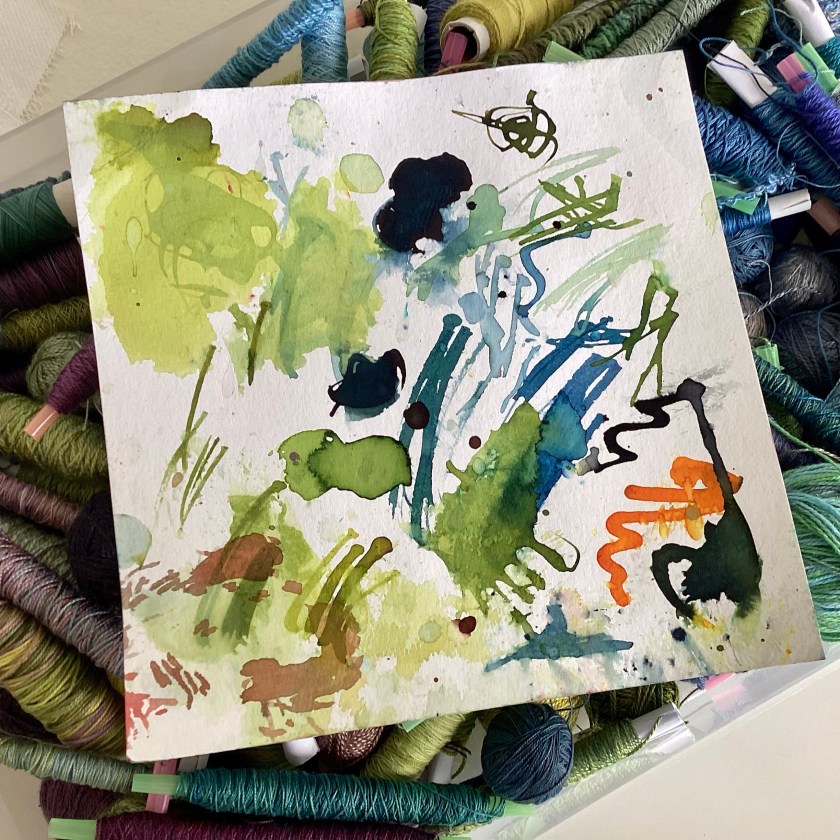
I really like the colour test card. Accidental abstract art in action, I’m calling it.

Dye splodge colour test

Back to sorting and labelling threads…

Skeins of silk and cotton thread

Colouring life

Difficult to concentrate on anything at the moment with all the conflict and trouble in Ukraine, so I rounded up everything that needed dyeing. It takes days to wind skeins of thread, dye fabric and thread, wash it, dry it, iron it, and unwind all the skeins, but it’s worth the effort.

Pile of newly-dyed fabrics and thread wound into little balls

Most of this is vintage linen/cotton, and the threads are mostly new and vintage crochet cottons. I find they work well as hand embroidery threads.

They look delicious don’t they? Like a box of chocolates

I prefer my threads wound into balls like this rather than wrapped onto thread cards. I don’t like the creases you get when you wind onto cardboard bobbins.

Difficult to get decent greens with procion but I’m happy with these

There is a lot of fabric here. There always seems to be more than I think there is, and it seems to last forever. This is a Good Thing. Some of it will find its way into the shop eventually.

Stitch doodling

It rained a lot today. I spent my lunch hour road-testing some of the threads while the frogs hopped around on the patio. I have plans for some new work, which I will start at some point. I still have a couple of ongoing things to finish first. I added this one to the shop this week:

Make a Wish

It was originally the sleeve of a coat that I was never going to finish but then it took on a life of its own. It seemed to find its own time, as these things do.

Niddy noddy

Niddy noddy is such a ridiculous word. I prefer to call it a skein winder. I used to have a lovely wooden one but it was very bulky and took up a lot of storage space. I’ve recently found a lightweight one here that comes apart and can be stored flat.

silk PLA niddy noddy from DorIdeas.co.uk

I’m not on commission, by the way, I’m just really impressed by the design and how easy it is to use – one wrap equals one yard, so it’s easy to measure skeins of thread for dyeing. I usually improvise this part of the process, winding skeins around the back of a chair etc, but I may decide to try selling some hand-dyed threads and in that case I will need to know the yardage of the skein.

silk PLA niddy noddy with textured yarns

I have more textured yarn than I need. These are good for couching onto experimental embroidery or contemporary art quilts. Sometimes I crochet a chain with these yarns and then couch that to a surface if I want a more chunky appearance.

selection of textured yarns in 10 yard mini-skeins

I will get round to doing a shop update at some point, just to see if there is any demand for a mixed pack of textured mini-skeins in these lovely woodsy muted colours. A little of these goes a long way, I find.

yarns and threads for winding

I also need to find time to dye some more embroidery threads. I often use crochet cotton as a substitute for perle threads as they are usually slightly more matt than perle and a bit smoother, which I prefer. My mother’s old knitting basket is the current repository for threads and yarns that need winding into skeins. It’s older than I am and has faded from red to pink, but it’s still going strong. It was always full of knitting in progress when I was a child and it’s good to see it still in service. I think these things remember what they were made for and like to stay useful.