Scraps

Birdie and I are in our happy place today.

fabric scraps, threads and birdie pincushion

I got ever so slightly sidetracked from what I started last week. I had to interrupt proceedings to deal with the scraps box, which was overflowing (and I forgot, in my distraction, to obtain photographic evidence of said abundance, but I know you’ve all seen an overflowing scraps box before, and I bet most of you have one of your own). I need the scraps box for something else right now, and that was a whole other sidetracking experience, cutting out lots and lots of paper piecing scraps. The scraps box is now temporarily a patchwork-pieces box, holding it all together.

temporary change of function for the scraps box

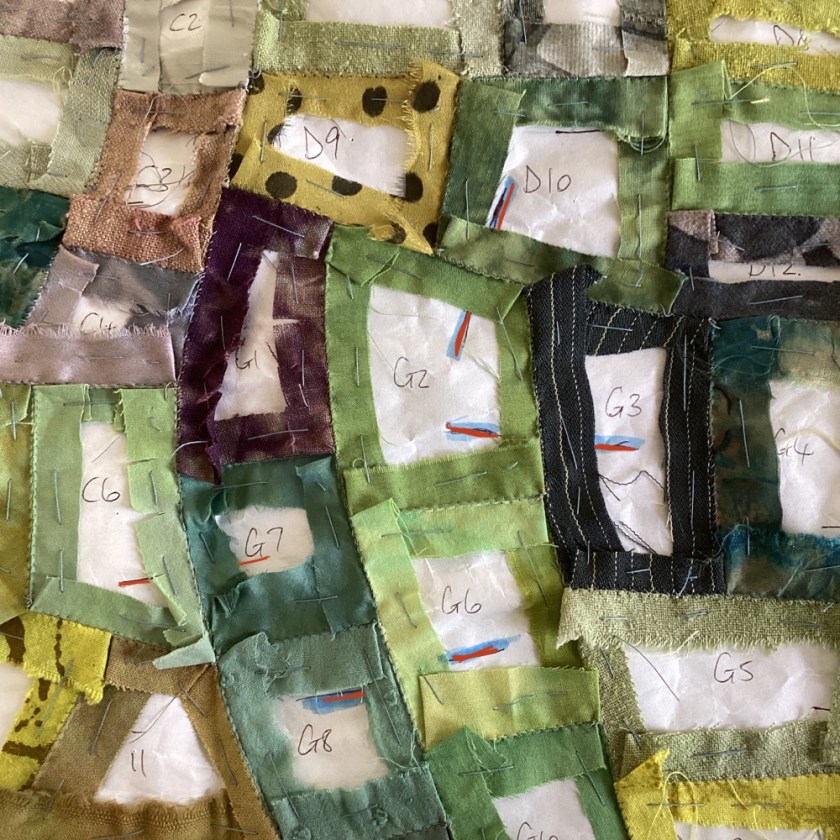
I sorted the scraps pile into lots of smaller collages where every tiny fragment will have its place.

delicious fabric scraps

I’ve also rounded up some very tiny/narrow strips and offcuts – selvedges, hems, seams, rolled hems from chiffon scarves etc) – all of which can – and will – be used.

can we use them? Yes we can

The tiny strips can be stitched across the collaged pieces quite effectively:

layered scraps and narrow strips

There are a few little collages so far; these are about 4 or 5″ square:

collaged scraps

I’m thinking of them as spots of time, a la Wordsworth (yes, Wordsworth again – no better poet, in my view, for exploring themes of experience, loss, and memory). In his long poem The Prelude, Wordsworth describes spots of time as moments that become profound memories with the capacity to rejuvenate and repair. I think most of the square collages might become round eventually:

collaged fabrics under a circular viewfinder

This one I think might just be complete as it is:

layered scraps, very simply stitched, about 5″ square

A square spot of time perhaps. I guess memories come in all shapes and sizes.

Spare a thought for poor birdie, though. I will be dismantling his nest.

Nesting birdie

Immersion

This piece takes its title from Wordsworth’s 1804 poem ‘Ode on the Intimations of Immortality’:

‘Strength in what remains’, 15″ square

It hasn’t photographed well on this very dark wet Wednesday; the colours and layers are a little more subtle in real life.

Strength in what remains, details

The text fabric (above, top left) is a handwritten page from a nineteenth-century almanac that I scanned and printed onto tea-dyed cotton. If you iron fabric to a piece of freezer paper that exactly fits your printer (usually A4 in the UK), it’s surprisingly straightforward. I expected it to get snarled up and jammed in the bowels of the printer but it sailed through quite smoothly. I used to print on fabric quite often and had forgotten how effective it can be. If you set it with a hot (ish) iron after printing it appears to be reasonably water resistant, though I haven’t yet tried washing it.

Strength in what remains, detail of hand stitch and layered sheers

There are a couple more like this in progress, an ‘Intimations of Immortality’ mini-series, perhaps.

‘Something that is gone’ in progress

There’s also a heap of loveliness on the table that will be turned into something a little larger…

fabric and thread waiting for action

…related to more sketchbook exploration:

big plans

I am definitely busy.

Piecing

Not quite a square yard – it’s about 32″ x 34″, and all pieced together now. Some people think English paper piecing is too fiddly and takes too long, but I find it fairly quick and very enjoyable. I’m already thinking about a bigger, bed-sized version.

slightly blurry picture, but you get the idea

All the curves went together just fine, after I added the balance lines.

look at that lovely curve

The best part of English paper pieced patchwork is removing the tacking thread and papers, when all the piecing is complete. The cloth starts to relax, and you can see what you’re working with.

some of the tacking and papers removed

Much nicer to handle, and the colours seem to come alive more.

A few more to go, then I need to think about how to back it, line it, or quilt it. Haven’t decided where it’s going yet. There will probably be textured yarns couched along some of the boundaries and of course some stitch here and there. Maybe even some tiny sheep.

some tacking still in, some already out

Initially this was going to be a PDF pattern but I think it might be a bit too complicated for that. There is quite a lot of tweaking and easing, to get the curves to lie correctly and line up the balance marks, which is easier to do than to explain. Maybe a PDF for the intrepid.

And, incidentally, there is thread in the shop.

delicious

I anticipate that this may well be the last thread update before Christmas, as our house move may or may not happen before then. Everything is still very up-in-the-air at this point. Good job I have the patchwork to keep me grounded.

Balancing curves

You might recall the patchwork I started last month, using my proposed 2024 stitch journal template to piece together an aerial map of fields:

false start

I got so far with it and then hit a slight problem: having pieced two A4 sized blocks together, it became clear that none of the next A4 blocks were going to fit properly. My mistake entirely – a couple of mistakes, actually, and schoolboy errors at that. I had failed to read the plan before stitching, so mis-aligned the outer edges, and I hadn’t marked balance lines on the template for accurately joining the curves.

It was less work to start again than to unpick, so I’ll use my false start as a practice piece and then will probably turn it into a sketchbook cover, so nothing is wasted.

So for attempt no. 2, I added balance lines to the template.

balance lines (in red) for piecing curves

Piecing curves is tricksy and has to be accurate, particularly when a lot of separate pieces are involved. You can see how this works:

balance lines in action (in blue/red)

It’s just an extra insurance for making sure everything is going to fit correctly later on. If the balance marks don’t join up on either side of the seam, then you know you’ve gone a bit wrong.

curves fitting nicely

The second thing I’ve done differently this time is piece the thing in irregular sections rather than A4-sized blocks, and it seems to be working better.

sections completed

I’ll wait until each section is finished before joining them all together.

fitted but not joined

It’s probably about half done, and is continuing to come together quite nicely. At this stage it’s still very portable so is an easy and relaxing thing to work on in the evenings.

box of tricks

I only roughly planned the colours (as in all of the M section will be greens and golds, the A section was greys and browns etc) so it’s a nice surprise to find out what ends up sitting next to each other. Keeps it interesting. And I always think patchwork is a kind of piecing together of life’s problems too, and finding a solution in the whole. Art, stitch and therapy all at the same time. What’s not to like?

Making connections

I’ve been having a go at designing next year’s stitch journal template. A bit early to be thinking about that, I know, but the way this year is speeding by I thought it best to make a start.

It will be slightly different from the last two years, in that next year’s daily stitching will be a big square (ish) rather than a long strip. I’ve designed it across twelve pieces of A4 paper that all have to fit together to make the whole thing, so it’s a reasonably complex task that is still very much in progress. I’m imagining that it’s a map of the coming year, in the form of an aerial view of fields.

I *think* it will work. I have yet to print it, to try cutting and re-assembling the separate pieces for myself, but once I’ve done that I’ll aim to make the template available before the end of the year.

As I was looking at all twelve pages glued together to make the 36″ square, I found myself imagining how it would look in fabric as patchwork.

These things often start out as idle wonderings but sometimes they gather momentum while you’re looking the other way and before you know it, you’re cutting out tiny bits of green fabric and the thing has begun.

patchwork shapes

The thing about English paper piecing (piecing fabric over paper) is that you can do it with any tessellating shapes, however irregular they might be, and I had a whole tableful of tessellating shapes waiting to be something.

I took a photo of the master template and added colour on Procreate, a digital drawing app. I envisage this as fields through the seasons, so the outer edges will be greys and browns, while the central area will be more vibrant greens and golds. That’s the plan so far, but the best thing to know about plans is that they can change completely at any moment.

patchwork in progress

I used to do a lot of patchwork, and it’s still one of my favourite things. I love the way it holds the connections between fabrics, time, and memory. I can identify every fabric here as the old friend each of them is – some from clothes that wore out; some from an old bed sheet that became a dust sheet and was later torn up and dyed; some vintage fabrics, found and dyed.

birdie is slightly startled by the sudden change of plan
progress so far, about one-sixth of the whole

What started out as a map for next year has gone sideways into a whole new adventure.

It will still be a stitch journal template as well, but what fun to make two different things out of the same design.

Busy

When I left the day job eight months ago, I thought I’d have loads more time to create. Hooray, I thought, at last I get to be a full-time artist. All that extra time for stitching and drawing and designing and sketchbook work…

The reality isn’t quite as I expected. I have a lot of tasks to complete, sometimes simultaneously, before I can get anywhere near anything I want to do for myself. This definitely isn’t a complaint. I love being my own boss, and I love the freedom that gives me. I also enjoy working, and I like to be busy.

It’s a good job because at the moment there is So. Much. To. Do.

There is a little heap of fabric scraps to sort into packs for the shop:

fabric scraps old and new, ready for making into packs

There is another pile of fabric scraps for my Stitch a Little Landscape course, waiting to be made into packs (and thank you everyone who’s purchased one, I hope you’re making beautiful landscapes with them)

Stitch a Little Landscape fabrics

There’s another pile of undyed fabrics for painting, also for the online course, also for making into packs:

luscious textures

And then there’s the thread mountain. Newly-dyed threads that need sorting, photographing and listing:

cotton and silk hand-dyed threads – some lovely colours this time

And thread taster sets, which take days to assemble:

thread taster packs coming soon

Everything takes twice as long as I think it will – I am optimistic by nature – but all of it is more pleasure than work. And dyeing is a kind of artistry too, I guess. So is curating fabrics and threads, and also creating any kind of online course. Interesting how the universe interprets and delivers your dreams into reality. It’s better than anything I could have anticipated.

I will take a break when all of this is done. But in the meantime, thank you for keeping me busy.

Just looking

The definition of good morning: a cup of hot black coffee, a cloth in progress, and a little collection of fabrics ready for their auditions.

Traveller’s blanket in progress

These are non-competitive auditions because they will all win in the end. I really like just looking at fabrics – although it’s never just looking, is it, because I have to pick them all up and touch them as well. It’s just seeing with hands, I suppose.

Fabrics that say Winter

The Traveller’s Blanket is turning into a short story collection. I’ve found it quite challenging to adopt someone else’s technique while making it look like my own work. Dijanne makes these cloths so beautifully and I didn’t want to produce an imitation. I imagine it’s a bit like doing a cover version of a very well-known song.

It’s a good opportunity to include some treasure, like this silk velvet, eco-dyed by Arlee

Eco-dyed silk velvet with couched silk bourette yarn on tea-dyed silk noil

And this beautiful eco-print from Jane Hunter

Fine silk, eco-printed, with hand stitch.
No straight/square edges happening here.

And then a few vignettes are happening here and there:

Traveller’s blanket, centre. Antique fine lawn cutwork embroidered panel
Hand-dyed vintage cutwork, more eco-prints by Jane Hunter

Now that a few fabrics have been applied, the cloth is stable enough to work on without support from the table. Eventually there will be some kind of quilting or seeding in between the motifs, but I think that point is still some way off. In the meantime it can carry on keeping my knees warm while I stitch in the evenings.

Traveller’s blanket

I’ve finally made a start on my traveller’s blanket for the last ever class with Dijanne Cevaal. It took a while to think about the right foundation for this quilt, and in the end I decided on a piece of tea-dyed silk noil. Soft but textured, lightweight but warm. The back is hand-dyed silk noil, and the middle layer is brushed cotton (also known as cotton flannel).

A slight stumbling block in the thinking process for this quilt has been that traditionally these quilts have been all about travel and recording experiences, and I’m probably the world’s worst traveller. I’ve never ventured beyond the UK, never been on an aeroplane, and have never had a passport. I don’t even drive. I get seasick just watching boats on TV. What could I possibly have to say about travel?

And then I thought of course we’re all travelling constantly – through time, through life, through experiences. And so my blanket has ended up being about a journey through winter, my favourite season, which will be with us very soon. I’m thinking greys, dark blues, sludgy/grey greens, browns, whites.

I’m starting in the centre with this beautiful piece of antique embroidered cutwork, a mystery object. Does anyone know what this would have been, originally? It seems to be a discrete piece, and doesn’t look as if it’s ever been part of anything else – at first I thought cuff, but it’s not long enough, and there is no evidence of unpicked seams. It’s about 2.25” x 6”. Dressing table mat? Answers on a postcard please.

The beginning. A very pretty start.

I’m using a few fabrics expertly eco-printed by Jane Hunter together with some vintage and antique pieces that I’ve been saving for something special.

Collecting treasures – eco-printed silks by Jane Hunter, fragments from an antique silk christening dress, various vintage cottons and scraps

And in the blue and grey corner:

More eco-prints, new and old silk and cotton

This is going to be really enjoyable, I think.

Laying out and looking

To dye for

I had a few days off from the day job this week so at last had time to dye some fabric and thread. This has been on the to-do list for months.

Smorgasbord

Some for me, and some for you, eventually. There will be a shop update when I can get round to sorting these into groups.

Delicious!

While I was waiting for everything to dry, I made a cover for the little notebook I use for dye notes. I made the book many years ago, when I first started having a go at dyeing. I don’t record everything in it, as most of my dyeing is quite intuitive so colours are often not repeatable. There are other dyers out there producing set lines but I prefer the more individual approach.

Colour notes from 2007, handmade notebook A6 size
A6 notebook cover, fabric from Hipposinhats
Hand-dyed silk and cotton threads in action

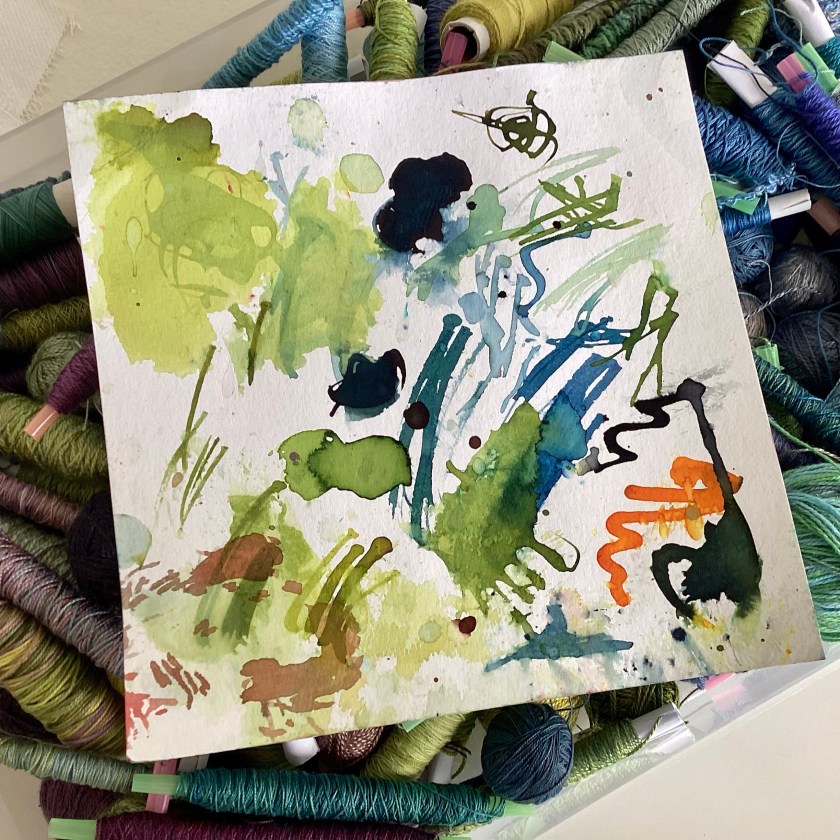
I really like the colour test card. Accidental abstract art in action, I’m calling it.

Dye splodge colour test

Back to sorting and labelling threads…

Skeins of silk and cotton thread

Hearts

The Covid Chronicle, founded by Wendy Bliss, is a community textile art installation, currently touring in the UK. It comprises about 140 panels worked in a range of textile art techniques and records contributors’ experiences of the pandemic since the first UK lockdown. You can see the work here from today until 19th June, and from July it will be on display at Riverside Studios, near Hammersmith Bridge.

The Hammersmith venue has a huge window space that isn’t suitable for the textile art because it gets too much light, so contributors have been invited to make hearts that can be displayed there a bit like the Wall of Hearts.

I already had a couple of patchwork hearts lying around in a drawer so it was quite easy to put these together.

Patchwork heart on layered background 9” x 12”

I really like layered sheers. I like the way they reveal as well as conceal, the way they cover the background but you can still see through them if you look closely. And of course we are all like that too. Very few people get to see through all our layers.

Layered linens, silk organza and silk chiffon

The other two are slightly smaller, about 6” x 8”, and are made with eco-dyed fabrics from Jane Hunter.

Pair of hearts made from linen, cotton and wool

The white heart is just strips of cotton fabrics pieced together into a heart shape, with some decorative stitching over the seams.

Strip of silk chiffon covering the edge

I really like the scrap of eco-dyed felted wool – it’s quite thick and substantial, I’m guessing from an old wool blanket, and perfect for this. It always amazes me how these orphans and scraps find their home eventually.

Eco-dyed wool with vintage cotton lace and little seed stitches

These will be travelling to Wendy very soon, and if you’re in London in July maybe you could go and visit.