US update (and happier things)

Thank you so much to my wonderful US customers for your recent orders; parcels are winging their way to you and hopefully – keeping all fingers and toes crossed – they should arrive in the US before August 29th. The Royal Mail target for international tracked mail is 5-7 working days, so we should be ok unless there’s some kind of international air disaster, but let’s try not to think about that.

I had intended to suspend all further US orders from Wednesday, but I’ve decided to bring that forward to today. The dates are causing me too much anxiety, and all I can think about is what if international post gets delayed and you all get hit with an $80 charge. It’s unlikely, but I’d prefer to play this as safe as I can, so today is my last day for posting to you. I’m sorry if you’ve missed out; do contact me if you have any questions.

In the meantime, US customers can still support me by taking my online classes – the White House machine isn’t tariffing digital products (yet!)

On to happier things. When I can, I’m continuing to work on this long cloth, Tabula Rasa.

Tabula Rasa, in progress

It’s about 6″ wide and several feet long. Part autobiography, part therapy, part self portrait. Lots of sheer and semi-sheer layers, with stitching beneath and on top of the surface.

Tabula Rasa, in progress

It’s rare for me to make something I like, or something I feel proud of, but this is it, happening right here. It’s a joyous feeling.

Tabula Rasa, in progress

It’s also rare for me to use a limited colour palette in such a sustained way, but I’m finding that I like that too.

Tabula Rasa, in progress

Progress is slow, because there are Many Other Things I need to attend to right now (more on that later) (and it’s nowhere near as exciting or intriguing as I’m making it sound!) But a few quiet moments on this cloth in between the general busyness is proving to be very calming and grounding.

I’m so sad to be losing my lovely US community. I hope the day we can reconnect through tangible thread is not too far away.

Scraps

This week I’m in the scraps box as I start compiling my new forthcoming course on making stitched samples for sketchbooks. New courses take a while to create, but I do enjoy making them.

fabric scraps

However much I take out of the scraps box, it never seems to get any emptier. It always reminds me of the fairy tale about a magic porridge pot that keeps refilling itself. Not complaining, but I do wonder where they all keep coming from.

I like to use lots of layers in my stitched samples. I think of them as transparent layers of time.

stitched samples in progress

The one below is made from scraps of antique and modern lace covered with two layers of very fine tulle, with some textured cotton yarns couched onto the surface.

whites

I’ve also been painting some lovely patterned tulles:

painted tulle

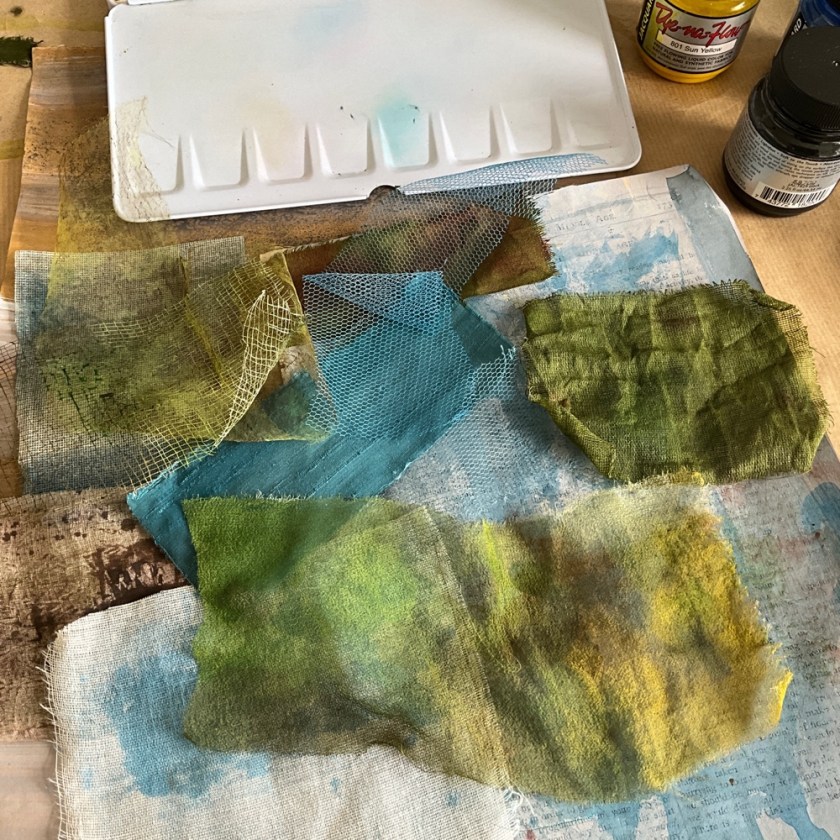
Fibre reactive dyes won’t work on synthetics, but fabric paints do. I use Jacquard Dye-Na-Flow, which are very liquid and behave more like dye than paint. My Stitch a Little Landscape course has a section on painting fabrics this way. You could even use standard watercolours, if you don’t need them to be washable.

At some point it will all come together nicely.

layered stitched scraps ready to become something useful

Scraps

Birdie and I are in our happy place today.
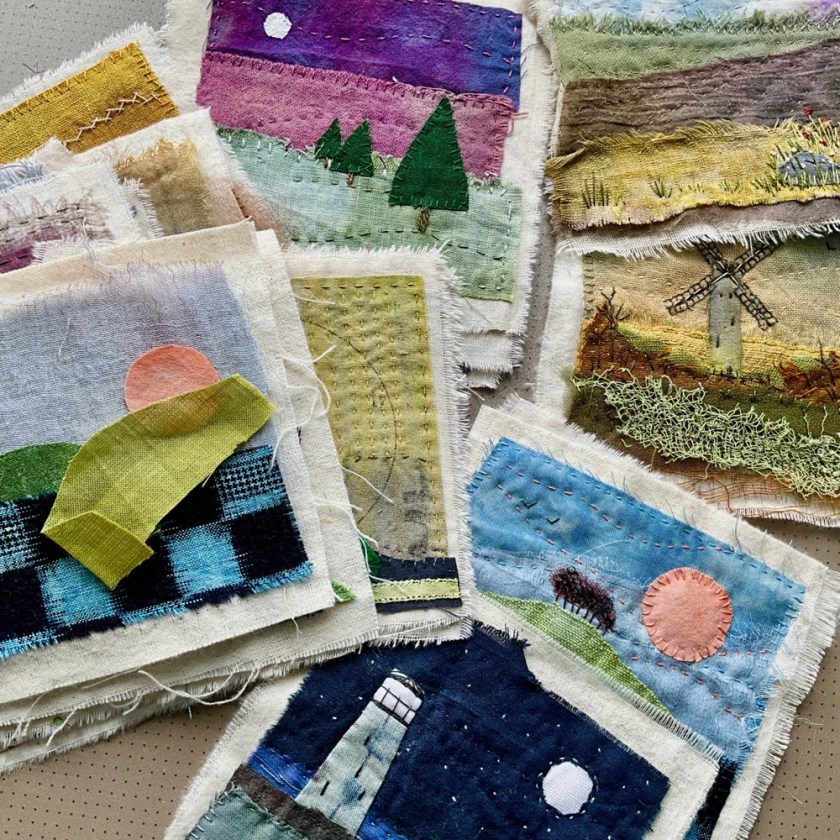
fabric scraps, threads and birdie pincushion

I got ever so slightly sidetracked from what I started last week. I had to interrupt proceedings to deal with the scraps box, which was overflowing (and I forgot, in my distraction, to obtain photographic evidence of said abundance, but I know you’ve all seen an overflowing scraps box before, and I bet most of you have one of your own). I need the scraps box for something else right now, and that was a whole other sidetracking experience, cutting out lots and lots of paper piecing scraps. The scraps box is now temporarily a patchwork-pieces box, holding it all together.

temporary change of function for the scraps box

I sorted the scraps pile into lots of smaller collages where every tiny fragment will have its place.

delicious fabric scraps

I’ve also rounded up some very tiny/narrow strips and offcuts – selvedges, hems, seams, rolled hems from chiffon scarves etc) – all of which can – and will – be used.

can we use them? Yes we can

The tiny strips can be stitched across the collaged pieces quite effectively:

layered scraps and narrow strips

There are a few little collages so far; these are about 4 or 5″ square:

collaged scraps

I’m thinking of them as spots of time, a la Wordsworth (yes, Wordsworth again – no better poet, in my view, for exploring themes of experience, loss, and memory). In his long poem The Prelude, Wordsworth describes spots of time as moments that become profound memories with the capacity to rejuvenate and repair. I think most of the square collages might become round eventually:

collaged fabrics under a circular viewfinder

This one I think might just be complete as it is:

layered scraps, very simply stitched, about 5″ square

A square spot of time perhaps. I guess memories come in all shapes and sizes.

Spare a thought for poor birdie, though. I will be dismantling his nest.

Nesting birdie

Immersion

This piece takes its title from Wordsworth’s 1804 poem ‘Ode on the Intimations of Immortality’:

‘Strength in what remains’, 15″ square

It hasn’t photographed well on this very dark wet Wednesday; the colours and layers are a little more subtle in real life.

Strength in what remains, details

The text fabric (above, top left) is a handwritten page from a nineteenth-century almanac that I scanned and printed onto tea-dyed cotton. If you iron fabric to a piece of freezer paper that exactly fits your printer (usually A4 in the UK), it’s surprisingly straightforward. I expected it to get snarled up and jammed in the bowels of the printer but it sailed through quite smoothly. I used to print on fabric quite often and had forgotten how effective it can be. If you set it with a hot (ish) iron after printing it appears to be reasonably water resistant, though I haven’t yet tried washing it.

Strength in what remains, detail of hand stitch and layered sheers

There are a couple more like this in progress, an ‘Intimations of Immortality’ mini-series, perhaps.

‘Something that is gone’ in progress

There’s also a heap of loveliness on the table that will be turned into something a little larger…

fabric and thread waiting for action

…related to more sketchbook exploration:

big plans

I am definitely busy.

Aprons one and two

My plain white linen/cotton apron is now structurally complete, sewn entirely by hand, and I’m very happy with it:

Janet Clare artisan apron

The top stitching took a while but it looks OK I think:

top stitching by hand

Difficult to get a sense of scale from the photo but the stitches are just under 1/8th of an inch. I’ll be working some kind of embroidery on it when it knows what it wants to be, so the top stitching will be less obvious when there’s some decoration in place. It’s definitely a blank canvas at the moment.

I’m very impressed by the pattern and the way the pieces fit together so perfectly. The fit is pretty true to size too. I’m a UK size 8-10 and I made the Small, which fits really well. I trimmed about half an inch from the centre front as my shoulders are quite narrow, and I made it a tiny bit longer.

The second apron (same pattern) is now under construction, pieced fairly randomly from hand-dyed cotton and linen fabrics.

Apron 2

I’ve used a couple of hand-printed fabrics on the front; this one was from Hippos in Hats on Etsy and I’ve been saving it for just such an occasion as this:

printed fabric from Hippos in Hats

…and with the hand stitched outline completed (it’s just straight stitch with cotton thread over the printed outline):

stitching over hand print

I’ve also used a couple of eco-prints from Jane Hunter, to which I’ve added a bit of very simple embroidery with colonial knots and straight stitch:

simple stitching over eco-print

As before, I’m stitching all the seams by hand:

side seam showing notches for pocket placement

The lining for this one is very lightweight calico which I dyed a while ago. I wasn’t keen on the way the grey/red turned out, but it will do just fine as a lining. There wasn’t quite enough so I’ve added pieces of the same fabric in turquoise/brown:

lightweight calico lining, hand dyed with Procion

I accidentally dropped this earthy orange scrap onto the apron after stitching the front and sides together. I really like the splash of colour against that green and magenta/purple, so I’ll find a way to add it somewhere.

that orange though!

Looking forward to seeing this one done.

New online course

It’s been a hectic few weeks, and another very steep learning curve, but my new online course is out now. All lessons are pre-recorded, so you can learn in your own time and at your own pace, and you get lifetime access once you’ve enrolled. You can watch the introductory video and read the notes for free.

In this course you learn how to paint your own fabrics – I show you some basic techniques and then away you go:

Painting fabric scraps with Dye-Na-Flow fabric paints

You learn to plan and develop your ideas in a sketchbook using some easy drawing, painting and collage techniques:

Sketchbook pages using drawing, painting and collage techniques

And you learn to layer and stitch fabrics to a foundation to create a unique little landscape. I show you how to stitch distant trees and hedges, how to add a sense of perspective to your picture plane, how to add buildings, structures, fences, and paths, and finally how to add foreground details using some simple hand embroidery stitches:

Little landscapes and how to make them into cards

The videos are very informal and are intended to look as if you’re in the room with me. Occasionally I dither about whether to move a scrap of fabric or paper up or down by a few millimetres, but feel free to fast-forward through the less engaging bits – and my video-editing skills are minimal, as you will see. However, I think it’s probably as good as it’s going to get, and I think it’s good enough for you to learn the skills I’m setting out to share.

I think there’s somewhere over three hours of video in total, and each lesson has written notes beneath the video section, so you’ll need to scroll down each lesson to see all the information. There aren’t any subtitles for this course, but the written notes and the video together should be enough for you to understand what to do.

I’ve also made up some little fabric packs in the shop here (undyed fabrics for you to paint yourself) and here (hand-dyed sheer, semi-sheer, and textured fabric scraps for layering).

Stitch a Little Landscape fabric scraps collection

I think the customary way to introduce a new thing like this is for me to say something like, ‘I’m super-excited to share details of my new online course…’

The reality is that middle-aged British people rarely get super-excited about anything, and frankly it feels terrifying, rather than exciting, to put this much of myself out there. But – well – feeling the fear and doing it anyway. Every day a new adventure, and every day a little braver.

Painting the land

Recently I rediscovered some work from a couple of years ago, from the pre-blog 100 Days of Winter series (all the pictures are buried on Instagram if you can be bothered to go back that far. 2019/20 I think it was). I sold some, gave some away, and still have a few left, which I’ve started reworking.

Work old and new, 4” square

I’m in the process of writing/creating an online course showing how to make these, and spent an engaging hour or so this morning experimenting with colouring some fabric scraps.

Painting some scraps

I’ve used watercolour, acrylic ink, and Dye-na-Flow fabric paints. An additional extra was accidentally creating some collage paper by using painted paper as a drop sheet.

Drop sheet collage paper
Blues and greens, land and sky
Sketchbook page with scraps

Still thinking it through. Learning all the time.

Letting go

My social media break so far is very productive. I have more time and rather more energy already. I’ve been able to take a little step back and review some past work, which I’ve listed in my shop here.

I had a few 4″ textile collages left over from my 100 days of winter venture a couple of years ago, which I’ve turned into square greetings cards.

textile art cards

I’ve also uncovered some work from 2020-21, one of which is called Letting Go. I don’t have any particular attachment to my completed work, since most of the enjoyment is in the making of it. Also I don’t have much storage space and I will very quickly run out of room if I hang on to too much. I prefer to let the cloths fly out into the world and find themselves a new home; it feels as if that keeps the energy moving.

older works now available

And the rest of this week will be painting. Alas, this kind of painting:

not the kind of painting I really want to be doing, but necessary

Past Present

Today I’m calling it finished.

Past Present, hand stitched long cloth, 6.25” x 42”

Fragments of antique cotton, silk, and lace, hand-stitched to tea-dyed vintage linen and cotton.

Vintage embroidered monogram with vintage mother of pearl buttons

It only named itself this afternoon. The past is always present. We carry it with us wherever we go. I guess that’s what memory is.

Fragments from vintage silk clothing, with hand-stitched buttonholes

And these fragments from the past are still present too. Clothing and accessories made by hands long dead and yet still here. Their voices still speak to us, and the sheer beauty of their work still moves us.

Eighteenth-century silk and nineteenth-century cutwork

The fragment of MJ’s monogrammed chemise became a pocket for some vintage needles.

Lace and silk, with Flora MacDonald needles

New stitches on old cloth, layering new memories over old ones

Past Present lower section: silk and lace

It hangs from some tea-dyed silk ribbon, which may or may not be strong enough – the cloth is heavier than it looks.

Stitched marks, with tea-dyed broderie anglaise from a nineteenth-century cotton petticoat

A short view of the other side:

Past Present

There are lots of frayed and ragged edges. Time made visible. The marks made by a quilter’s needle are still visible in this fragile cotton:

Fragile fragments of cotton from a Victorian quilt, with original quilting path still visible

It’s like making time stand still.

Spring Days

I made a start on translating some of my recent watercolour doodles into stitch.

Spring Days in progress

I’ve applied some tiny fragments (mostly about an inch or two) of hand-dyed silk, cotton, and linen to a strip of hand-woven (not by me!) cotton cloth, stitched them down around the edges, and then embroidered each one to illustrate the coming of Spring.

Spring Days, detail

It’s a lovely opportunity to find a use for the very tiny precious fragments that we all seem to end up collecting. I’ve added bits of vintage lace motifs and a metal charm, and a flat white bead. Each fragment ended up as a tiny collage expressing hope and new life.

Spring Days, detail

It measures about 4” x 17.5” and hangs from a piece of hand-dyed thick cotton boucle. After a couple of hectic months in my new occupation, it feels really good to be restarting my own work.

Complete and read to hang: 4” x 17.5”
The back