The last day of June, and another month on the stitch journal.

A little handstitching every day, reflecting on the time that has passed…


…and on the time to come. July will be with us tomorrow.


The last day of June, and another month on the stitch journal.
A little handstitching every day, reflecting on the time that has passed…
…and on the time to come. July will be with us tomorrow.
Making some progress on the Klee sketchbook front cover, based on his painting ‘Small Picture of Fir Trees’. I upgraded the blog and apparently I can upload videos now – this is just a little test to see what I can do.
I have a very small piece of hand-dyed silk net, which is one of the most delightful (and expensive) fabrics you can handle, and I’ve been saving it for a special occasion. I decided this was the occasion. I’m using an eco-dyed stranded floss from Arlee on layered organdie, silk organza and net.
I don’t often use a frame but seed stitching is easier this way. I also want to scatter stitches across the surface so it’s good to be able to see the whole thing.

The sun is a raw-edge circle of loose-weave cotton scrim, covered with very sheer chiffon – a type of shadow applique, I guess, since the cotton circle is secured underneath the sheer.

Video, though. Imagine the possibilities!

I pick this cloth up from time to time, usually when I don’t know what else to do or, in this case, while I’m thinking about how to start some new work. I started this one a couple of years ago, as a kind of map. Then it became a kind of journey.
Then I looked again at the embroidered E in the corner, and renamed it Evolution, since it never seems to know what it wants to be.

It was always intended to be a very lightweight bed cover for those awful hot summer nights when no one can get any sleep. The backing is a large vintage tablecloth, onto which I have randomly layered pieces of hand-dyed lawn, cheesecloth, and muslin – all ultra-lightweight, semi-sheer fabrics to add colour without adding too much warmth. I made it a bit bigger at some point by adding a 10” border of brushed cotton to either end so it’s now about the size of a single duvet.

At some point I applied a ragged row of circles across it and then realised they looked a bit heavy. I’ve cut the centres out of the bigger circles and am stitching the edges under to form rings. Better, I think.

It has a long way to go, and there is no plan. I often think life should come with some kind of handbook so we all know where we’re supposed to be going. I think most of us haven’t a clue what we’re doing here and are making it up as we go along. Some people manage to make it look as if they have everything under control, which can be quite unsettling for the rest of us.

I’m guessing this isn’t going to be finished in time for this year’s hottest nights in a month or two, though it is functional in its present form. In an emergency it would do.

Another month gone, and another 31 blocks on the stitch journal.

Time is flying. There is really not much more to say about that.


I ended with a square for no-mow May. We did this last year too but this year seems to have brought lots more buttercups and daisies, the prettiest of flowers.
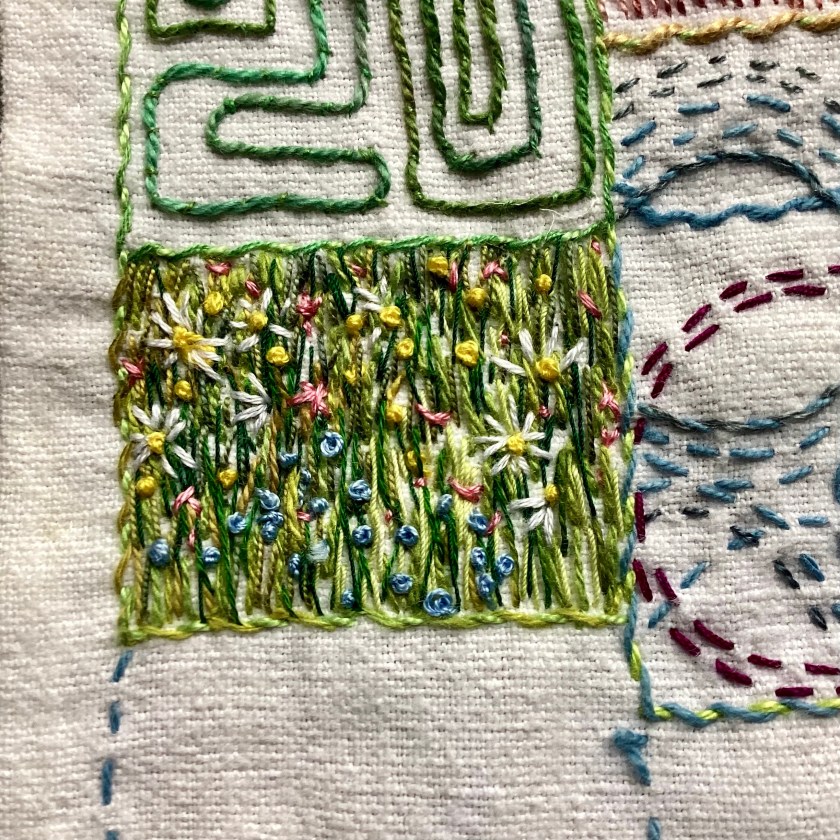
I like the way we stand between, sometimes – between day and night, between the old month and the new. Standing still for a moment, to look back and then ahead. A bit like pausing before crossing a road. So onwards, into June:

This is not what I intended to start right now, but I’m really intrigued to know how long it will get, and how long it will take.
Let’s start at the beginning.
A while ago two things happened that made me stop and think: I read a statistic that the lifetime of a person who lives to be in their early 80s amounts to around 30,000 days. That strikes me as much, much fewer than you might expect. Life is short, even when you get to be old.
I also very luckily found a collection of antique and vintage clothing online that included (hand-stitched!) christening gowns and home-made vintage lingerie. One of the items was a silk petticoat, pre-dating elastic because the waistband was made from lingerie tape, but machine-sewn. It was simply made: a narrow A-line skirt constructed with French seams, and a flounced frill around the hem. The silk is very lightweight and billowy – similar to fine habotai.

I wonder (and this is just a hunch that feels ‘right’) if this might be a post-war silk parachute that has been repurposed by a resourceful stitcher in the late 1940s.
So I ended up putting those two thoughts together – taking something from around 80 years ago that has potentially saved someone’s life, and using it to make something that signifies an octogenarian lifespan. There is something quite incredible about launching yourself out of an aeroplane with only a gossamer-thin canopy of worm-spit between you and the ground.

So the result is a very, very long cloth, just 6” wide, with bits of vintage silk parachute/petticoat applied to a strip of brushed cotton (for stability and softness) on which I intend to place 30,000 stitches.

I’m keeping as much of the original sewing as possible.

I have no idea what 30,000 stitches will look like but I’m looking forward to finding out.
The Covid Chronicle, founded by Wendy Bliss, is a community textile art installation, currently touring in the UK. It comprises about 140 panels worked in a range of textile art techniques and records contributors’ experiences of the pandemic since the first UK lockdown. You can see the work here from today until 19th June, and from July it will be on display at Riverside Studios, near Hammersmith Bridge.
The Hammersmith venue has a huge window space that isn’t suitable for the textile art because it gets too much light, so contributors have been invited to make hearts that can be displayed there a bit like the Wall of Hearts.
I already had a couple of patchwork hearts lying around in a drawer so it was quite easy to put these together.

I really like layered sheers. I like the way they reveal as well as conceal, the way they cover the background but you can still see through them if you look closely. And of course we are all like that too. Very few people get to see through all our layers.

The other two are slightly smaller, about 6” x 8”, and are made with eco-dyed fabrics from Jane Hunter.

The white heart is just strips of cotton fabrics pieced together into a heart shape, with some decorative stitching over the seams.

I really like the scrap of eco-dyed felted wool – it’s quite thick and substantial, I’m guessing from an old wool blanket, and perfect for this. It always amazes me how these orphans and scraps find their home eventually.

These will be travelling to Wendy very soon, and if you’re in London in July maybe you could go and visit.
I finished the scraps quilt that I started about this time last year.

Its working title was ‘All Together Now’ but I found that gave me a constant earworm of the song with the same name, which became distracting, so it had to go. I dropped the outer words and have named it simply ‘Together’. I like the etymology – it comes from an Old English word meaning ‘to gather’ – and that’s exactly what this quilt is. It’s a gathering: of fabrics, of textures, of colours, and of time.

I have a perennial problem with making large quilts. I like working on a large scale, as a rule, but when the thing is finished I have no way of taking a decent photograph of it. I don’t have a wall big enough to hang it on (in any case, there is no hanging sleeve on this one). Usually what happens is we have to move the furniture out of the dining room, lay the quilt out on the floor, and then climb up a stepladder, hold a camera out at arms length over it and hope for the best. Textiles are very difficult to photograph at the best of times and always look so much better in real life.

The quilt is made entirely of scraps and leftovers, hand-pieced over paper using the traditional English paper-piecing method. I assembled the blocks as 6″ squares, using patches in multiples of 1″ (so for example, 1 x 1, 1 x 2, 2 x 2, etc). I then arranged the blocks by colour group, with the whites and neutrals in the centre. The fabrics are an immensely eclectic mix of very modern and very old, plain and patterned, textured and plain-weave. The oldest pieces in it are from the eighteenth century, and they sit happily next to very modern scraps and samples. Most of the fabrics are hand-dyed vintage cotton and linen, with some over-dyed modern quilting cottons. There are a few synthetics and satins in there as well. I don’t normally like shiny fabrics much but I do like the way these little squares catch the light.


The seeding stitches in the central panel create circles of negative space. Initially this was just a design decision to disrupt the straight lines created by the square blocks, but now I can see that the circles create little oases floating like bubbles across the surface. I like the way the circles are distinct but at the same time visibly still a part of their foundation.


The middle layer of the quilt is cotton flannel rather than traditional quilt batting, only because that’s what I had. I didn’t want to have to buy anything for this one. The backing is pieced together from a vintage silk sari. The quilt is thin but quite heavy.

I am a little nervous about the longevity of the quilt. It’s designed to be decorative rather than functional, but not to hang on a wall. I imagine it displayed on a bed, ideally. I don’t know the remaining life span of the silk backing: silk tends to tear very easily as it ages, and I’m not sure how old this sari is. The quilt isn’t washable, due to all the different kinds of fibre – the very elderly patches will shred, and the hand-dyed fabrics might not be entirely colour-fast. The seeding stitches on the surface would be quite easy to pull and distort accidentally. Its new owner (when I find them) is going to have to be very careful with it. But then, very few things last for ever.

I did think about whether it needed some sort of additional circular pattern in the outer borders, but in the end I think there’s probably enough going on in it. I’m looking forward to being able to start something a little more manageable.
I started quilting ‘All Together Now’ with a meandering line, and I thought I knew exactly where it was going.

This quilt has been very particular from the very beginning about what it wants, but I was just starting to feel that we were becoming friends now that we’ve reached the outer sections. The quilt waited until I had done a fair few meandering lines before telling me that was very wrong and not what it wanted at all. Quite a lot of unpicking and tutting ensued. The second attempt is now well under way, and everyone seems to be happier. I’m now working very simple diagonal lines across each of the 6” blocks.

I couldn’t sew a straight line if my life depended on it, so I use quilter’s masking tape. It’s one of the best things ever invented.
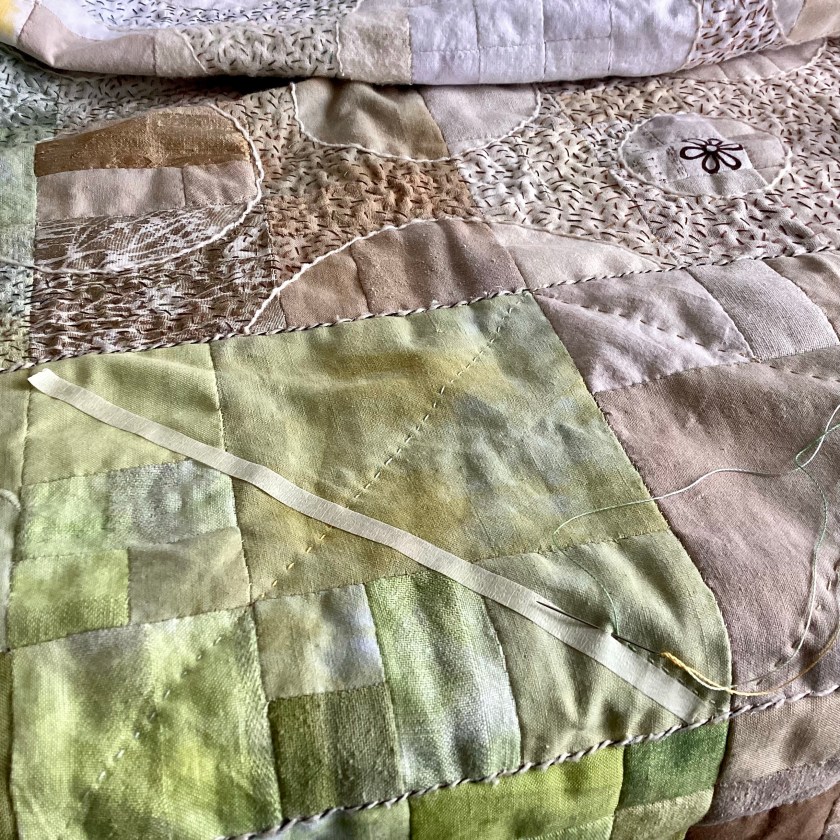
I confess I am slightly disappointed not to have more expressive quilting lines to create. It’s one of my philosophies of life that there are already enough straight lines in the world and now here I am, adding to them. There is, however, quite a lot going on in this quilt – there are a lot of colours to manage, with a lot of seams and some very busy seed stitching – and keeping the rest of it simple I think is the right thing to do.
I started this quilt some time last year, rounding up (squaring up) all the scraps into 6” blocks and then assembling them into a kind of square colour wheel with all the whites in the centre. It’s 11 blocks square, so 66”-ish, all paper-pieced. I had to abandon it when I broke a bone in my right hand in October, but that was no great hardship as by then I didn’t really like it. It also had no name, so I didn’t know what it was trying to be.


Last year I had started seed-stitching the central panel to define the circles, and it quickly turned into one of those things I wish I’d never started. Seed-stitch takes a long time, and there was acres of it. OK, about a square yard. I tend to exaggerate.

So since October it has been rolled up in a corner of the room, nameless and baleful, scowling every time I passed it, and now I need to finish it before I feel free enough to start something else. A few days ago I steeled myself to set about finishing the seed-stitching. And what do you know? It didn’t take as long as I thought it would, and it looks OK. The texture is really interesting. The backing is made from a vintage silk sari, and the middle layer is cotton flannel, so it isn’t too bulky but is still quite substantial. It’s surprisingly heavy.
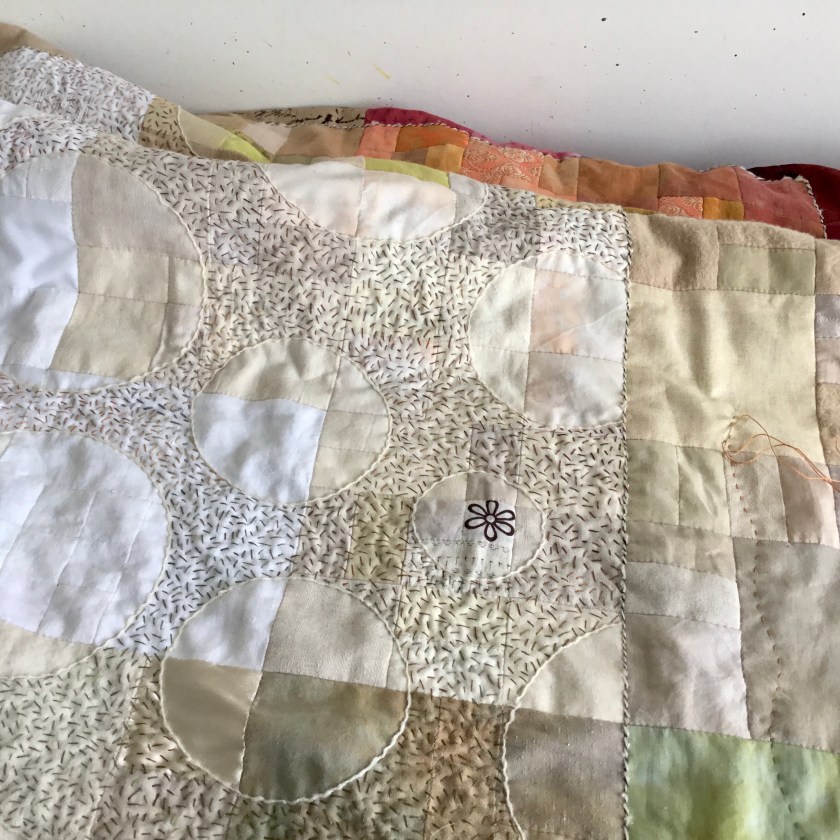
And then it named itself: All Together Now. So now I need to figure out what to do with the rest of it. I’ve couched some two-tone silk bourette yarn down to create a couple of borders around the central panel, and I’m starting with a meandering line just to see where it goes.

Sometimes making a large quilt by hand feels a bit like wrestling with an alligator (no, since you ask, I have never wrestled an alligator). I do feel as if I am starting to tame this one.
I am having some very strange dreams lately. It’s all the tumult and conflict in Ukraine, I think. The daily news pictures and reports are truly harrowing. I believe that we are all connected by the single thread of humanity, and seeing others suffering on this huge scale causes the rest of us to feel it, one way or another.

It seemed like a good time to finish this little wall hanging that has been, well, hanging around for a while. It started life as the sleeve of an outrageous coat that I was realistically never going to finish. It’s an image of a town house that dreams of being in the countryside, far away from pavements and roads, where it can hear the breeze blowing through the trees.

I don’t know if it’s reasonable to be carrying on, keeping going like this, amid all the trouble in the world right now. It feels somehow wrong but also right, if that makes any sense. In many ways it’s one of the few things we can do. My immediate environment is the only thing I have any control over right now, and I know even that’s an illusion. In fact we have very little control over anything that happens beyond ourselves and yet we learn to trust life and its processes, and we learn to assume that we will wake up every morning to a new day.

The backing on this piece is part of a viscose scarf with a ragged fringe, hanging by a frayed thread. As many of us are.