Daily paint doodles have produced these little pictograms, influenced by prehistoric art and the images found on rocks and in caves everywhere in the ancient world:
Daily paint sketches, watercolour on cotton paper with pen added
Prehistoric art is something I’ve always found really interesting. Not so much the figurative drawings of the various beasts fleeing from human hunters, but more the abstract mark-making and simple patterns. They seem to crop up everywhere from the same kind of time. Shapes like circles, spirals, wavy lines, squares, short lines – basic marks. These are the marks I make most often in my sketchbooks too, and a lot of the shapes will translate very effectively from pen to needle and thread.
Sketches for long cloths
I’ve prepared a few long cloths, about 10” x 40-ish”, for adding timeless marks with thread. Just to see where it goes. I’m using linen or cotton as the backing fabric, and brushed cotton in place of batting. The top layers are strips of hand-dyed silk, cotton, and linen.
Long cloth ready to begin
I’m beginning with circular blanket stitch on hand-dyed textured silk fabric and looking forward to following the thread.
I’ve been looking for a set of good quality watercolours but haven’t been able to find anything that doesn’t include a lot of colours I would never use. After falling down a few online watercolour rabbit holes, I found that you can make your own half-pan set from tubes.
Imagine the possibilities! I have quite a few little tubes already – probably far too many, but colour is too enticing to resist, and I will use it all eventually. I’m not a painter, but I do like to paint. Getting all the tubes out feels like too much hassle and mess for a quick sketchbook page, so making a pan set with the colours I’ve already got is the perfect solution.
Sketchbook page in progress: handmade sketchbook made with deckle-edge cotton paper. Drawn details are Posca paint pens and Signo uniball white pen
You can buy empty watercolour tins quite cheaply, and many of them come with empty half pans ready to fill from tubes.
Empty pan set with samples of colours I’ve already got
The result is a perfect set of watercolours, conveniently in a metal box that takes seconds to set up.
Custom water colour palette
There’s a lot of green, but then that’s what I like. There’s a mix of brands here – mostly Daniel Smith, with some Winsor & Newton, Schmincke, and Jacksons. They all sit quite happily together and mix well. Some set harder than others, but it seems to make no difference to the paint itself. The Jacksons paints still haven’t set hard after a few days, but this palette lives in a drawer and won’t be carried around, so I don’t think it matters if it doesn’t set.
I’d like to spend a bit of each day on sketchbook work, and this convenient set-up will make it so much easier to restart a daily practice. I’ve been doing some doodles just to see what happens and already they look like possible textile/stitch samples.
This week I’ve made a notebook using some light weight cotton rag paper – somewhere to collect colour palettes, swatches, and notes about colour.
Sketchbook page with colour notes
The paper signatures were easy enough – just folded pairs that could be stitched to the spine of a cover. The cover itself literally dropped through the letter box one day. I cut a corrugated cardboard mailer box to size and painted it white:
Free! Corrugated cardboard mailer cut down to size
The depth of the box turned out to be exactly the right size for a spine to fit the pile of signatures:
Signatures stitched to cardboard cover
I painted some abaca tissue paper with acrylic inks and collaged/stencilled it a bit and used that to cover the white cardboard. I’ve reinforced the spine with another layer of painted tissue.
Little book of colour (front)Little book of colour (back)
You can still see the texture of corrugated cardboard underneath the colour but it’s functioning pretty well as a book.
Next job this week is to find a way through these, when they’re dry:
Hand dyed threads – it’s like waiting for thread to dry
If I can get through them all (and if I can stop myself from keeping them!) they’ll be available from next week.
In my new life of freedom from the nine to five treadmill, I’m trying to set aside Fridays for research and development (AKA playing).
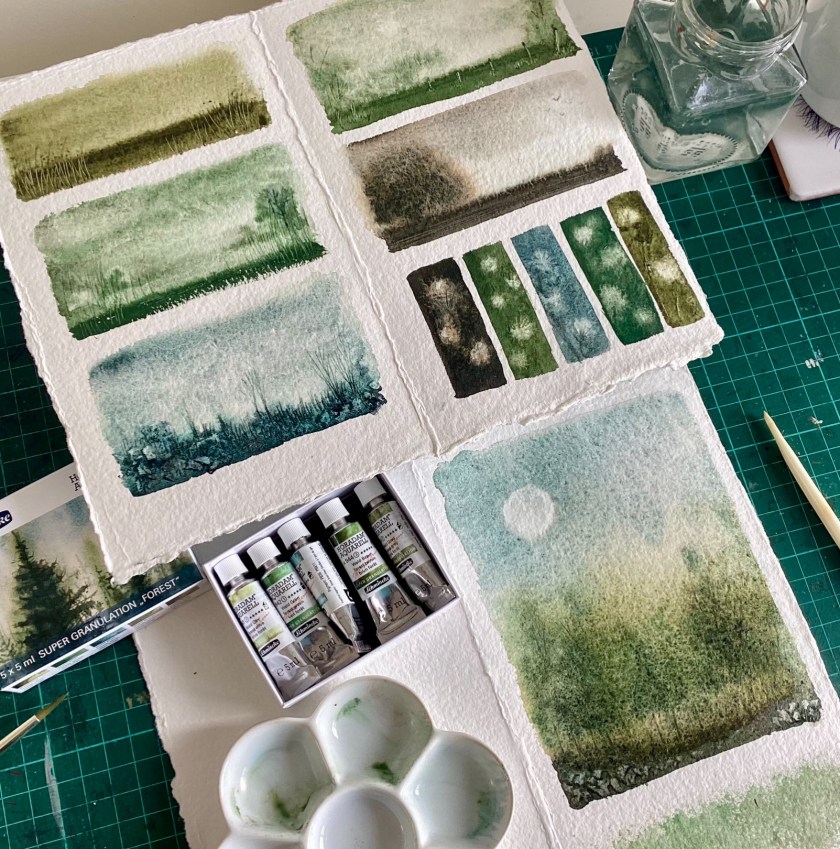
I was given these beautiful super-granulation Schmincke watercolours for Christmas but have been really busy since January and I’ve been trying to set aside some time to try them. It turns out today was the day.
Schmincke super granulation watercolour set ‘Forest’
I’m no great watercolourist but what I like most about watercolour paints is that it’s quite hard to make anything look ugly. I really like the granulation effect.
Watercolour sketches, about 2” x 4”Single colour sketch, wet on wet, lines made with a stickIn progress
Imposter Syndrome, inner critic, Captain Failure, whatever you call it – I feel as if I finally understand it, and this understanding has truly changed my life. It’s one of the many amazing things I’m learning from the incredible Stacie Bloomfield and her Leverage Your Art online course.
Having been beaten down countless times (for decades) by the inner critic’s ‘you’re not good enough’ mantra, I now understand it for what it is. It’s just a part of my brain that doesn’t like change and is frightened by risk-taking. It comes up with what it thinks are valid reasons to prevent my doing something that doesn’t feel safe.
In a real life-or-death situation that’s immensely useful, and the inner critic is actually your greatest protector if it tells you that you really shouldn’t jump out of a tenth floor window. The problem is that the inner critic can’t always tell the difference between a genuine life-threatening change and a personal challenge, so it tells you the same limiting things over and over again until you can no longer tell the difference either. It seems to me that you and the inner critic grow together and you just get used to not questioning its advice.
I’ve nearly finished the right-brain business plan, and am including the inner critic just so I don’t forget that sometimes it tells me things that may not be true.
The inner critic: actually my greatest protector who doesn’t like to admit that they are sometimes wrong
Underneath all of those life-limiting nonsense messages is the truth – that somewhere in there, a part of your brain is afraid that you will die if you change. You can’t grow if you don’t take occasional considered risks. It’s not natural to stand still or stay the same. Everything changes eventually.
So finally I’m recognising that messages like ‘you don’t deserve this’ and ‘this will never work’ are just really, really silly.
Settle down with a cup of tea or something because there are lots of pictures today.
You might recall I enrolled on the Heart of Soil online workshop last month – you can see my earlier post about it here. I collected all the lessons into a little sketchbook, and it’s been a lot of fun to revisit some techniques I haven’t used for a while. I particularly liked the limited colour palette – just blues and yellows – and the pages in the resulting book are nicely coordinated.
Front cover with strip of hand dyed silk wrapped aroundFront and back coversString of Hearts class taught by Tiffany SharpeBluebird of Peace class taught by Megan Quinlan (mine is a blue tit, since I think that’s the closest thing we have to a bluebird in the UK)Buds class taught by Michelle Schratz
I went a bit off-piste with some of these and added some lines from a vintage poetry anthology to some of the pages, and I added a teabag pocket to this one too. I made a stencil from Tyvek for the background leaf and flower images.
The lines of poetry on the page below are from a Rupert Brooke poem, mixed up to create a found poem.
Pebbles and Peace classes taught by Leaca YoungPaper doll class (I adapted this one a fair bit just to get it on the page) taught by Kim Smith (@slaphappystudios on Instagram) and painted watercolour tubes class taught by Kelly Hoernig (@kellyhoernig.artist on Instagram)Watercolour wildflower garden class taught by Tracey WozniakWatercolour/mixed media backgrounds and mark making class taught by DeeDee CatronThe one-page journal technique, shared by Kiala Givehand (@kialagives on Instagram) and a sunflower for Ukraine taught by Lorraine Bell (@lorraine_bell on Instagram)
Of course the sketchbook itself is based on the one-page sketchbook technique (you fold a single sheet of paper, cut it strategically and fold it into an eight-page booklet) but I thought it would be fun to make a tiny sketchbook to tuck inside the bigger one. The smaller version is made from a sheet of A4 paper; just me enjoying myself, really.
Collaged pages in mini-sketchbook with various marks and papersPages from mini-sketchbook, collaged and painted, with lines from a vintage poetry anthology
I thought it might be fun to include a little video run-through but then I noticed the colour of my hands and thought I ought to explain. I did some dyeing this morning and – I do it every time – forgot to put the gloves back on when rinsing. My hands are not normally purple, just in case anyone is worried.
A very happy collection of classes and I enjoyed them immensely. Next up, I’m doing the Traveller Blanket course with the lovely Dijanne Cevaal and am looking forward to that. Next year I hope to be teaching online classes myself, and I’ve figured that the best way to see what works is to sign up for a few myself. And of course there is always something new to learn.
Still having lots of creative fun with paint and paper in the Heart of Soil class – it’s a lovely course and for an excellent cause – there is still time to sign up, which you can do here.
Accidental discovery of the day is that you can very easily make your own stencils from Tyvek. Apparently Tyvek is used for making envelopes in the US but you’re more likely to find it in a DIY shop in the UK – I think it’s used in building/construction and in PPE, but it’s also been used in mixed media art for several years now for its propensity to shrink and bubble when heated. It’s about as thick as copy paper but is much more durable, and very easy to cut with a craft knife.
Simple stencil made from Tyvek, coloured with watercolour paintsHeart shape cut from Tyvek used as a stencil with dry-brushed watercolour paint
This page is based on a technique taught by Michelle Schratz (if you’re an Instagram person you can find her here.)
A6 sketchbook page based on Michelle’s Heart of Soil class
I found a couple of lines of poetry (Rupert Brooke, from a vintage anthology) and used an old teabag as the pocket for the cut-out flowers.
Teabag pocket with flowers cut from sketchily-painted vintage papers
The yellow ribbon, saved from something many years ago, is exactly the right colour, which is proof that you should Keep All Your Collage Supplies For Ever. One of these days I will need a bigger house.
Yellow and blue flowers
I am really enjoying the limited palette and am already thinking way ahead with ideas to try this in various other colours and media. Also it’s immensely enjoyable to make something just for the fun of it, without any pressure for it to turn out ‘right’, whatever that is. Wishing everyone a happy week.
I have given myself too many things to do: no surprises there. I have signed up for three online courses, all running at the same time, while continuing to work three days a week at the desk job. I did know what I was doing, and all of it seemed like a really good idea at the time, and I’m already slightly behind. But then I get lifetime access to all three courses, and you can do them all at your own pace, so there is no rush really.
One of the classes I signed up for is a delightful mixed media watercolour course called He(art) of Soil, organised by Leaca Young (you can find her on Instagram here). It’s very accessible, with ten mixed media artists each contributing a simple project, and there’s still time to sign up if you’re interested – go to Leaca’s website in the link above for more information. All the proceeds go to World Central Kitchen, in aid of the conflict in Ukraine. The projects in this course are based on a very limited palette: just three shades of blue, and three shades of yellow, for the Ukrainian flag. The paints are made from soil and pigment and look really beautiful. You can see more about how they’re made here. I didn’t purchase the paints – it would have been very expensive to have them shipped from the USA to the UK, and I don’t need more watercolour paints, so I’m adapting what I’ve already got. You can see my substitute palette below.
A6 folded sketchbook for The Art of Soil online class
I don’t need much of an excuse to splash some paint around, so I had a very happy hour or so this afternoon painting some collage papers in these colours.
delicious pile of vintage and modern papers painted with acrylics and watercolours
I’m collecting and completing all the lessons in a little folded A6 sketchbook made with three sheets of A3 paper, folded and cut to make a little zine-type booklet. If you’re not familiar with the technique, you can find instructions for making a one-page booklet here. One of the tutorials in this class includes instructions for making this kind of booklet, which will be perfect for keeping everything together.
The projects are very simple and suitable for all abilities, and I guess you could make them as quick or as complicated as you like.
Page based on Tiffany’s Hearts project – find her on Instagram here
It’s really interesting to work with such a limited palette, and surprising to see just how many shades of blue, green, and yellow you can actually make. A lot of the artists remark on the texture of the watercolours that they’re using, describing them as quite gritty. My paints are all very smooth, so I might try using some watercolour texture medium for some of the classes, just to see how it turns out.
Loosely worked page based on Megan’s Bird of Peace tutorial. You can see her work here
Regardless of how long you might have been making art, in whatever medium, I love the fact that there is always something more to learn, something more to practice, and plenty more ways to grow. I really like the fact that this online class supports a great cause, and that the artists have given their time and skills so freely. I’m looking forward to completing more of the classes in this course.
Focusing on the Big Plan is taking most of my time and energy at the moment, but it’s utterly absorbing and much more immersive than I had expected. At the moment it feels like a good use of my time. I’m seeing things more clearly as a result of taking the time to work on these visual representations of where I go next on the journey, and it’s so much more effective than writing words in a box with a biro. It turns out I had completely underestimated the power of creative journalling.
I do like a nice lighthouse. On this page it’s a metaphor for my strengths.
The concertina sketchbook turns out to be perfect for this (it’s the Seawhite Octopus sketchbook, with eight 4-page foldouts). I’ve never used one extensively before, and I’m really liking the format. Ideas can spread across the page, ideas and pages unfolding together. I think the subconscious mind enjoys these metaphors.
A little digression here: it’s also a really fun way to explore some mixed media techniques. I made my own acrylic ink spray.
Home made acrylic ink spray on cartridge paper painted with a little gesso for texture
You can buy ink sprays, of course, but most of them are not colourfast when dry. I wanted something that would allow for using watercolour over the top without it rediluting. There is nothing complicated about this – it’s just a fine mist spray bottle with one part acrylic ink and three parts water. You could probably dilute it more or less according to your needs. Of course I’m now making a mental note to try this on fabric as well – I’m fairly confident (or maybe just hopeful) that it will work.
The Right Brain Business Plan has a section called ‘painting your business landscape’. I grew up by the seaside on the east coast of the UK and this page has ended up looking a bit like the cliff top walks I used to enjoy as a teenager. I remember the feeling of freedom, the wildness of the wind blowing in from the sea, and the sense of space and perspective you get from a high vantage point. Interesting how your mind shows you these meaningful images once you turn your attention away from the left brain and all its fretting.
Business landscape, showing strengths, competitor analysis, barriers and opportunities
I’ve been asking myself this question most of my life:
Finding my place
I guess it’s about identifying the values that you want to live by. Life is short, and living my best life is becoming more important the older I get.
Values. I like quiet and calm, living at my own pace, taking time to think
This is definitely giving me time for reflection, and the format makes it really easy to connect ideas and see the bigger picture. Sometimes on paper is the most useful place to be.
I’ve been trying to write a business plan, because I know I will need one if I ever get to give up the day job, but haven’t made much progress.
I don’t know what operations and logistics even means
It’s all boxes and straight lines and charts and columns. I have no idea what to write. I don’t even understand some of the questions. Key findings from desk research, marketing strategy, financial forecasts… how are you supposed to know all that when you haven’t started yet?
And then I found this:
Right Brain Business Plan by Jennifer Lee
I’ve had it in my hands for about three hours and already it has changed my life. It comes with a handy checklist:
Yes, yes, and yes
I don’t know why I didn’t think of it myself, but there we are. It’s much easier to think ‘what’s wrong with me?’ rather than ‘what is it about this format that isn’t working for me?’ My left-brained husband wouldn’t dream of hanging a picture without a spirit level. I would bang a nail in and eyeball it. It wouldn’t bother me if it wasn’t even straight.
Almost every sentence in the first chapter has me jumping up and down in my chair. This particularly:
“The challenge is when left-brain thinking comes too early in the visioning and planning process and kills the party with its questioning, judgement, and need for every single piece of the puzzle to make absolute sense before taking that first step. This limits your thinking: good ideas are quashed before they’ve even had a chance to form.”
So now I know a business plan can be pictures and colours and shapes, there is nothing stopping me and I find I know exactly what I want and where I’m wanting to go.
Business plan
The Business Plan book says ‘let it unfold’. I’ve had this accordion-style sketch book since Christmas and have been waiting for it to tell me what it wants. Of course, all this time it’s just been waiting for me.
A call to action, from an old poetry anthology
I’ve gone from constantly putting it off because it’s dull to actually wanting to get started on it.