Thinking sideways, not knowing

I’ve been revisiting my Lines on the Land sketchbook this week. It’s a collection of sketches and designs based on ancient landscape features like standing stones and rock art, just to explore some of the patterns.
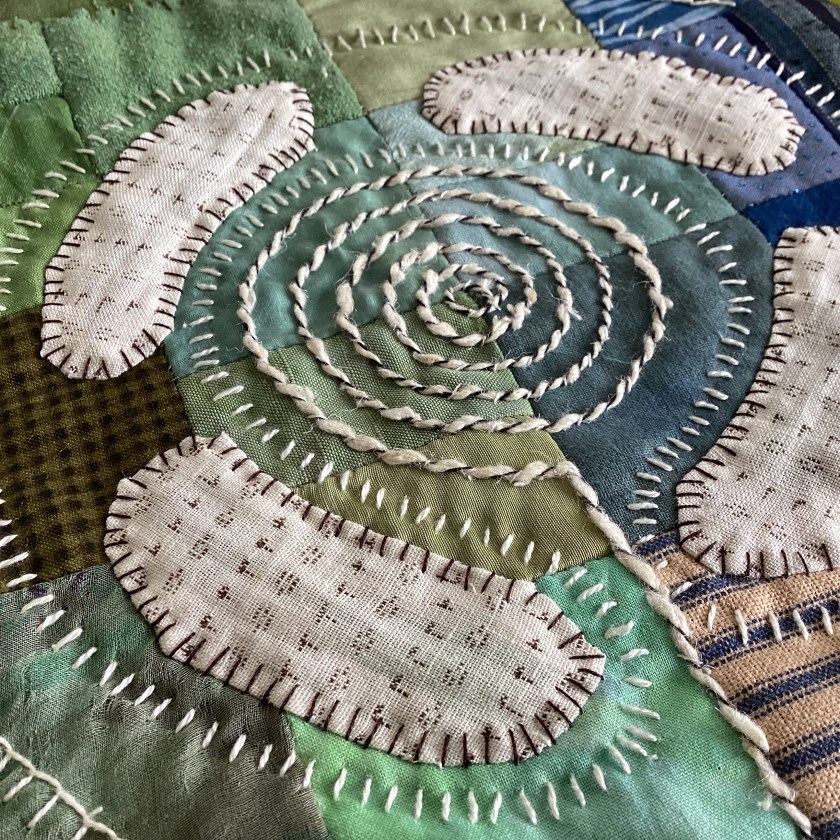
Lines on the Land, front cover

I made this sketchbook myself, using signatures of cartridge paper, and then collaged and painted the pages before assembly. I prefer to make my own sketchbooks because I have more control over the size, shape, and proportions. I don’t always like the proportions of standard A4.

I usually cut off part of the page when making a sketchbook if I know I’m going to include fabric or stitched samples, as with this one below which is waiting for me to do something with it:

Deliciously blank sketchbook waiting for an adventure

When I get round to doing something in it, I will be able to attach a stitched sample to the short tab which will form a new page that will be separate from the paper pages.

I didn’t do that with the current sketchbook; there are some pull-out pages, but no partial pages. While trying to figure out a way of sticking stitched samples in it without covering a finished page, I accidentally discovered that you can add pages sideways:

Extra page glued over the top edge of existing pages

You can lift up the stitched sample to reveal the completed page underneath. I like it. Necessity, invention, etc.

Mixed media sketch of Callanish beneath the stitched sample

Of course I made a cover for it. I do like a well-dressed sketchbook.

Front cover, patchwork earthwork
Back cover, patched ragged spiral

I’ve found spaces for some stitched samples I made a while ago:

Mixed media sketchbook page, mini monolith
Mixed media sketchbook page, circles
Textile sample, layered scraps and sheers on painted handmade paper

I don’t always think of a sketchbook as preparatory work for something bigger or better, though it often is that. This may or may not lead to some larger textile work. Part of the adventure is the not knowing, the voyage in the dark, and true of any creative venture I think. Having a go, never knowing whether what you’re making is any good or not. And then realising that it doesn’t really matter, if you’ve enjoyed doing it.

Little collages with drawings added

In the zone

I experienced a proper state of what psychologists call flow this morning – utterly absorbed and focused on making these little samples, I somehow lost two hours. I quite like it when that happens. You literally lose yourself in something while time rolls on without you. You come back to reality slightly dazed, feeling a bit like Rip Van Winkle.

I really like this Klee painting, ‘Oceanic Landscape’ (1929) and have been drawing tree shapes with watercolour. I love the simplicity of these shapes – just a few very easy lines that nevertheless unmistakably say ‘tree’

Oceanic Landscape, Paul Klee, 1929 – sketchbook page

Of course I wanted to see how these would work in fabric and thread. The first sample is layered sheers and silk net on a scrap of very soft brushed cotton.

Little fir trees, stitched area about 3” x 4”

The second is a scrap of vintage linen/cotton sheet, painted with watercolours and then stitched. You can see the imprint of the embroidery frame which kept the fabric taut just while the paint was drying. I will soak and stretch the creases out at some point.

A row of little trees, painted area about 3.5” square
Birdie is looking a little scruffy this season

This sketchbook (so far) is just for me, and just for fun. I’m not sure it’s leading anywhere, although really everything is good practice for something.

Two stitched samples inspired by Klee’s Oceanic Landscape

I’m having a few days away from the day job next week and am looking forward to a break. I have a strong need to paint – who knows where these directives come from? I think it’s probably important to listen, in any case – so will be on paper for a while. Just to see what happens.

Klee sketchbook

Sketchbook cover, Klee’s 1922 painting of a little fir tree. Layered sheers and hand-dyed fabrics with simple hand stitch and applique

The sketchbook cover is finished – despite all the careful measuring and re-measuring along the way, I am always really surprised when it fits.

12” square sketchbook with cover

I have sketchbooks in various sizes, mostly made from papers that I collate and bind myself. This one is a bought spiral bound 12” square one, which is a good size for exploring mark-making and for holding samples of stitched work.

First page: A Klee medley, or Klee’s best bits
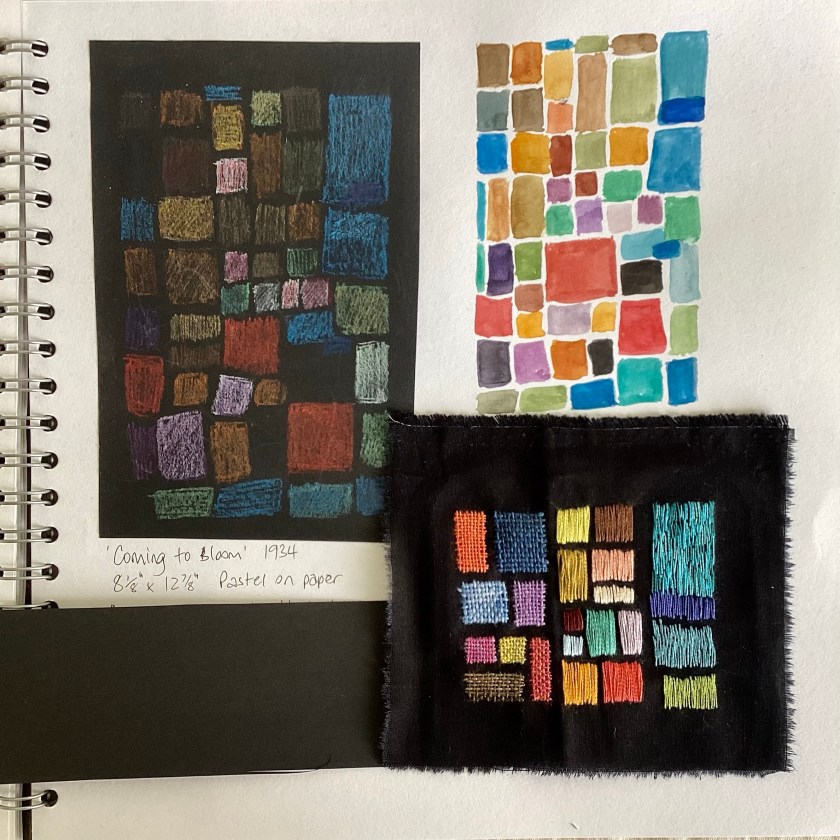
Sketchbook page exploring blocks of colour

‘Coming to bloom’ is a pastel drawing made by Klee in 1934, on black paper. I made a quick sketch with pastels, also on black paper – the fixative has dulled the colours a little, so I made a duplicate sketch in watercolour on a white background.

Then the fun really started. I made a little stitched sample on a scrap of black cotton fabric, only about 4” square or so, exploring ways of creating stitched blocks.

4” square sample. From the left: needle weaving with hand-dyed threads; rough satin stitch with 2 strands of DMC floss; sketchy long and short stitch with one strand of DMC floss

I really like the woven blocks. The satin stitch blocks have floats that are too long to be practical, but I also quite like the irregular sketchy effect of the straight stitch sample on the right. I worked the samples from right to left, so the weaving was the last thing I did.

Stitched sample on sketchbook page

Not quite sure where all this is going, but then some journeys are about exploration and discovery rather than arrival.

Immersion

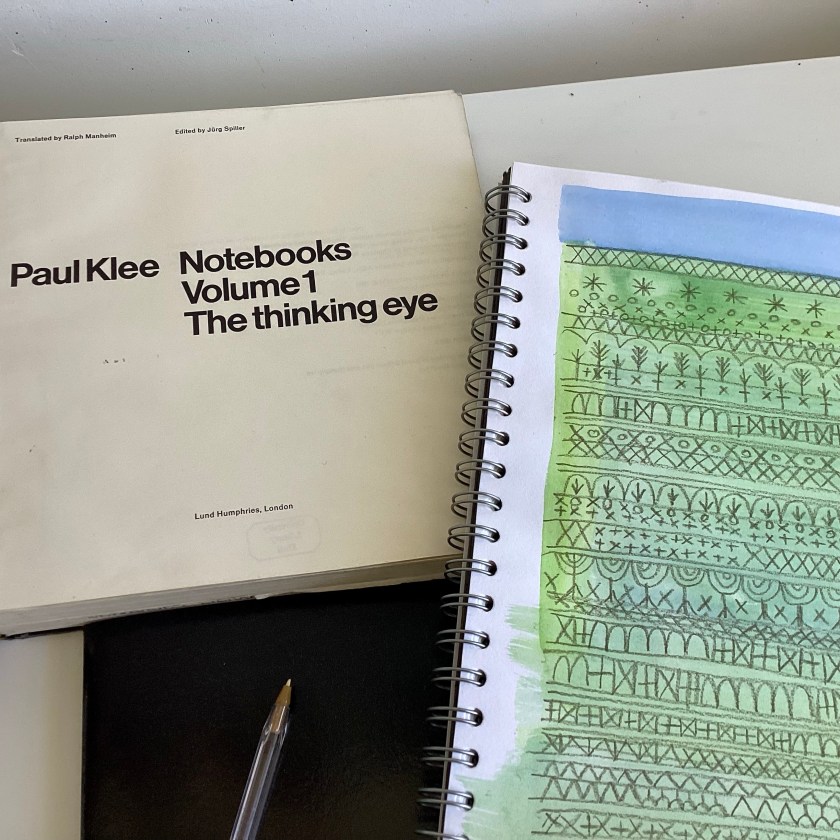
One of the perks that comes with working at a university is free access to an academic library, and last week I found this:

Paul Klee Notebooks Vol. 1

You can read it free online, actually, but I prefer books to be on paper. I like leafing through pages and don’t like scrolling up and down a screen. It was good exercise carrying it home too, so twice the benefit.

I’ve had a completely free weekend so have been immersing myself in Klee and his life and works.

Notes

Having started to read his words, I feel I am beginning to understand him and his work better. Weirdly, I understand myself better too. I periodically berate myself for not drawing more often (what kind of artist doesn’t draw?) but then I read Klee and feel more validated about valuing process over object and trying to explore the intangible. I admire people who can draw with photographic realism but learning how to do that doesn’t really interest me. I don’t want to draw what I can already see. Klee famously said, ‘art does not reproduce the visible but makes visible’. And I guess I draw with a needle and thread instead of a pencil.

Klee’s writing is, as you would expect, pretty dense, so in between nibbles of philosophical art theory I’m working on a sketchbook cover. I accidentally deleted the photo I took of it in progress, so this is just a screenshot:

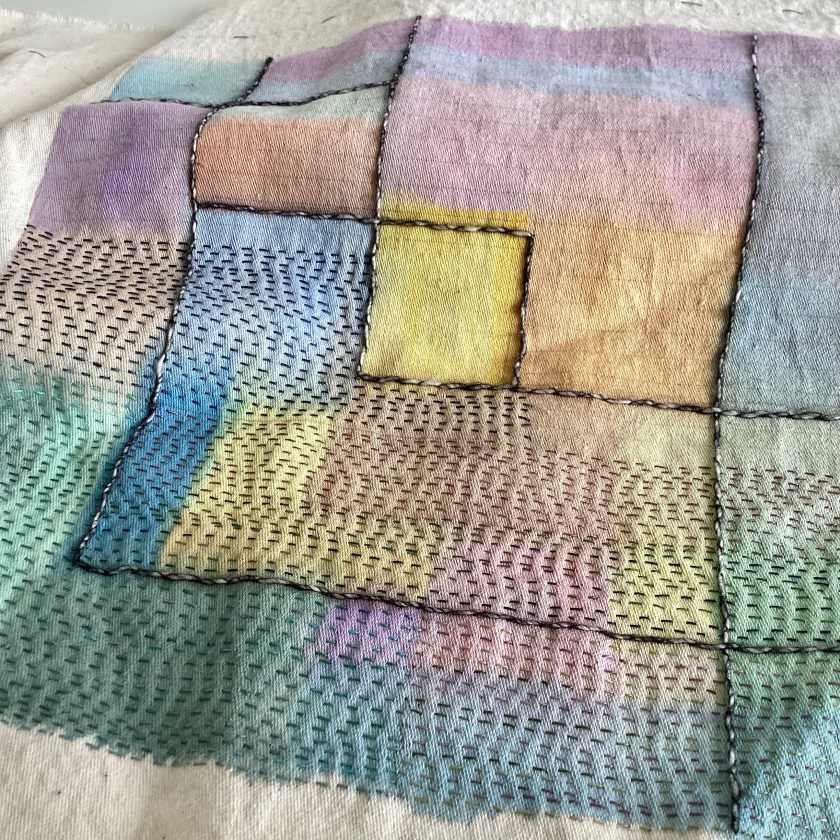
Watercolour on loom state cotton, inspired by Klee’s painting ‘Clarification’ (1932)

It’s just regular watercolour on fabric. It won’t ever be washed so it doesn’t matter about fixing the colour. The fabric I’m using is loom state cotton, and it’s a really good surface for sewing on. It’s not quite as thick as furnishing fabric, but a bit more substantial than heavyweight calico, and a nicer weave than cotton canvas – it’s quite a fine twill weave, similar to impossibly lightweight denim, if there could be such a thing. I’ve started to add rows of running stitch in threads similar to one strand of DMC floss.

The colour seems to be fading slightly already, but that’s ok. I thought it was a bit too bright to begin with anyway. You can see how I’ve had to draw lines on it to keep me on the straight and narrow and not go wandering off on a tangent. I’m not keen on the way the yellow square has ended up being more or less right in the middle, but it’s never going to end up on show anywhere so I can overlook that I think.

Front cover of sketchbook in progress

A play day with Klee

Firstly, thank you so much to everyone who has purchased fabric and thread – it’s now all on its way to you. I hope it arrives soon and that you can do something lovely with it.

I’m back in the day job from tomorrow so I’m having a little me time today, working (playing) in the second of two sketchbooks I have on the go at the moment. The first sketchbook is about ancient marks, standing stones, and lines on the land. The second is a study of work by Paul Klee, one of my favourite artists. I have often registered the affinity that Klee’s work seems to have with textiles. One of the first textile wall hangings I ever made was an interpretation of Klee’s ‘Fire at Evening’. Many of his paintings are basically patchwork, and many of his drawn lines look very like stitched marks.

Sketchbook page in progress

This painting looks exactly like a stitch sampler to me, and reminds me of my own stitch journal.

Paul Klee, ‘Rhythms of a Plantation’, 1925
Drawing based on Rhythms of a Plantation, 1925, 10” square

The marks on Klee’s painting ‘Clarification’ also look exactly like running stitch or kantha stitching.

Sketchbook page, watercolour and pencil, exploring lines and marks

What particularly interests me about Klee is his work linking painting with music. He thought of music as having similar principles to painting, particularly in terms of composition – and of course we use the same word to describe an arrangement of musical notes and an arrangement of painted or drawn shapes on a page. I like the layering in his polyphonic works, which are usually a series of regular painted marks over a patchwork-like background. To me this is very like a quilt – the patchwork ground tells one story, and the quilted lines on the surface tell another story, like two voices singing in harmony.

‘Ad Parnassum‘, Paul Klee 1932

The stitched sample is an exploration of how tiny bits of fabric would look if applied to a textile surface. I’ve used felt in this first foray, simply because it’s easy to cut up into small pieces and it doesn’t fray. I’ve experimented with different ways of attaching the little tiles (for scale, the bits of felt are about a quarter of an inch square).

Tiny pieces of felt applied to vintage linen

Probably my favourite is the invisible method (top right), but I’m not confident that it would be stable enough. I took the needle and thread horizontally through the centre of the felt, like threading a bead, and then down into the base fabric. I suspect over time it might split the layers, in which case the top layer could peel off.

Whether any of it works or not is immaterial today, really. It’s just nice to have some time to think about the possibilities.

Drawing stitches

Still working on paper, thinking things through. I don’t have a lot to say about this today. Not in words, at least. Colour, shape and composition have their own language that is universal and goes far beyond the limits of words.

Collaged sketchbook pages in progress

I have started to draw what might become stitches.

Marks on a standing stone
Patterns similar to those found on carved rocks
Stone circle with henge
Abstract marks suggested by irregularities in the inked background

Ongoing. Going on. Same thing.

On paper

I really like paper. I especially like painting sheets of paper and then tearing them up to make collages for sketchbook pages – I find this much easier than drawing on a blank page with a pen or pencil. I like the accidental shadings that occur, and the blocks of colour. It’s like patchwork, really.

sketchbook page, collage with painted paper

I’m in the process of making two sketchbooks: one that explores the marks on ancient rocks and stones, and one that explores the marks on ancient landscapes. I find land particularly fascinating because it holds so much time and has witnessed millions of years of life. Land and ground can be synonyms, and grounding is what happens when we connect to the land.

sketchbook page, collage with painted and textured papers
sketchbook page, drawing over collage
Sketchbook page, cut and torn painted papers
sketchbook page, mark-making over monoprint

While I’ve been working on these pages, some thoughts about the fiction I’ve read recently have been weaving themselves together. A couple of months ago I read All Passion Spent, by Vita Sackville West (first published in 1931), which is about an elderly woman who, when widowed, decides to live where she chooses and on her own terms. There is a passage at the beginning of Part Two, where Lady Slane finds that for once she has time to reflect:

‘She had plenty of leisure now, day in, day out, to survey her life as a tract of country traversed, and at last become a landscape instead of separate fields or separate years and days, so that it became a unity and she could see the whole view, and could even pick out a particular field and wander around it again in spirit, though seeing it all the while as it were from a height, fallen into its proper place, with the exact pattern drawn round it by the hedge, and the next field into which the gap in the hedge would lead. So, she thought, could she at last put circles around her life.’

Sketchbook page, collage – ‘so could she at last put circles around her life’

I recall seeing a fascinating interview with the actor Liz Smith a few months ago, and she said it’s only when you get older that you can look back at your life and begin to see the recurring patterns that have always been there. You don’t notice the patterns at the time because you’re too close to recognise them.

In another novel I’ve read recently, Alias Grace, by Margaret Atwood (1996), one of the characters, Reverend Verringer, speaks this line:

“What becomes of the soul? We cannot be mere patchworks!” (p. 471, ‘Pandora’s Box’)

Patchwork, silk and cotton fabrics

All these thoughts and patterns are coming together, like paths converging, and it feels as if I am going somewhere. I am still drawing the map, but I have a compass and a vague sense of direction. I am travelling slowly, on foot. Step by step, or stitch by stitch, or piece by piece, it will come together somehow, in its own time.

And *of course* we are all patchworks. What else could we possibly be?