Beginnings (part one)

It takes time, I find, to get to know a new cloth before you can do the right thing for it. The new stitch journal for 2024 feels very different from the previous two years, despite being exactly the same vintage French linen. The main difference is its shape. It’s exactly the same size and scale – i.e. twelve A4 pages – but setting the monthly pages in a 3 x 4 grid formation is making it feel ‘bigger’ somehow.

Four days in January

As always, I don’t plan any day’s design in advance; it just happens in the moment. Sometimes that means unintentionally stitching something I end up not liking much. I’m not keen on the raincloud, for instance. The advantage of intuitive stitching is that it really doesn’t matter whether you like what you’ve stitched or not, nor does it matter if the stitches are wonky or irregular sizes. Some days it just is what it is. The point of it is to record time mindfully, so there’s no need to worry about how it turns out. And definitely no need to unpick.

3rd and 4th January

If you’re following my 2024 template, you can of course stitch the blocks in whatever order you choose. Personally I prefer each day to share a border with the previous and next blocks, so that they form a continuous stream of time.

I made a short video of yesterday’s stitch, weaving a new path between rows of herringbone stitch:

weaving between other stitches

And I’m also working on some other new beginnings, more of which later.

2023

And that’s that. I hadn’t anticipated when I started this in January that this year’s stitch journal might become a cloth book, but now I can’t see it as anything else.

2023: the year of the book

I’ve had a few messages recently asking if my PDFs or my online course include instructions for making the cloth book. They don’t, but there’s a blog post here that might help you to see how to make something similar.

New Year’s Eve inevitably encourages reflection on the days that have gone. There have been winter-into-spring days:

January/February

Spring days:

Early March

Long summer days:

June

Flowery summer days:

July

Early autumn days:

August

Autumn-into-winter days:

October

Actually let’s linger here for a moment as I think the leaves are my favourite:

Autumn leaves

Early winter days:

November

And ending at the beginning, in the winter:

December

Thank you so much for taking the time to visit and read my blog throughout the year. An especially huge thank you if you have purchased my PDFs, threads, fabrics, and online courses in the last twelve months – you have made it possible for me to make a living doing what I love. I’m enormously grateful to each and every one of you.

Tomorrow I’ll be starting on 2024, using my new template. I have no idea how it will work, but I’m looking forward to finding out. (A brief description of how I made the cover for it is here.)

2024: land ahoy!

I hope 2024 brings peace, joy and fulfilment to you. And – of course – some happy stitching.

Inventing stitches

If you do a lot of hand stitching, you can’t help inventing new stitch variations occasionally. There are lots of variations on basic stitches, and many ways to combine one basic stitch with another.

Blanket stitch tree with interlaced blanket stitch border

Here’s an interlaced/woven running stitch/blanket stitch combination, which looks best in two colours:

Sound on: Lovely Day, Bill Withers

You need to work a row of running stitch first, keeping the stitch and space between stitches as even as you can. Then you can work a blanket stitch into the gap, using a different colour, and weave through the running stitch to start the next blanket stitch.

Interlaced blanket/running stitch

A simple enough idea, and easy to stitch. It probably needs a better name though, combining blanket and running. Blanning stitch. Runket stitch. Oh dear me, no. Suggestions on a postcard please.

A little loopy

I thought I’d invented a pretty loop stitch the other day, but apparently it already exists.

Interlaced running stitch, discovered by accident

It’s basically pekinese stitch but with the thread looped around running stitches rather than back stitches.

The long cloth in the video and below has been in progress for a while, just somewhere to collect stray stitches and orphan fabric scraps when I remember to catch them.

Home for waifs and strays

Thinking sideways, not knowing

I’ve been revisiting my Lines on the Land sketchbook this week. It’s a collection of sketches and designs based on ancient landscape features like standing stones and rock art, just to explore some of the patterns.

Lines on the Land, front cover

I made this sketchbook myself, using signatures of cartridge paper, and then collaged and painted the pages before assembly. I prefer to make my own sketchbooks because I have more control over the size, shape, and proportions. I don’t always like the proportions of standard A4.

I usually cut off part of the page when making a sketchbook if I know I’m going to include fabric or stitched samples, as with this one below which is waiting for me to do something with it:

Deliciously blank sketchbook waiting for an adventure

When I get round to doing something in it, I will be able to attach a stitched sample to the short tab which will form a new page that will be separate from the paper pages.

I didn’t do that with the current sketchbook; there are some pull-out pages, but no partial pages. While trying to figure out a way of sticking stitched samples in it without covering a finished page, I accidentally discovered that you can add pages sideways:

Extra page glued over the top edge of existing pages

You can lift up the stitched sample to reveal the completed page underneath. I like it. Necessity, invention, etc.

Mixed media sketch of Callanish beneath the stitched sample

Of course I made a cover for it. I do like a well-dressed sketchbook.

Front cover, patchwork earthwork
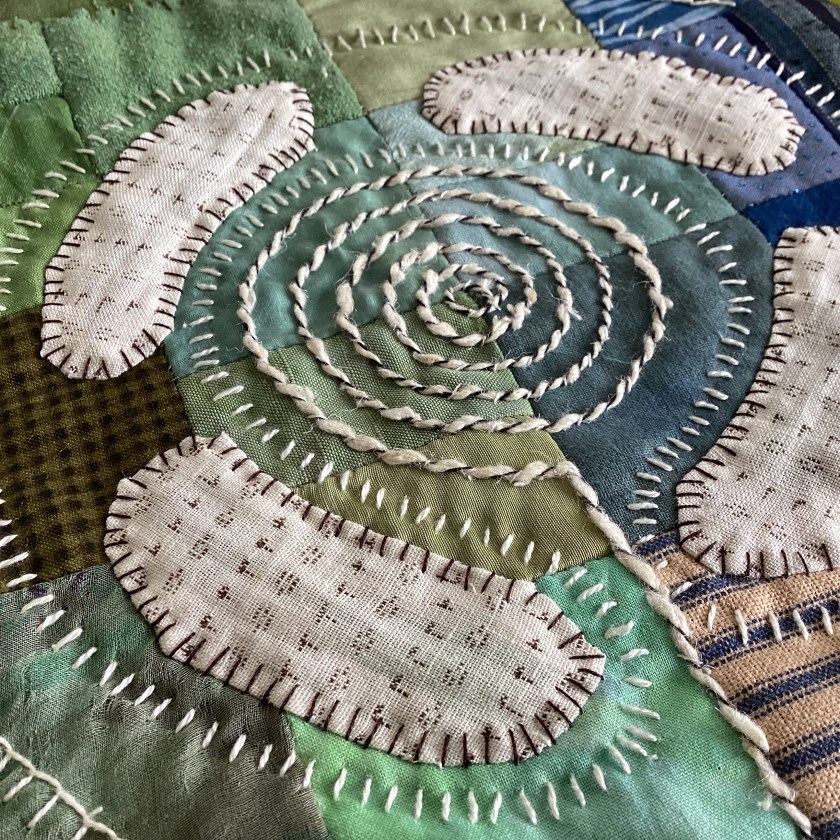
Back cover, patched ragged spiral

I’ve found spaces for some stitched samples I made a while ago:

Mixed media sketchbook page, mini monolith
Mixed media sketchbook page, circles
Textile sample, layered scraps and sheers on painted handmade paper

I don’t always think of a sketchbook as preparatory work for something bigger or better, though it often is that. This may or may not lead to some larger textile work. Part of the adventure is the not knowing, the voyage in the dark, and true of any creative venture I think. Having a go, never knowing whether what you’re making is any good or not. And then realising that it doesn’t really matter, if you’ve enjoyed doing it.

Little collages with drawings added