A quick quilt

This has been the week of New Kitchen, which I anticipated (correctly, as it happens) would be Quite Stressful.

I needed a little quilting/stitching task that wouldn’t take too much space, effort, or concentration, because of all the noise and disruption. Something that would keep me busy enough to be distracted but available enough to make regular cups of tea for the workers and be prevailed upon to make decisions etc.

This little chair has been in the conservatory over the summer. It’s pretty basic and uninspiring but has the advantage of folding out into an emergency bed should we ever need one. The conservatory is currently 2°C so we brought it into the house to prevent it getting too cold or damp. Due to lack of space it’s ended up in my work room, where it makes a very acceptable little reading chair. I may well keep it here.

the dull chair

This seemed like the week to make a more colourful covering for it. You can see I’ve started on the arms, just by wrapping some padded patchwork strips around them. They need the ends gathering and stitching to secure them better.

I was never going to completely reupholster the chair; it just needed something a bit more colourful as a throw.

patchwork throw

I’d bought a few cotton fat quarters a while ago. I very rarely buy new fabric, but this was my consolation purchase for the disappointment of not being able to go to the Knitting and Stitching show in Harrogate this year because it was Kitchen Week. Somewhat incredibly, all nine fat quarters ended up sitting together quite happily. The fabrics are mostly Moda and Marcia Derse quilting cottons. The map fabric is Tim Holtz.

I didn’t paper-piece this one, of course, and you can see some little mis-matches here and there where my quarter-inch seams went a bit awry. Slightly imperfect, but it was just what I needed to see me through a fairly turbulent week.

Here’s how our kitchen looked on Monday, by the way:

alas, poor kitchen

It will be really lovely when it’s done. The upside is that there were a few meals out, so no cooking and no washing up. The kitchen should be finished next week, if all goes well, then it will need redecorating and new flooring. In the meantime it’s a case of keep calm and quilt.

ready for quilting

Quilting time

You might remember this that began in June. It’s taken five months to put it together, in between other things, but it’s now one complete square, about 37″ or so.

removing the basting stitches – always the best job

I hadn’t originally envisaged ‘proper quilting’ it – as in backing, batting, and top, but somehow that just happened. Normally I would just have used a top and a backing. My batting of choice is Hobbs Heirloom wool, which is lightweight and very easy to quilt; I’ve never got on well with the cotton or polyester battings. The backing is cream cotton calico.

making a start

It’s very pale, and very neutral, and I’m currently undecided about whether that’s a good thing or a dull thing. It’s definitely quiet, and I like quiet. And it’s winter, which is a good time for quilts and quiet.

The circular outline (couched, black and cream silk bourette yarn) is a little thin, and the quilting so far is probably a little small.

silk bourette circular outline

But it’s a start. For now, it will rest on the chair while I look at it a bit more.

Gutermann cotton 12 thread

My problem generally, and this applies to painting as well as textile art, is that I usually like backgrounds as they are. I often have trouble adding the requisite focal point because I don’t want to obscure the background.

This little quilt has some really interesting patches, some of them made from layering sheer fabric over another, like this tea-dyed silk with a layer of dress net over the top:

layered patch, silk and net

And this vintage cotton with textured nylon chiffon over the top:

layered patch, cotton and spotted chiffon

I don’t want the quilting to trample all over the piecing and the more interesting patches, but I do need to quilt all the layers together securely. I may try tying the layers here and there. I think it just needs to sit on the chair for a bit while it thinks about what it needs (don’t we all!)

The sketchbook I’m plotting this (and others) in is an A4 landscape-format book, one of my favourite layouts.

Remember sketchbook

Everything in this sketchbook is about remembering, recollecting, and forgetting. There are spots of time, there are ghosts (from time past), there are attempts to turn something intangible and unfathomable into something visual and tactile. There are shadows from time past, and there is the light of time present.

sketchbook page

The thinking and the testing is all part of the finished thing.

sketchbook page

Today I will be mostly looking at a small quilt as it rests on a chair. And yes, I call that work now. It’s ridiculous really.

Immersion

This piece takes its title from Wordsworth’s 1804 poem ‘Ode on the Intimations of Immortality’:

‘Strength in what remains’, 15″ square

It hasn’t photographed well on this very dark wet Wednesday; the colours and layers are a little more subtle in real life.

Strength in what remains, details

The text fabric (above, top left) is a handwritten page from a nineteenth-century almanac that I scanned and printed onto tea-dyed cotton. If you iron fabric to a piece of freezer paper that exactly fits your printer (usually A4 in the UK), it’s surprisingly straightforward. I expected it to get snarled up and jammed in the bowels of the printer but it sailed through quite smoothly. I used to print on fabric quite often and had forgotten how effective it can be. If you set it with a hot (ish) iron after printing it appears to be reasonably water resistant, though I haven’t yet tried washing it.

Strength in what remains, detail of hand stitch and layered sheers

There are a couple more like this in progress, an ‘Intimations of Immortality’ mini-series, perhaps.

‘Something that is gone’ in progress

There’s also a heap of loveliness on the table that will be turned into something a little larger…

fabric and thread waiting for action

…related to more sketchbook exploration:

big plans

I am definitely busy.

Quilts

I’m finding all sorts of treasure as I unpack the boxes in my work room.

These are quilts I made around 15 years ago, mostly with commercial cotton fabric scraps.

glorious colour

All are hand-pieced and hand-quilted, made using the quilt-as-you-go (QAYG) method. This is where you piece, layer and quilt each block separately and then join all the blocks together. There are lots of QAYG tutorials online if you’re not familiar with it.

quilts

This block made me smile:

number 24

Made in the first house I owned and rediscovered during the second week in our new house, the number of which happens to be… 24. Not only that, but the little yellow flowers next to it suggest spring. Maybe I was seeing my own future. Spooky!

Quilt-as-you-go gives you the opportunity to use up larger scraps for the back of the blocks, rather than having to wrestle with a large piece of backing fabric. I never have enough floor space for that, so I prefer this more portable method. The backs of these 7″ quilt blocks are all different:

quilt back

Nice to find this little burst of colour on what’s been a grey overcast day.

Marking Time II

I think I’m calling this one finished today – apart from finding some sort of stick to hang it from and making a label for the back, both of which still need doing.

Marking Time II detail

I’ve enjoyed working on this one. It seems to have taken its own time, as all things do – a few minutes here and there, whenever we could sit down together. But these things happen, one stitch at a time, like putting one foot in front of the other. Just to keep going and see what happens. It’s always an adventure and a voyage of discovery. We always seem to get there in the end, wherever it is we’re supposed to be.

Marking Time II detail

I’ll show a picture of its full length when I’ve sorted out the hanging rod. It’s about 43″ long and about 9.5″ wide.

Marking Time II top

I really like the long narrow format; it strikes me as quite practical because it doesn’t take up too much wall space and is pretty easy to hang.

On my work table today

I also like how the ancient cup and ring marks translate so readily to stitch, and how universal these patterns are. There are circles everywhere in life.

Cloth with the sketch that started it

The summer solstice tomorrow – and there’s my northern hemisphere bias again, for which apologies – is another circle, another turn of the wheel. And so we continue, keeping on keeping on.

back to work…

…after the second bank holiday weekend in a row. It’s probably done me some good to take a couple of days out, though time off isn’t quite the same when you get to do what you love for a living.

The more industrious corner of my work table doesn’t know about time so it’s still exactly as it was when I downed tools on Friday. I see now it needs dusting. Thread and fabric shed their fibres all the time.

You can also see a couple of beautifully smooth pebbles from a recent trip to the seaside. I was lucky enough to find a hag stone, a pebble with holes in it, which you can just see hanging above. It’s sometimes said that they find you. I love to marvel at how old these things are, how many millions of years they’ve been around. How much time they hold.

work, waiting for me to catch up

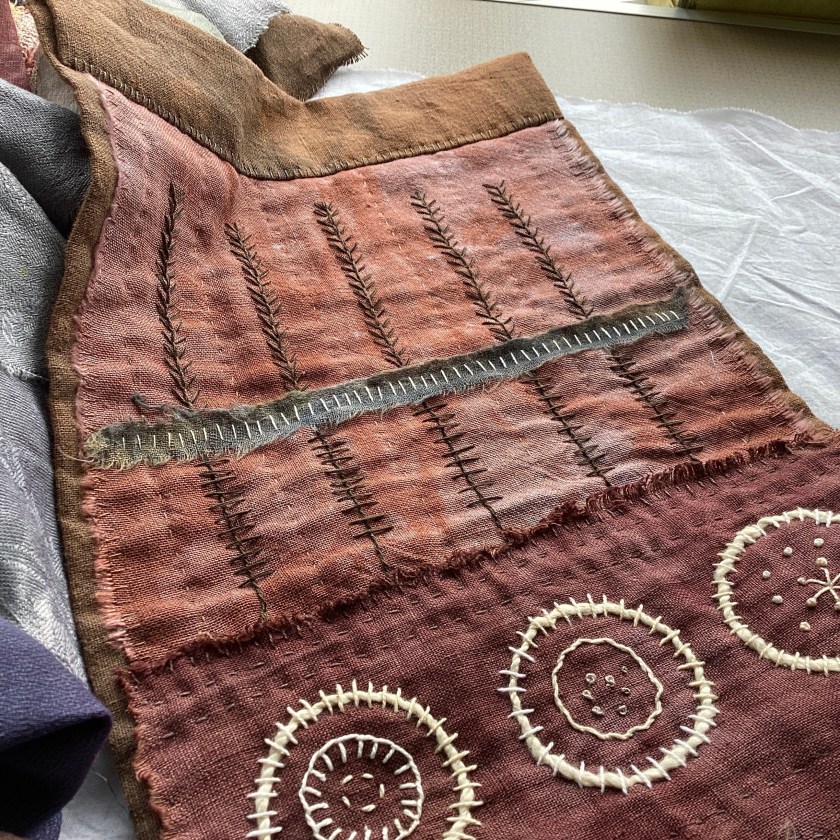
Also on the table, appropriately enough, is Marking Time II (and thank you, Dawn, for naming it). This is another long cloth pieced from hand-dyed vintage fabrics and stitched with motifs from ancient rocks and prehistoric marks on the land.

ancient hill forts, couched cotton yarn with simple stitch on hand-dyed linen

The beautiful lightweight cotton fabric in the section below is eco-printed by Jane Hunter and makes the perfect ground for some couched cup and ring marks. I will add more stitch, of course.

cup and ring marks in progress

Easing myself back into the working week, and hoping your week ahead is a good one.

Still making time

I gave myself a break over Easter. I’ve come back to the cloth that (as yet) has no name: the first in a small series about cup and ring marks, ancient circles and spirals, lines and basic marks.

Nameless cloth in progress

These lines and circles seem to communicate without words. Maybe they come from a time before language; certainly before literacy. There is a kind of magic about them, a deep and unfathomable wisdom in their shapes.

Couched spirals with running stitch and straight stitch

I’m enjoying the earthy colour palette here, and the repeating motifs.

Marks and lines

I’ve been invited to give a talk to a local stitching group and I’m just gathering together some inspiration. I’ll take this unfinished cloth too, mostly to see if anyone can help name it.

Sketchbooks, daily stitching, and mixed media all up for discussion

Making time

This cloth is the first in a series exploring the timeless marks found on ancient rocks. Circles, rings, spirals, and lines – all quite abstract but eternally symbolic and full of meaning.

Cup and ring marks in progress

I’ve used hand-dyed silk bourette yarn for couching the rings. It has a lovely soft texture and, unusually for silk, doesn’t have so much of a sheen. It looks and feels more like very soft wool.

The rings on the grey silk band are made with very fine silk tulle, which weighs almost nothing but has a strong will of its own and can be quite tricksy. You have to work very slowly with it and pin it down as you go, otherwise it tends to wriggle away and wander off. This is not a great photo but was only intended to show myself where the rings needed adjusting a little before committing to stitching them down.

Silk tulle rings

A few stitches later, they’re sitting quite nicely.

Silk tulle rings on hand-dyed silk, in progress.

It’s taking its time, and I’m sitting with each mark to see where it needs more. These plain running stitch circles may or may not be finished. The cloth in this section is textured silk, similar to silk noil but slightly heavier and thicker.

Running stitch circles on textured silk

Taking time to make time. All the time is already there. It’s just a matter of finding it.

Cloth in progress

A beginning

Daily paint doodles have produced these little pictograms, influenced by prehistoric art and the images found on rocks and in caves everywhere in the ancient world:

Daily paint sketches, watercolour on cotton paper with pen added

Prehistoric art is something I’ve always found really interesting. Not so much the figurative drawings of the various beasts fleeing from human hunters, but more the abstract mark-making and simple patterns. They seem to crop up everywhere from the same kind of time. Shapes like circles, spirals, wavy lines, squares, short lines – basic marks. These are the marks I make most often in my sketchbooks too, and a lot of the shapes will translate very effectively from pen to needle and thread.

Sketches for long cloths

I’ve prepared a few long cloths, about 10” x 40-ish”, for adding timeless marks with thread. Just to see where it goes. I’m using linen or cotton as the backing fabric, and brushed cotton in place of batting. The top layers are strips of hand-dyed silk, cotton, and linen.

Long cloth ready to begin

I’m beginning with circular blanket stitch on hand-dyed textured silk fabric and looking forward to following the thread.

Circular blanket stitch on textured silk

Inventing stitches

If you do a lot of hand stitching, you can’t help inventing new stitch variations occasionally. There are lots of variations on basic stitches, and many ways to combine one basic stitch with another.

Blanket stitch tree with interlaced blanket stitch border

Here’s an interlaced/woven running stitch/blanket stitch combination, which looks best in two colours:

Sound on: Lovely Day, Bill Withers

You need to work a row of running stitch first, keeping the stitch and space between stitches as even as you can. Then you can work a blanket stitch into the gap, using a different colour, and weave through the running stitch to start the next blanket stitch.

Interlaced blanket/running stitch

A simple enough idea, and easy to stitch. It probably needs a better name though, combining blanket and running. Blanning stitch. Runket stitch. Oh dear me, no. Suggestions on a postcard please.