The end of a beginning

365 days.

Long cloth recording a long year

It measures 10” x 95”

Impossible to photograph effectively

950 square inches of hand embroidery.

Wrapped around a large industrial wooden bobbin

A record of time passing, days spent and gone. Each little block the shape of a unique moment, preserved for ever.

Summer days

It isn’t important to me that I remember what each day meant, or what happened when. It’s more meaningful overall as a visual record of time. The bigger picture. A piece of my life.

Last winter

A few of you are starting stitch journals of your own in 2023, and an enormous thank you if you’ve purchased and downloaded my template (here). I’ve created a Facebook group, Stitching Life Community, for hand-stitchers to chat, connect, share progress and best tips for hand-stitching. Type the group name into the Facebook search bar and you should find it. It’s a private group, so you need to apply for membership by answering a few (easy) questions. I’d love to see you there and follow your progress.

Sound on!

Vintage cloth, December days

Over halfway through December, and heading towards the darkest days of the year here in the UK.

Darker days

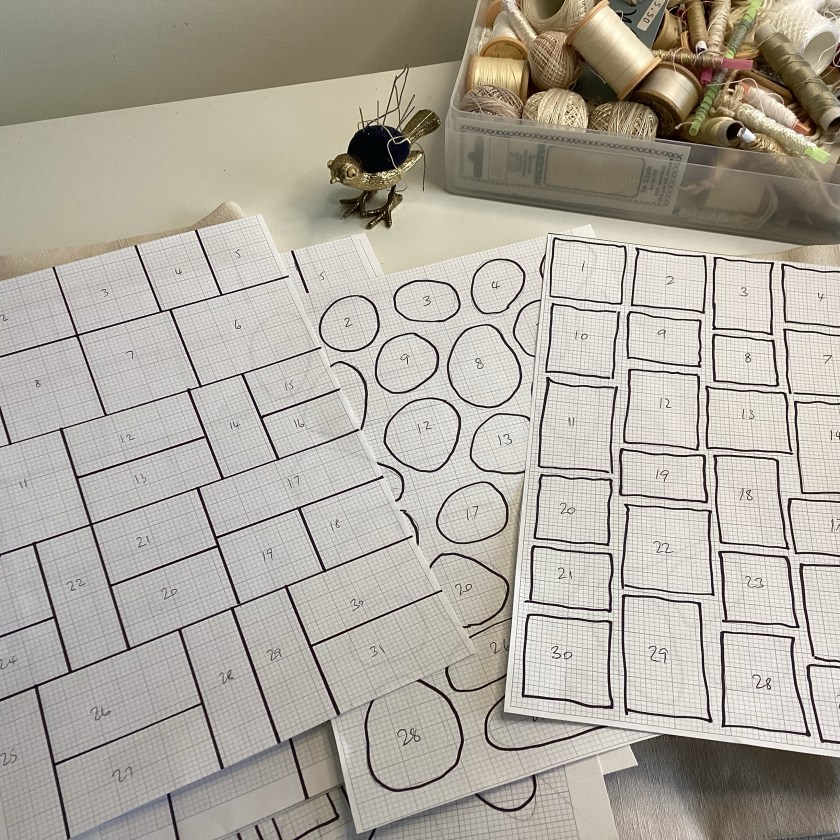
I’ve learned such a lot through making this stitch journal. I no longer think of it as a journal though; it’s become more a collection of daily stitch meditations. I will certainly make something similar next year, though probably not exactly this design. If you want to try something like this, you can download a PDF with templates and notes here.

At least once a week someone asks me what the foundation fabric is. It’s this, a vintage French bed sheet, cotton/linen blend (sometimes called metis):

French vintage cotton/linen blend bed sheet

I will stitch on this fabric again next year. I probably have enough fabric here for another four daily stitch scrolls, if I stick to the long/thin format. I find it an easy shape to work on because you can roll up the ends as you go along, which keeps it fairly compact.

The sheet holds a few memories of its previous life, one of which is a hand-stitched seam down the centre. I’ve assumed that this was a sign that it had worn well enough for a previous owner to have turned it, because parts of the sheet I’ve been stitching on (a strip torn from the outer edge) had worn very thin. Turning is where you extend the life of an old sheet, which tends to wear most in the middle where you’ve been lying on it, by cutting it down the centre and then swapping the edges – so you then sew the original outer edges together, creating a central seam and letting the worn parts become the new outer edges. Someone from the past has hand-sewn this seam down the middle:

Hand-stitched central seam

BUT there is also a darn on the outer edge, which is clearly a selvedge – so, given that the sheet appears to have been turned, but the new outer edges are selvedges (and not hemmed raw edges) I’m deducing that the fabric was possibly hand-woven on a home loom because it’s taken two widths to make one sheet. Hand looms created fabric with narrower widths than the big commercial looms, so the only way to create wider fabrics was to stitch narrower lengths together.

Vintage bed sheet with original darning

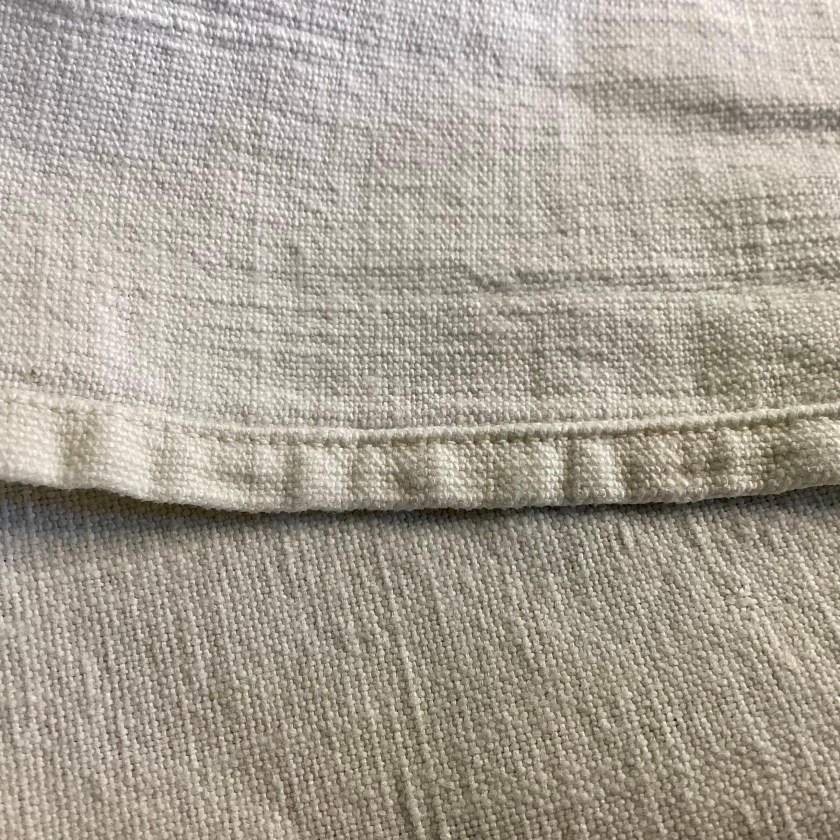
The sheet has been hemmed with impossibly tiny, regular stitches. I had assumed that this was machined, but I’ve unpicked a tiny bit and it’s just one single thread so has clearly been done by hand. It’s a very good quality fabric so will have been stitched and mended carefully.

Tiny stitches on a hand-stitched hem

The only thing I’ve been occasionally dissatisfied with this year is that the fabric is white. Sometimes I have wanted to stitch with white thread, and it just doesn’t show up well enough. The rule that I made for myself was no painting or dyeing, no added fabric or applique, just thread on a foundation. I don’t want to dye or paint it, because then I’d have to predetermine the colour, and I think that would create more limitations. I may, however, give it a very quick dip in some weak tea, just to knock back the whiteness but not enough to colour it too much.

I’m looking forward to revealing the whole thing at the end of the month. Yikes, that’s a week on Saturday! Hope you’re looking forward to seeing it too. In the meantime have a wonderful, peaceful festive season, and thank you for your friendship and support during 2022.

Little tree

Is your Christmas tree up yet?

Ceramic tree on our hearth. Tree from Emily Grace Ceramics

Ours doesn’t go up until the day before the winter solstice. This is because husband and I both have birthdays before Christmas, and it can’t be Christmas until after the birthdays. That’s the rule, and a completely arbitrary illogical one it is too. Strictly speaking, it isn’t Christmas until Noddy from Slade shouts ‘It’s CHRIIIISTMAAAS’ and neither of us has heard that yet this year.

Until it’s time to haul our thirty-year-old tree out of the loft, I will make do with embroidered ones. The traveller’s blanket has a little Christmas tree panel, made with herringbone stitch and cotton perle threads:

‘Little tree, little silent Christmas tree… who found you in the green forest and were you very sorry to come away?’ – e.e.cummings, ‘little tree’

And one for the stitch journal:

Little tree

November

Where does the time go?

November on the stitch journal

A few moments of each day are here, of course, memorialised in thread.

A few days
November days

There was some chain stitch that became a crossroads.

Crossroads with roundabout

One month to go, and this year will be sewn up. I can see the end of the cloth.

December days, waiting for transformation

The other side

A few people have asked to see the back of the stitch journal.

I hardly ever stitch on just one layer of fabric, being a bit of a quilter at heart, and I wondered at the start of the year how robust a single layer of stitched fabric would be. Surprisingly robust, is the answer. The layer of thread, through added stitch, becomes integral to the fabric, and the resulting cloth feels almost like a thin quilt.

I also wondered how difficult it would be to maintain even tension on a single layer without using a frame or hoop. Likewise, it’s been surprisingly easy. Some of the circular stitches have ended up with a little raised bump in the centre, because my tension was a bit off, but some days are like that and I don’t mind the imperfections.

The other side of autumn

You can see some of the thread ends, but I tend to weave most of them in, and I tend to bury most of the ends in the whipped running stitch borders.

Thread ends on show

There are some minor snarl-ups and accidental knots on the back, but that doesn’t matter to me. Most of us carry knots and tangles in the side we don’t show to the world, and I like the honesty of having all the ends visible. As every maths teacher says, ‘show your working’ and the back of the cloth traces the paths I’ve taken more clearly than the more orderly front. If this had been a two-layered cloth, I would have buried all the thread ends neatly between the layers and none of this would have been visible.

Some days I actually prefer the back, as with this green day in the centre:

Bands of green running stitch

And the front of the same day:

Green day from the front

Most of my stitches are very simple variations on running stitch so the back often doesn’t look that much different from the front, apart from being slightly untidier. Tidy can be over-rated, I think, and we all have a mess hidden in the cupboard that no one is allowed to look in.

I don’t mind referring to the other side as ‘the back’ but I won’t call it ‘the wrong side’. The front couldn’t exist without the back, and vice versa. Neither of them is right or wrong. I think of each side as a self and shadow self, where one helps to illuminate and complete the other. Two sides of the same cloth, of course.

Back of late summer
(Almost) the corresponding front

A little loopy

I thought I’d invented a pretty loop stitch the other day, but apparently it already exists.

Interlaced running stitch, discovered by accident

It’s basically pekinese stitch but with the thread looped around running stitches rather than back stitches.

The long cloth in the video and below has been in progress for a while, just somewhere to collect stray stitches and orphan fabric scraps when I remember to catch them.

Home for waifs and strays

October

Another month on the stitch journal, recording the autumn days.

31 days of October

The weather is still unseasonably mild, which I find worrying. But weather is not the same as season, and the light is starting to change as we continue on our annual journey around the sun.

Days in October

31st October is Samhain in the pagan calendar and traditionally marks the start of winter. The days are so much shorter already but I enjoy the long dark nights. Just extra sewing time really; time to reflect and make plans.

November is stretching out ahead, its days already outlined.

November days ahead

I’m stitching on a vintage French metis (linen/cotton blend) bed sheet which had worn thin in places. I can see I will have to start the new month with some darning.

Threadbare days

A good evening

On work days I settle down with the stitch journal in the evenings. I don’t mind the dark nights at all – actually I prefer night to be dark. I don’t get on well with the endlessly light summer evenings at all.

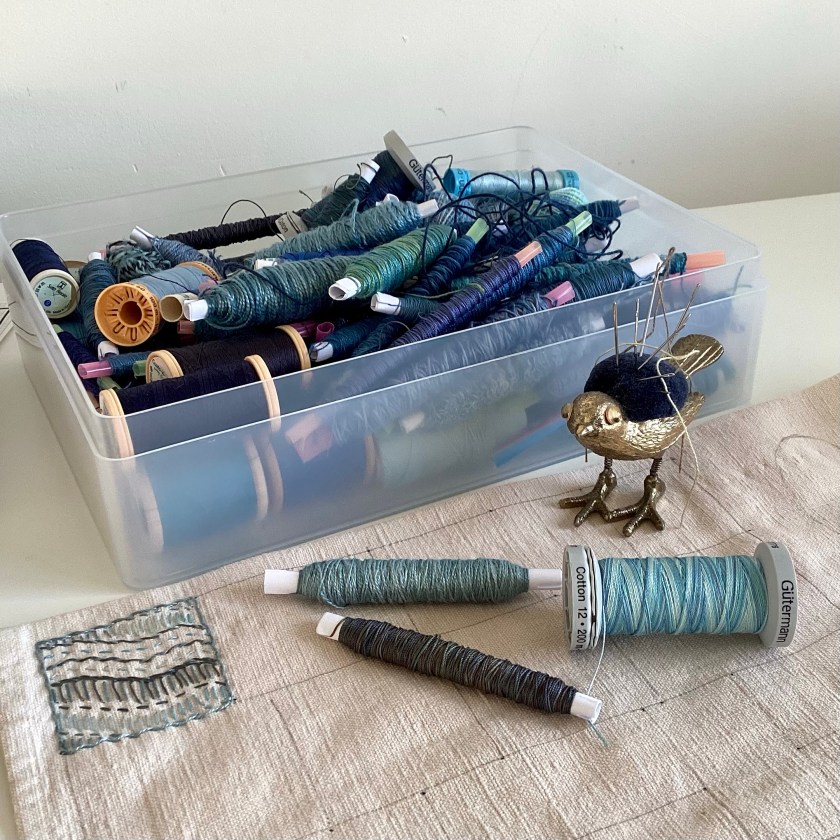
Box of threads and some cloth. What could be better?

There have been some golden days.

Hand dyed silk thread, autumn gold.

Today was a very rainy day.

A long day of rain. Hand dyed silk thread in grey/lilac

The purple day in between is rows of blanket stitch, also in silk thread.

Sometimes I like to look at the other side of the stitch journal. I really like the fact that this is just one piece of cloth, no lining or backing, so everything is visible: the good, the bad, the ugly, and all the loose ends.

The other side

There are some days that I’m glad to see the back of.

September

What a month.

September on the stitch journal

There I was, merrily stitching the passing of time, celebrating my mother’s birthday and generally looking forward to all the colours of autumn. Then the Queen died, plunging the country into ten days of national mourning.

Grey for mourning

I wouldn’t describe myself as a staunch royalist, but I felt it was important to mark these days on the journal. For one thing I wasn’t sure what national mourning was going to look like, so it was an opportunity to experience something I had never seen on that scale. I actually like the colourlessness of these days and the way they stand slightly apart from the rest. There was definitely something different about that time.

Stitch journal, September

We were away in North Yorkshire for part of the mourning period. We walked a lot, and climbed a mountain, and enjoyed lots of peace and fresh air. We encountered American and European tourists wanting to know how we felt about the Queen and expressing their sympathy. I don’t normally feel any particular national sentiment, but it seemed as if everyone assumed that this was ‘our’ loss. It was really quite moving at times. There was a palpable sense of subdued sadness everywhere we went.

September, detail

I stitched the day of the Queen’s death and the day of her funeral in black, and all the days between in shades of grey. They look a bit otherworldly now. It was a strange time.

Early September

The unworked part of the stitch journal is getting shorter and shorter, as is the year. The days are really hurtling past. I have made some big decisions, and the end of the year will be a turning point for me. Until then, it’s a matter of keeping calm and carrying on.

October ahead

August

Up early this morning, before going to the day job in the office, to sit with the stitch journal for a few minutes to complete the last day of August.

August

I am starting to feel autumn in the air, and I can see the light starting to change. Summer is my least favourite time of year – too bright, too hot, too noisy – so I’m looking forward to a little more quiet and a bit more darkness. I think of darkness as restful, like a cosy blanket or a thick curtain, but I know a lot of people struggle with the shortening days.

We are lucky to have seasons in this part of the world, to move through the months and be able to see the continuing cycles of life, death, and rebirth. Many of the flowers in our garden are just seed heads now, but they contain a whole new cycle of life ready to begin again after the winter. I guess stitches are like seeds too. There is a pun here, right, about sewing and sowing but I think I’ll probably just leave that there.

August, detail

I worry sometimes that the stitch journal will become too busy, too much of a maelstrom of colour and texture, but so far it seems to be still quite cohesive. The colours and textures need quite careful managing but the stitches themselves just seem to happen along and pop out of nowhere.

I’m already thinking about how I will structure next year’s stitch journal and I think it will be different from this year somehow. I may choose a coloured background rather than white. It’s still a way off, so there is time to think about it some more.

August, with a glimpse of September ahead